


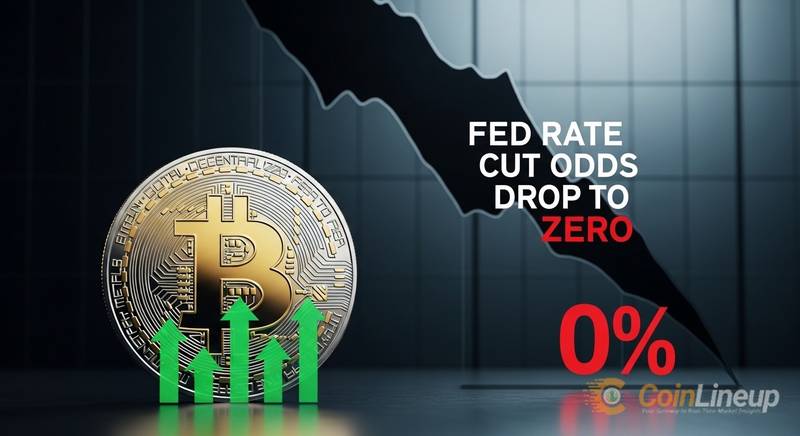
Fed funds futures are now pricing in zero chance of a near-term rate cut, a sharp reversal that has reignited stagflation fears and refocused attention on Bitcoin’s role as a long-term inflation hedge.
The collapse in rate-cut expectations marks a significant shift in market sentiment. After months of speculation that the Federal Reserve would begin easing policy, futures markets have repriced to reflect a prolonged hold, according to CryptoSlate. The current fed funds rate remains at restrictive levels as the Fed continues to prioritize its inflation mandate.
The Fed’s reasoning is straightforward: inflation has not fallen convincingly to the 2% target. Despite an extended tightening cycle, price pressures have proved stickier than policymakers anticipated, keeping rate cuts off the table for now.
Zero Rate Cuts Plus Slowing Growth: A Stagflation Setup
Stagflation describes a rare and painful economic combination: persistent inflation alongside stagnant or declining economic growth. It is particularly toxic for traditional portfolios because the usual playbook fails. Central banks cannot cut rates to stimulate growth without fueling inflation further.
The current macro backdrop increasingly resembles that setup. Growth signals have softened even as inflation remains elevated, creating a policy trap for the Fed. With rates locked at current levels, both equities and bonds face headwinds, as crypto analysts have noted when weighing stagflation risks against Bitcoin’s outlook.
The 1970s offer the closest historical parallel. During that decade’s stagflation episode, equities stagnated in real terms while hard assets with constrained supply, particularly gold, outperformed. Bonds suffered as persistent inflation eroded fixed-income returns.
The key mechanism is simple: when both growth and monetary easing are absent, assets that derive value from scarcity rather than cash flows tend to hold up better. That dynamic has drawn renewed attention to Bitcoin, much as Britain’s recent bond market stress has strengthened the case for Bitcoin as an alternative store of value.
Bitcoin’s Fixed Supply as the Core Inflation Hedge Argument
Bitcoin’s 21 million hard cap is the foundation of its inflation hedge thesis. Unlike fiat currencies, where central banks can expand the money supply indefinitely, Bitcoin’s issuance schedule is mathematically fixed and verifiable on-chain.
The April 2024 halving reduced Bitcoin’s block reward, bringing its annual issuance rate to roughly 0.85%. That rate is already lower than gold’s estimated annual supply growth of 1-2%, making Bitcoin one of the hardest monetary assets in existence by supply inflation metrics.
Institutional adoption has added credibility to this thesis. Spot Bitcoin ETFs have attracted substantial capital since their approval, providing a regulated on-ramp for allocators who view Bitcoin as a portfolio diversifier. The surge in stablecoin flows, with USDC alone seeing $4.5 billion in year-to-date supply growth, further signals growing capital flows into the broader crypto ecosystem.
This is a long-term structural argument, not a short-term price prediction. Bitcoin’s inflation hedge narrative strengthens in environments where monetary policy remains restrictive and fiat purchasing power erodes gradually over time.
Network fundamentals remain active alongside the macro narrative. Bitcoin mining difficulty recently saw its sharpest decline since February, adjusting to shifts in hashrate that reflect the ongoing economic pressures miners face in a high-rate environment.
What Comes Next
The Fed’s next moves will be dictated by incoming inflation and employment data. If inflation remains sticky while growth continues to soften, the stagflation thesis gains further traction, and assets with fixed supply stand to benefit from renewed allocation interest.
For Bitcoin, the zero rate-cut scenario removes one of the key catalysts that speculative traders had been pricing in. But it simultaneously reinforces the longer-term case: in a world where monetary policy cannot solve inflation without crushing growth, a provably scarce asset with no central issuer occupies a unique position in the macro landscape.
Disclaimer: This article is for informational purposes only and does not constitute financial or investment advice. Cryptocurrency and digital asset markets carry significant risk. Always do your own research before making decisions.


About the author


Cardano Teams Seek $50M for Bitcoin DeFi, Vision 2030
Cardano teams are seeking nearly $50 million for Bitcoin DeFi projects and Vision 2030, marking a major funding request tied to the network's roadmap.
US Spot Bitcoin ETFs Add $1.9B in 7 Days, Led by BlackRock
US spot Bitcoin ETFs pulled in $1.9 billion over seven days, with BlackRock leading inflows. Here is what the streak signals for BTC demand.

GSR Debuts Active Multi-Asset Crypto Staking ETF on Nasdaq
GSR has debuted an active multi-asset crypto staking ETF on Nasdaq. Here is what the launch means, how the fund is positioned, and what investors should watch next.

BlackRock Bitcoin ETF Sees $900M Net Inflows in Five Days
BlackRock's Bitcoin ETF logged about $900 million in net inflows over five days, highlighting sustained investor demand and broader spot ETF momentum.

US Indo-Pacific Commander Tells Senate Bitcoin Is a Reality
A US Indo-Pacific commander told the Senate that Bitcoin is a reality. Here’s what the remark means for policy, adoption, and Bitcoin’s public narrative.

Crypto Hacks Hit $17B as Attackers Move From Code to Keys
Crypto hacks have surpassed $17 billion over the past decade, with attackers increasingly targeting private keys and access points instead of code exploits.
Related
US Spot Bitcoin ETFs Add $1.9B in 7 Days, Led by BlackRock
US spot Bitcoin ETFs pulled in $1.9 billion over seven days, with BlackRock leading inflows. Here is what the streak signals for BTC demand.
BlackRock Bitcoin ETF Sees $900M Net Inflows in Five Days
BlackRock's Bitcoin ETF logged about $900 million in net inflows over five days, highlighting sustained investor demand and broader spot ETF momentum.
US Indo-Pacific Commander Tells Senate Bitcoin Is a Reality
A US Indo-Pacific commander told the Senate that Bitcoin is a reality. Here’s what the remark means for policy, adoption, and Bitcoin’s public narrative.

In 2010, This Bitcoin Faucet Gave Away 5 BTC Per CAPTCHA
A look back at the 2010 Bitcoin faucet that handed out 5 BTC per CAPTCHA, why it existed, and what the giveaway says about early crypto markets.
Over 80% of U.S. Bitcoin ETFs Rely on Coinbase Custody
A focused SEO outline on why more than 80% of U.S. Bitcoin ETFs depend on Coinbase for custody, and what that concentration means for markets, risk, and investor attention.

Bitcoin Halving Block #840,000: ViaBTC Mined Rare Sat
A flashback to Bitcoin block #840,000 in 2024, when ViaBTC mined the halving block and it carried a rare sat tied to a milestone in Bitcoin history.