



Treasury Secretary Scott Bessent urged the Federal Reserve to hold off on cutting interest rates, calling for a “wait and see” approach as war-driven inflation complicates the outlook for Bitcoin and risk assets broadly.
Speaking at the Semafor World Economy Summit on April 13, 2026, Bessent said the Fed was doing the right thing by watching how the Iran conflict affects the economy before making any moves on rates. He described the latest price spike as transitory and argued it should not become embedded in inflation expectations.
Why Bessent Wants the Fed to Wait Before Cutting Rates
The “wait and see” message signals that the Treasury sees no urgency to push for monetary easing. The March 2026 CPI release showed headline inflation rose 0.9% month over month and 3.3% year over year, with the energy index surging 10.9% and gasoline jumping 21.2%.
Federal Reserve minutes from the March 17-18 meeting confirmed policymakers kept the federal funds target range at 3.5% to 3.75%, noting that Middle East developments had added elevated uncertainty to the economic outlook. Almost all members supported holding steady.
The stance has real consequences for rate-cut expectations. AP reported that more Fed officials had become willing to consider rate hikes, with many pointing to higher oil and gas prices that could keep inflation elevated longer than expected.
ING analysts James Knightley, Padhraic Garvey, and Chris Turner quantified the shift in market pricing.
“Financial markets have swung from anticipating two 25bp rate cuts this year to now pricing in barely one.”
— James Knightley, Padhraic Garvey, and Chris Turner, ING THINK
ING argued the war-driven energy shock delays, rather than removes, the Fed easing cycle. For traders watching macro signals, that distinction matters: delayed cuts mean tighter financial conditions persist, keeping pressure on speculative assets.
How War-Driven Inflation Is Clouding the Bitcoin Outlook
Bitcoin traded at $74,426 at press time, up roughly 4.9% over 24 hours, with a market cap near $1.49 trillion and daily volume around $58.9 billion.
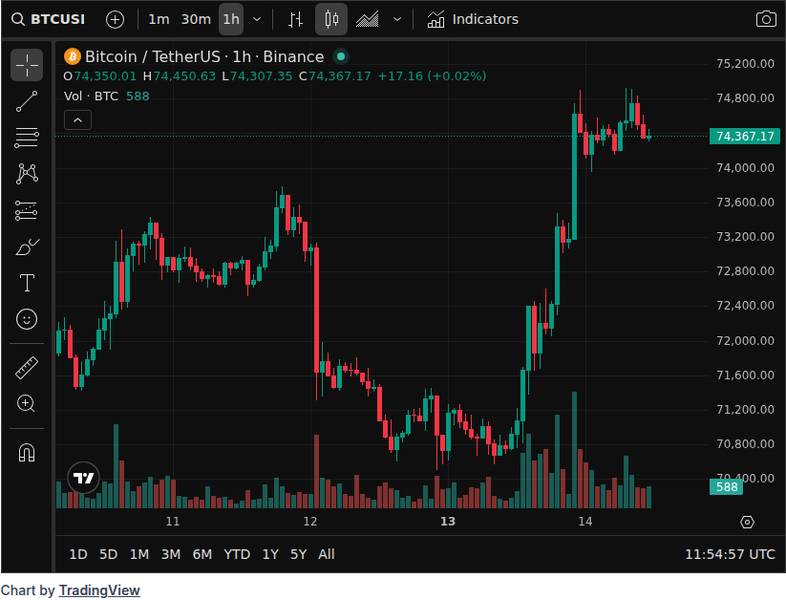
The bounce came against a backdrop of extreme caution. The crypto Fear & Greed Index sat at 21, deep in “Extreme Fear” territory, suggesting the broader market remains risk-off despite the day’s price action. That tension, a green daily candle against a fearful sentiment reading, reflects the conflicting signals macro policy is sending.
When inflation runs hot and the Fed holds rates higher for longer, the liquidity conditions that typically fuel crypto rallies get squeezed. Gasoline alone accounted for the bulk of March’s CPI jump, and as long as the Iran conflict keeps energy prices elevated, the case for near-term rate relief weakens. Some analysts, like Peter Schiff, have argued investors should rotate out of Bitcoin into gold during periods of macro stress.
That said, the inflation-to-Bitcoin link is not straightforward. While macro pressure can weigh on short-term sentiment, the direct causation between any single inflation print and a specific Bitcoin price move remains unproven. Traders should treat the connection as plausible context, not a guaranteed trade signal.
What This Means for Bitcoin Traders and the Wider Crypto Market
The practical takeaway is that macro commentary now drives crypto volatility as much as on-chain fundamentals. Every Fed speaker, every CPI print, and every geopolitical development around the Iran conflict feeds directly into rate-cut expectations, which in turn shape risk appetite across digital assets.
With markets now pricing barely one cut in 2026, down from two previously, the window for a liquidity-driven rally has narrowed considerably. Bitcoin’s positioning as a macro-sensitive asset means traders will be watching upcoming Fed communications closely for any shift in tone. The broader question of whether Bitcoin’s longer-term thesis can withstand near-term macro headwinds remains central to how institutional capital allocates.
Bessent’s framing of the inflation spike as transitory echoes language the Fed used in 2021, a comparison that crypto market participants will watch closely given how that earlier call aged. If energy prices stabilize and the transitory thesis holds, rate cuts could return to the table later in 2026. If it doesn’t, the Fed may face pressure to tighten further, a scenario that would test Bitcoin’s resilience well below current levels.
Disclaimer: This article is for informational purposes only and does not constitute financial or investment advice. Cryptocurrency and digital asset markets carry significant risk. Always do your own research before making decisions.
Related reading: For a broader macro explainer, see how Fed rate cuts could change the setup for crypto markets.


About the author


Cardano Teams Seek $50M for Bitcoin DeFi, Vision 2030
Cardano teams are seeking nearly $50 million for Bitcoin DeFi projects and Vision 2030, marking a major funding request tied to the network's roadmap.

US Spot Bitcoin ETFs Add $1.9B in 7 Days, Led by BlackRock
US spot Bitcoin ETFs pulled in $1.9 billion over seven days, with BlackRock leading inflows. Here is what the streak signals for BTC demand.

GSR Debuts Active Multi-Asset Crypto Staking ETF on Nasdaq
GSR has debuted an active multi-asset crypto staking ETF on Nasdaq. Here is what the launch means, how the fund is positioned, and what investors should watch next.

BlackRock Bitcoin ETF Sees $900M Net Inflows in Five Days
BlackRock's Bitcoin ETF logged about $900 million in net inflows over five days, highlighting sustained investor demand and broader spot ETF momentum.

US Indo-Pacific Commander Tells Senate Bitcoin Is a Reality
A US Indo-Pacific commander told the Senate that Bitcoin is a reality. Here’s what the remark means for policy, adoption, and Bitcoin’s public narrative.

Crypto Hacks Hit $17B as Attackers Move From Code to Keys
Crypto hacks have surpassed $17 billion over the past decade, with attackers increasingly targeting private keys and access points instead of code exploits.
Related
Cardano Teams Seek $50M for Bitcoin DeFi, Vision 2030
Cardano teams are seeking nearly $50 million for Bitcoin DeFi projects and Vision 2030, marking a major funding request tied to the network's roadmap.
US Bankers Association Seeks 60-Day Delay for Stablecoin Rules
The US Bankers Association is urging a 60-day delay before stablecoin rules take effect. This outline focuses on the pause request, regulatory timing, and market implications.

Polymarket Paris Weather Glitch Sparks $37K Scrutiny
Polymarket faces scrutiny after traders reportedly made $37K from a Paris weather market glitch, raising fresh questions about trust and market rules.

New York Seeks $3.4B in Crypto Fines Over Prediction Apps
New York is seeking $3.4 billion in crypto fines tied to prediction apps. This outline tracks the claims, the products involved, and the broader fallout.
GSR Debuts Active Multi-Asset Crypto Staking ETF on Nasdaq
GSR has debuted an active multi-asset crypto staking ETF on Nasdaq. Here is what the launch means, how the fund is positioned, and what investors should watch next.
UK watchdog raids eight London sites over illegal P2P crypto trading
UK authorities raided eight London locations in a suspected illegal P2P crypto trading probe. Here is what happened and why it matters for compliance.