


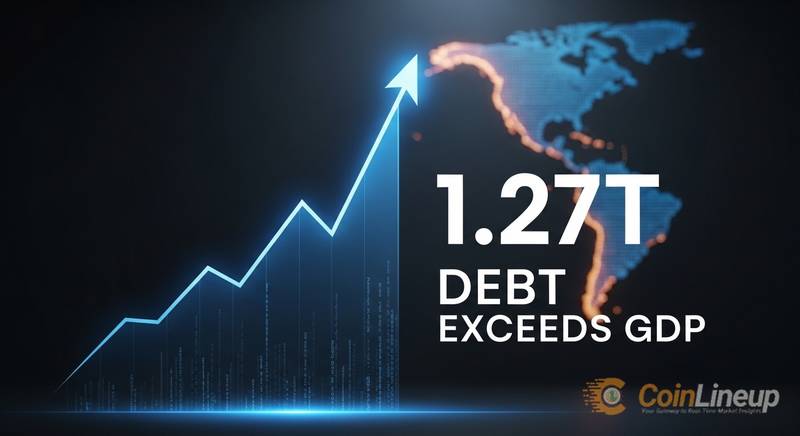

America’s national debt has crossed $31.27 trillion, now exceeding the country’s gross domestic product. The milestone, flagged in Saturday’s crypto news cycle, is drawing attention from Bitcoin and digital asset investors who view sovereign debt expansion as a long-term tailwind for alternative stores of value.
Why America’s $31.27 Trillion Debt Surpassing GDP Is Making Headlines
The debt-to-GDP ratio measures a country’s total government debt against the size of its economy. When debt exceeds GDP, it signals that a nation owes more than it produces in a single year. The Committee for a Responsible Federal Budget flagged this threshold as a significant fiscal marker.
The U.S. Treasury’s Monthly Statement of the Public Debt tracks the federal government’s outstanding obligations. Crossing the 100% debt-to-GDP line places the U.S. among a small group of major economies operating above that level.
For markets, the ratio matters because it influences expectations around interest rates, government borrowing costs, and long-term currency stability. When debt grows faster than economic output, questions about fiscal sustainability intensify.
What the Debt-to-GDP Shift Could Mean for Bitcoin and Crypto Sentiment
This headline appeared in a crypto news roundup rather than a traditional economics report, and the framing is deliberate. Bitcoin’s original whitepaper positioned it as a peer-to-peer system outside government monetary control, and sovereign debt milestones tend to resurface that narrative.
Periods of macro uncertainty have historically coincided with increased discussion around Bitcoin as a hedge against currency debasement. Whether that narrative translates into sustained price action is a separate question, as Trump’s crypto-linked net worth gains near 33% illustrate how political and economic forces create unpredictable crosscurrents.
The connection is analytical, not automatic. Debt levels rising above GDP do not guarantee any specific market outcome for crypto. But they do feed a broader investor conversation about monetary policy, inflation expectations, and whether traditional safe havens remain sufficient.
That conversation has grown louder in recent months as traders debate whether Bitcoin’s key price levels represent genuine breakouts or relief rallies against a shifting macro backdrop.
Key Market Signals to Watch After the Latest U.S. Debt Headline
Investors tracking the debt headline’s impact on crypto should watch Treasury yield movements and Federal Reserve commentary in the coming weeks. Changes in borrowing costs ripple through risk assets, including digital currencies.
Congressional action on fiscal policy also matters. Ongoing negotiations around U.S. crypto legislation could intersect with broader spending debates, creating regulatory signals that affect market positioning.
For Bitcoin specifically, the debt narrative adds one more macro input to a market already processing ETF flow data, halving cycle dynamics, and global liquidity conditions. The $31.27 trillion figure is unlikely to move prices on its own, but it reinforces the structural argument that drives long-term crypto allocation strategies.
Disclaimer: This article is for informational purposes only and does not constitute financial or investment advice. Cryptocurrency and digital asset markets carry significant risk. Always do your own research before making decisions.

About the author

Top Crypto News for May 2: America’s $31.27T Debt Exceeds GDP
Catch up on the top crypto news for May 2, including why America's $31.27 trillion debt exceeding GDP matters for Bitcoin, market sentiment, and crypto investors.

Crypto VC shrinks to $659m in April, lowest since 2024
Crypto venture capital funding fell to $659 million in April, marking its lowest monthly total since 2024. Here’s what the drop could mean for the crypto market.

Brazil Central Bank Bans Crypto in Cross-Border Settlements
Brazil's central bank has barred crypto use in regulated cross-border payment settlements. Here's what the move means for institutions, users, and policy.

Ripple, OKX Expand RLUSD With 300+ Pairs, Futures, Margin
Ripple and OKX are expanding RLUSD on OKX with 300+ spot pairs plus futures and margin support, broadening how traders can access the stablecoin.

Polymarket Launches On-Chain Integrity Monitor With Chainalysis
Polymarket has introduced an on-chain integrity monitor with Chainalysis, aiming to improve market transparency, oversight, and user trust.

Coinbase to Delist DAI, Halt Trading on May 4
Coinbase plans to delist DAI and disable trading on May 4. Here’s what the exchange move means for users, timelines, and the next steps to watch.
Related

Trump Crypto Gains Near 33% of Net Worth, Wealth Up 280%
Trump's net worth is reportedly up more than 280% since taking office, with crypto gains making up nearly a third of the total. Here's the news angle.

Coinbase Says Negotiators Reached Agreement on Key Provision in U.S. Crypto Bill
Coinbase says negotiators agreed on a key provision in a U.S. crypto bill. Learn what the development could mean for regulation, exchanges, and the market.
Brazil Central Bank Bans Crypto in Cross-Border Settlements
Brazil's central bank has barred crypto use in regulated cross-border payment settlements. Here's what the move means for institutions, users, and policy.

Brazil Bars Crypto Settlement in Cross-Border eFX Payments
Brazil blocks crypto settlement in regulated cross-border eFX payments, reshaping how licensed providers handle compliance, FX flows, and digital assets.
Polymarket Launches On-Chain Integrity Monitor With Chainalysis
Polymarket has introduced an on-chain integrity monitor with Chainalysis, aiming to improve market transparency, oversight, and user trust.
Coinbase to Delist DAI, Halt Trading on May 4
Coinbase plans to delist DAI and disable trading on May 4. Here’s what the exchange move means for users, timelines, and the next steps to watch.