

Bitcoin is holding near the $70,500 support level on April 13 after U.S.-Iran ceasefire talks collapsed in Pakistan and oil prices surged past $103 a barrel, sending the crypto Fear and Greed Index to an Extreme Fear reading of 12.
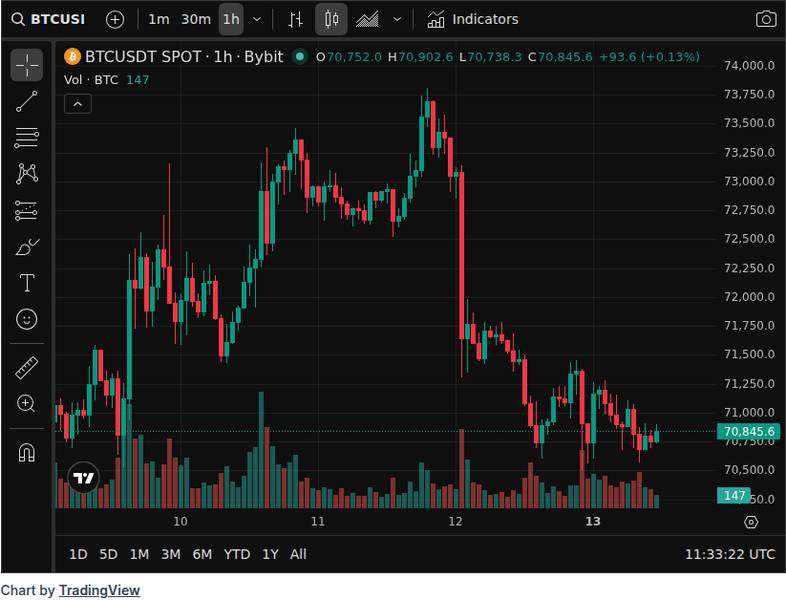
BTC traded at $70,871 at press time, down roughly 0.9% over the past 24 hours. Market capitalization sat at approximately $1.42 trillion on 24-hour trading volume of $28.06 billion.
The Fear and Greed Index printed 12, its lowest territory in months, reflecting the kind of broad risk-off positioning that has historically preceded either sharp bounces or deeper capitulation in crypto markets.
Bitcoin tests the importance of $70,500 support
Analysts have identified the $70,000 to $70,500 band as the critical zone for short-term price stability. Moneycontrol reported that BTC was consolidating near this support band as traders weighed whether buyers would defend the level against mounting macro pressure.
The fact that Bitcoin has not broken below $70,500 despite a sudden geopolitical escalation suggests buyers are still present at that floor. A clean break below would shift attention to deeper support levels and could trigger broader liquidations across leveraged positions, similar to the cascading pressure seen during recent exploit-driven selloffs in the broader crypto market.
For now, the price action looks more like a compression than a collapse. Volume at $28 billion over 24 hours is elevated but not panic-level, and the narrow trading range signals that neither side has committed to a decisive move.
How the collapse in US-Iran talks and the oil spike changed the market mood
The White House had announced on April 8 that Iran agreed to a ceasefire and the reopening of the Strait of Hormuz while broader negotiations proceeded. That framework unraveled five days later.
The Associated Press reported on April 13 that ceasefire talks in Pakistan ended without an agreement. The U.S. military said a blockade involving all Iranian ports would begin Monday at 10 a.m. EDT.
The immediate market response was brutal for energy prices. Benchmark U.S. crude jumped $7.12, or 7.4%, to $103.69 a barrel. Brent crude rose $7.04, also 7.4%, to $102.24. Al Jazeera separately confirmed Brent topped $103 with a gain exceeding 8% on the session.
Energy shocks of this magnitude tend to ripple across all risk assets. Higher oil prices feed into inflation expectations, which in turn pressure central banks to maintain restrictive monetary policy. Bitcoin, which has increasingly traded alongside equities during macro stress events, absorbed the spillover as traders reduced exposure to anything outside safe-haven assets.
The speed of the reversal, from ceasefire optimism on April 8 to blockade announcement on April 13, left little time for markets to adjust. That compressed repricing helps explain why Bitcoin’s decline has been measured rather than chaotic; the move down was orderly because the geopolitical deterioration, while sharp, followed a pattern of institutional actors repositioning ahead of headline risk rather than reacting to a surprise.
What traders may watch next if volatility stays elevated
If $70,500 holds through the start of the Iranian port blockade on Monday, buyers will likely view the level as validated support, potentially attracting fresh bids from sidelined capital. A sustained hold could set up a relief rally back toward $73,000 to $74,000 if oil stabilizes.
A failure below $70,000 would shift the narrative. Traders would begin watching $67,000 to $68,000 as the next structural support, and the Extreme Fear reading of 12 could deepen further, discouraging speculative entries in both BTC and the broader altcoin market, where projects like meme coin presales have already seen reduced momentum.
The key variable is whether the oil spike proves transient or marks the beginning of a sustained energy crisis. If U.S. crude remains above $100 for more than a few sessions, the inflationary implications would weigh on all risk assets, including crypto. Conversely, any resumption of diplomatic talks could reverse the oil premium as quickly as it appeared.
For Bitcoin specifically, the correlation with macro risk sentiment means Monday’s blockade deadline is the next concrete catalyst. Price action into and immediately after 10 a.m. EDT Monday will likely determine whether the $70,500 floor becomes a launchpad or a trapdoor.
Disclaimer: This article is for informational purposes only and does not constitute financial or investment advice. Cryptocurrency and digital asset markets carry significant risk. Always do your own research before making decisions.


