


| Sponsored Post Disclaimer: This publication was produced under a paid arrangement with a third-party advertiser. It should not be relied upon as financial or investment counsel. |
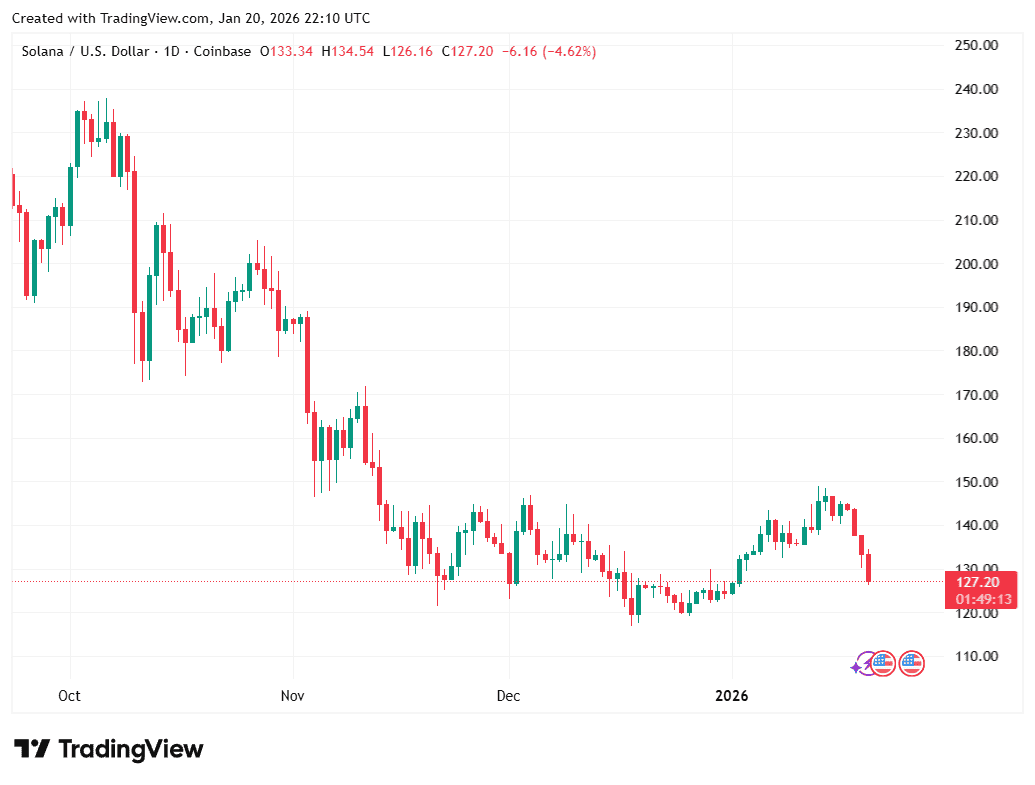
Solana price action softened after failing near the $150 level, ending the weekend below $140 as overall risk mood became cautious. Short-term pressure has increased due to renewed tariff concerns and small ETF outflows, creating a delicate setup at the start of the week. Still, on-chain and ecosystem data remain positive, pointing to a pullback that may reflect consolidation rather than a clear breakdown.
At the same time, Zero Knowledge Proof (ZKP) is being viewed from a different angle. Focus is shifting away from price-driven stories toward how zero-knowledge proofs function in practice and why cryptographic verification sits at the core of ZKP’s structure. This contrast is influencing how market participants assess the best crypto to buy now in 2026.
Solana Price Slips as ETF Outflows Pressure Short-Term Mood
Solana’s latest move lower reflects a market dealing with macro uncertainty and changing capital flows. Key updates include:
- SOL faced rejection near $150 and closed below $140, pushing near-term bias lower
- Solana ETFs posted around $2.2M in net outflows, marking their first outflow period since launch
- Risk-averse sentiment increased the effect of what were otherwise limited flows

ETF activity often affects short-term sentiment, especially during periods shaped by macro volatility. While the outflows remain small in size, they have weighed on momentum as traders rethink positioning.
On-Chain Data Continues to Show Underlying Support
Despite recent price weakness, Solana’s broader ecosystem metrics still point to steady long-term engagement. Recent data highlights:
- RWA ecosystem TVL near $1.12B, showing growing institutional involvement
- Ongoing capital moving into application-level use cases
- Liquidity and network activity staying firm even as price consolidates
This gap between short-term flow pressure and longer-term fundamentals suggests the current move may be a shakeout rather than a lasting shift, depending on whether buyers can hold the next key support area.
What Zero Knowledge Proof Means in Real Use
Zero Knowledge Proof is built with cryptographic verification as a core system feature. The goal is to allow computation and marketplace activity to be confirmed through proofs, letting systems verify results while data stays private. This design places structure ahead of speculation, with rules enforced by cryptography instead of middle parties.
Breaking Down How Zero-Knowledge Proofs Function Inside ZKP
Zero-knowledge proofs let one party show that a claim is correct without sharing the underlying information. Rather than revealing inputs or execution steps, the prover creates a cryptographic proof that others can check on their own. At a basic level, the process includes:
- Commitment: Data and computation are turned into a mathematical statement
- Proof creation: A cryptographic proof is generated to show the statement is valid
- Verification: Anyone can confirm correctness without seeing the data
This process allows validation without exposure, which becomes critical as blockchains move past simple transfers into data-heavy and computation-focused use cases.
Why ZKP Relies on Cryptographic Proofs by Design
ZKP’s system is built around zero-knowledge proofs as the main verification layer, instead of open and visible execution. This model highlights:
- Correctness based on math, not trust or visibility
- Privacy-first computation, where sensitive inputs remain hidden
- Auditability, since proofs can be checked on-chain without revealing data
By separating verification from disclosure, ZKP aligns execution with real-world limits where privacy and compliance are required. As blockchain use grows, the limits of transparency-first models are becoming more obvious.
Data-driven applications, from AI workflows to regulated systems, need platforms that can prove correctness without exposure. ZKP’s cryptographic base matters because it:
- Cuts execution risk by enforcing rules through verification
- Reduces friction where data privacy cannot be compromised
- Moves trust away from intermediaries and toward mathematics
Final Take
Solana’s move into a key demand zone shows the push and pull between short-term ETF flows and longer-term ecosystem strength. While near-term mood has softened, on-chain data suggests the wider structure can stay intact if support levels hold.
Zero Knowledge Proof offers a different way to evaluate systems. By grounding its design in how zero-knowledge proofs operate, ZKP focuses on verification without exposure and disciplined execution rather than price-led stories. As markets evolve and place more value on privacy-first computation, this cryptographic approach is becoming central to how participants decide what qualifies as the best crypto to buy now.

Explore Zero Knowledge Proof:
Website: https://zkp.com/
Buy: http://buy.zkp.com/
Telegram: https://t.me/ZKPofficial
FAQs
Why did Solana weaken despite strong ecosystem metrics?
Short-term ETF outflows and macro risk weighed on sentiment, even as on-chain fundamentals remained constructive.
What does a zero-knowledge proof actually prove?
It proves that a computation or statement is correct without revealing the underlying data.
Why is cryptographic verification important for blockchains?
It enables trust without disclosure, reducing execution risk and supporting sensitive use cases.
| Disclaimer: The text above is an advertorial article that is not part of CoinLineup editorial content. |


About the author


The Wait is Over: BlockDAG Debuts on Global Exchanges After Record-Breaking Launch
BlockDAG is now officially tradable on Coinstore, LBank, and Pionex USA after an unprecedented presale. Analysts anticipate strong early price growth as one of the most significant crypto launches in history unfolds.
As Trading Goes Live, BlockDAG Eyes a Top 50 Debut: Can it Break the $1.2B Market Cap Barrier?
Explore how BlockDAG could reach a $1.2B market cap as trading starts, making it a strong contender for the best crypto to buy among the top 50 rankings.
Top Cryptos to Watch in 2026: BlockDAG, SUI, AVAX, and Stellar Drive Real Adoption
BlockDAG debuts at $0.05 with whale activity already depleting supply. While SUI, AVAX, and Stellar remain relevant, BlockDAG currently presents the clearest growth opportunity.
BlockDAG Launches With Instant Record Numbers Volume Outpaces Kaspa and Solana While $0.20 Moves Into Range
BlockDAG launched, and the data is already record-breaking. Volume tops early Kaspa and Solana figures, staking leads early Solana levels, and $0.20, $0.40, $0.50 are firmly on the map. The biggest catalysts have not even arrived yet.
BlockDAG’s Historic Launch Sparks Top 50 Market Cap Predictions! Why It’s The Top Crypto to Buy Now
Explore BlockDAG’s three exchange launch, strong early trading volume, and $1.2B market cap goal that could position BDAG among the top 50 cryptocurrencies.
BlockDAG Just Broke the Internet with a 3-Exchange Launch, And the Biggest News is Still Coming!
Tier 1 US exchanges are targeting BDAG. Learn why the post-launch $0.05 price is the best crypto to buy before the next major catalyst resets the entry cost.
Related
The Wait is Over: BlockDAG Debuts on Global Exchanges After Record-Breaking Launch
BlockDAG is now officially tradable on Coinstore, LBank, and Pionex USA after an unprecedented presale. Analysts anticipate strong early price growth as one of the most significant crypto launches in history unfolds.
As Trading Goes Live, BlockDAG Eyes a Top 50 Debut: Can it Break the $1.2B Market Cap Barrier?
Explore how BlockDAG could reach a $1.2B market cap as trading starts, making it a strong contender for the best crypto to buy among the top 50 rankings.
Top Cryptos to Watch in 2026: BlockDAG, SUI, AVAX, and Stellar Drive Real Adoption
BlockDAG debuts at $0.05 with whale activity already depleting supply. While SUI, AVAX, and Stellar remain relevant, BlockDAG currently presents the clearest growth opportunity.
BlockDAG Launches With Instant Record Numbers Volume Outpaces Kaspa and Solana While $0.20 Moves Into Range
BlockDAG launched, and the data is already record-breaking. Volume tops early Kaspa and Solana figures, staking leads early Solana levels, and $0.20, $0.40, $0.50 are firmly on the map. The biggest catalysts have not even arrived yet.
BlockDAG’s Historic Launch Sparks Top 50 Market Cap Predictions! Why It’s The Top Crypto to Buy Now
Explore BlockDAG’s three exchange launch, strong early trading volume, and $1.2B market cap goal that could position BDAG among the top 50 cryptocurrencies.
BlockDAG Just Broke the Internet with a 3-Exchange Launch, And the Biggest News is Still Coming!
Tier 1 US exchanges are targeting BDAG. Learn why the post-launch $0.05 price is the best crypto to buy before the next major catalyst resets the entry cost.