



Stablecoin transaction volumes could reach $719 trillion by 2035 through organic growth alone, according to new projections from blockchain analytics firm Chainalysis, as Visa and Mastercard race to embed crypto into their global payment rails.
The figure, published in a Chainalysis report on stablecoin utility, represents adjusted on-chain economic activity spanning payments, remittances, and settlement. With macro catalysts such as regulatory clarity and institutional adoption factored in, that number could approach $1.5 quadrillion over the same period.
Chainalysis estimates that adjusted stablecoin volumes already hit $28 trillion in real economic activity, growing at a compound annual rate of 133% since 2023. At that trajectory, stablecoin payment volumes are on pace to match Visa and Mastercard off-chain transaction volumes between 2031 and 2039.
The projection does not mean $719 trillion will flow exclusively through card-network rails. According to unconfirmed reports, some interpretations conflate total stablecoin economic activity with card-rail throughput, but the Chainalysis data describes a broader category that includes remittances and on-chain settlement alongside point-of-sale payments.
KEY TAKEAWAYS
- Stablecoin volumes projected at $719T by 2035 through organic growth, per Chainalysis.
- Visa and Mastercard are actively building crypto payment infrastructure, with live stablecoin card programs and billion-dollar acquisitions.
- The projection covers broad economic activity, not just card-rail throughput; readers should distinguish payment volume from settlement value.
Visa and Mastercard Are Taking Different Paths to the Same Goal
Both payment giants have moved beyond pilot programs into production-scale crypto infrastructure, but their strategies differ in execution. Visa is building outward through partnerships and merchant reach, while Mastercard is acquiring infrastructure to connect on-chain and fiat rails directly.
Visa and its partner Bridge announced that stablecoin-linked Visa cards are now live in 18 countries with expansion planned to more than 100 countries by year-end. Those cards are accepted at Visa’s 175 million-plus merchant locations globally.
Cuy Sheffield, Visa’s head of crypto, framed the push in infrastructure terms:
“Visa is committed to meeting businesses where they operate, and increasingly, that’s onchain.”
— Cuy Sheffield, Visa Newsroom
Mastercard took a different approach in March, announcing a definitive agreement to acquire BVNK for up to $1.8 billion, including $300 million in contingent payments. The deal aims to integrate on-chain payment rails directly into Mastercard’s existing network.
Jorn Lambert, Mastercard’s chief product officer, said the acquisition reflects where transaction infrastructure is heading:
“Adding on-chain rails to our network will support speed and programmability for virtually every type of transaction.”
— Jorn Lambert, Mastercard Press
Mastercard cited research showing digital currency payment use cases reached at least $350 billion in 2025, a figure it attributed to BCG analysis. That baseline helps explain the urgency behind the BVNK acquisition.
Regulatory clarity across multiple geographies is enabling both companies to move faster. As U.S. lawmakers push for stablecoin legislation, both Visa and Mastercard have cited the evolving policy landscape as a key driver of their rollout timelines.
What This Means for Users, Merchants, and the Broader Market
For merchants, the value proposition centers on lower settlement costs and faster finality. Stablecoin payments can settle in minutes rather than the two-to-three-day window typical of traditional card processing, reducing treasury float and chargeback exposure.
User adoption is likely to accelerate when crypto payments become invisible within familiar checkout flows. The Visa-Bridge card model, where users hold stablecoins but spend through a standard Visa card at existing terminals, removes the friction that has historically limited crypto payment adoption.
The near-term use cases most likely to scale first are cross-border remittances and B2B settlement, where existing rails impose the highest fees. Consumer point-of-sale payments face more barriers, including UX complexity, merchant treasury risk from price volatility, and interoperability gaps between different stablecoin issuers and chains.
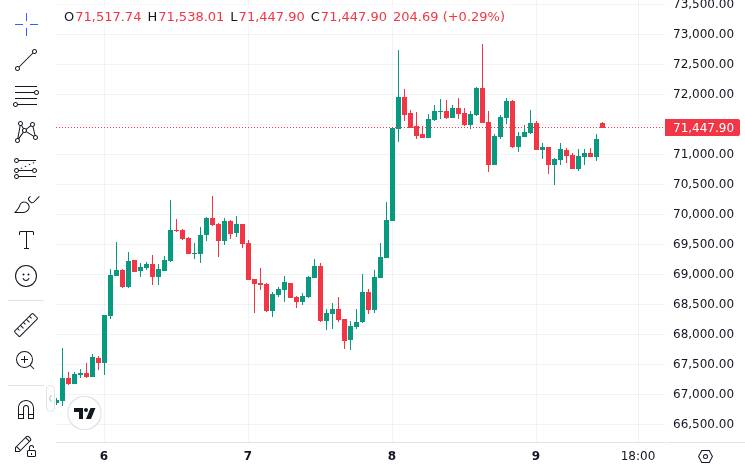
The broader crypto market context adds nuance. Bitcoin traded near $71,503 at press time, while the Fear & Greed Index sat at 14, reflecting extreme fear. The disconnect between bearish short-term sentiment and structurally bullish long-term infrastructure buildout suggests that institutional payment adoption and speculative market cycles are operating on different timelines.
That infrastructure-level investment from companies like Visa and Mastercard echoes similar institutional momentum in other segments. Morgan Stanley’s Bitcoin ETF launch drew $34 million in day-one inflows, and broader crypto market developments continue to signal growing traditional finance engagement with digital assets.
The main barriers to the $719 trillion projection materializing remain regulatory fragmentation across jurisdictions, interoperability between competing stablecoin standards, and whether merchant savings on settlement actually outweigh the cost of integrating new payment infrastructure. The Chainalysis timeline of 2031 to 2039 for matching legacy card volumes reflects that uncertainty, spanning an eight-year window rather than a fixed date.
Disclaimer: This article is for informational purposes only and does not constitute financial or investment advice. Cryptocurrency and digital asset markets carry significant risk. Always do your own research before making decisions.

About the author


Crypto Could Move $719T in Global Payments as Visa, Mastercard Push Ahead
Crypto is projected to handle $719 trillion in global payments as Visa and Mastercard expand blockchain payment rails, stablecoin settlement, and merchant integrations.

Bitcoin Rebound Looks Fragile as Hormuz Risk Persists
Bitcoin has rebounded, but Wall Street cautions that Hormuz disruption risk is not over. Here is what could keep BTC volatile in the near term.

Cardano Eyes Bitcoin Liquidity With $80M Fund for $3B DeFi Target by 2030
Cardano plans an $80 million fund aimed at unlocking Bitcoin liquidity as it pushes toward a $3 billion DeFi target by 2030. Here is what the strategy could mean.

Bitcoin Long-Term Holders Reach 4.37M BTC on April 7: What It Signals
Bitcoin long-term holders increased their balances to 4.37 million BTC as of April 7. Here is what this accumulation trend may signal for supply pressure and market sentiment.

Binance Founder CZ Releases “Freedom of Money”: Key Insights From His Autobiography
Binance founder Changpeng Zhao (CZ) has released his autobiography, Freedom of Money. Explore the book’s core themes, Binance-era insights, and why this release matters for crypto readers.

Top Crypto News for April 7: Bitcoin Briefly Jumps Above $70K
Catch the top crypto news for April 7, including why Bitcoin briefly moved above $70,000 on Iran deal hopes and what traders are watching next.
Related

Crypto News Recap: CZ’s ‘Freedom of Money’ and Top 24-Hour Updates
Catch up on the biggest crypto developments from the last 24 hours, led by Binance founder CZ’s autobiography release, ‘Freedom of Money.’

Scott Bessent Urges Congress to Pass Clarity Act for Crypto Rules
Treasury Secretary Scott Bessent is urging Congress to pass the Clarity Act, a proposed framework aimed at setting clear U.S. crypto market rules.

Ethereum Foundation to Sell 5,000 ETH via CoWSwap TWAP: Market Impact
Ethereum Foundation plans a 5,000 ETH sale through a CoWSwap TWAP. Here’s what the structured execution could mean for ETH liquidity, volatility, and near-term market sentiment.

After the $285M Drift Hack, Solana’s New Scare Points to Insider Crypto Risk
The reported $285M Drift hack and a new Solana scare suggest crypto’s next major threat may come from insider access. Here’s what teams and users should watch.

BlackRock ETF Wallets Move $49M in BTC and ETH to Coinbase Prime
BlackRock-linked ETF wallets moved $49M in Bitcoin and Ethereum to Coinbase Prime. Here's what the transfer could signal for liquidity, custody flows, and market sentiment.

Thailand SEC Proposes Tighter Scrutiny of Crypto Firm Funders
Thailand’s SEC has proposed rules to tighten scrutiny of who funds crypto businesses. Here’s what the proposal covers and why it matters.