




Pi Price Prediction 2026 Drops Below Key Support—Qubetics Climbs With $0.40 Exchange Listing Set
The market narrative is shifting once again. On one hand, Pi Network—a once-hyped project—is struggling to maintain upward momentum after a wave of profit booking and missed resistance levels. On the other hand, Qubetics, a newcomer built around interoperability, is climbing rapidly with its exchange listing set at $0.40 and a growing reputation for solving real Web3 problems.

While Pi Coin continues to dominate Google searches in regions like India and Pakistan, particularly with interest around its value in 2026, sentiment has cooled. The price has slipped under a critical support level near $0.60, and indicators show it may fall further without strong bullish confirmation.
Meanwhile, Qubetics is nearing the end of its presale, with a confirmed launch on one of the top 10 global crypto exchanges. With core infrastructure like QubeQode and multichain interoperability already in place, Qubetics is rapidly becoming one of the top cryptos to watch heading into the next bull cycle.

Why Pi Network Still Has Global Appeal
Pi Network was designed to solve crypto accessibility by allowing users to mine tokens directly from their phones. This mobile-first approach helped it onboard millions of users across emerging markets. Its app-based mining and gamified referral system created a viral adoption effect, especially in countries like Nigeria, India, and the Philippines.
In terms of ecosystem momentum, Pi has also made key partnerships, such as Banxa acquiring 10 million tokens after completing KYB approval. Combined with rumours of a Binance listing, these developments gave Pi a significant credibility boost in early 2025.
The protocol has also been expanding its exchange footprint, with listings on platforms like OKX, MEXC, Gate.io, and BitMart. However, its core challenge remains converting viral community growth into sustained price performance and reliable infrastructure.
Technical Sentiment Behind the Pi Price Prediction 2026
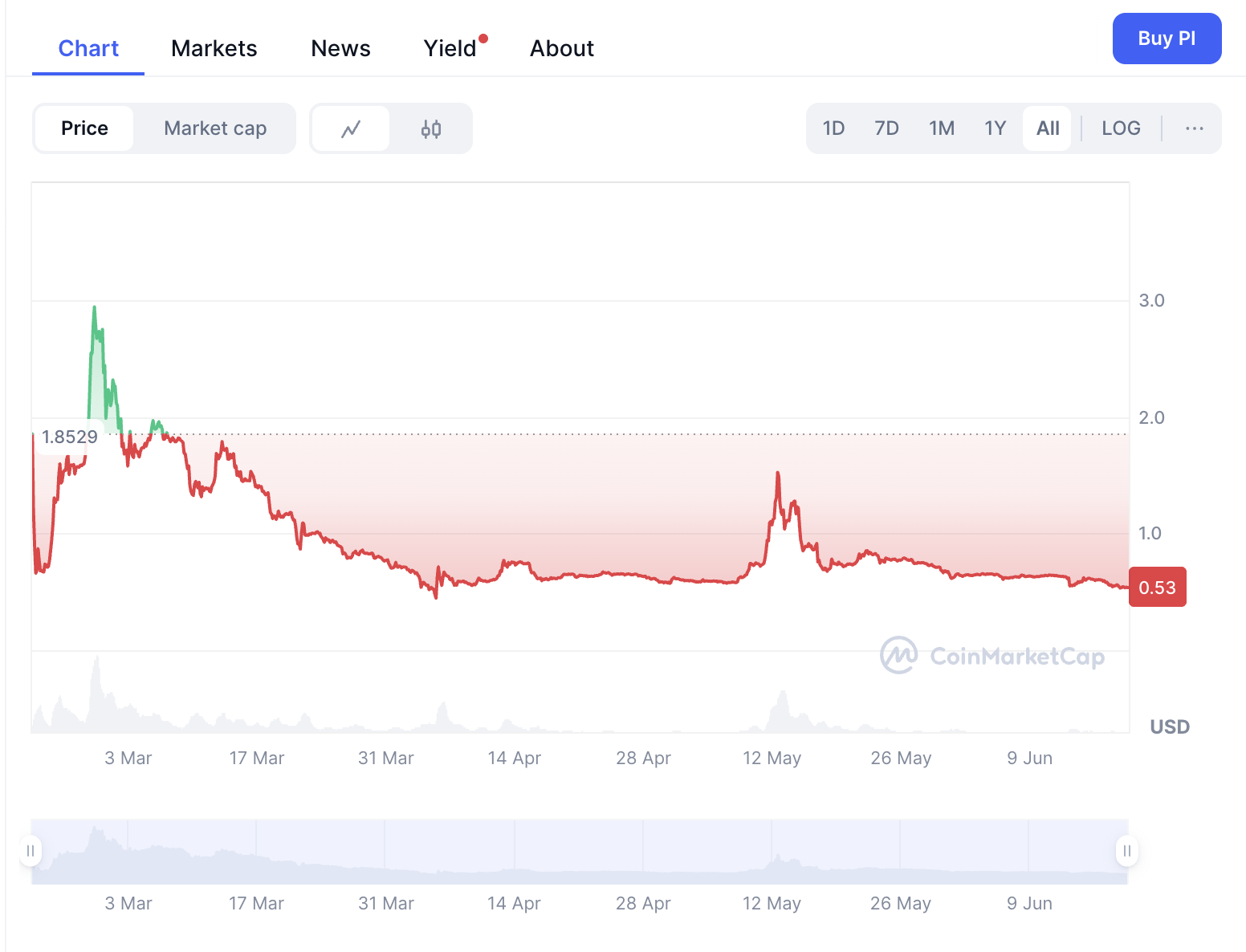
Pi Coin experienced a powerful short-term breakout to $1.65 earlier in 2025, but that rally proved unsustainable. A wave of profit-taking dropped the price to as low as $0.40 after the Israel-Iran conflict caused broader market turbulence. While the token rebounded 40% from those lows, it still trades 65% below recent highs.
Technically, the coin is attempting to hold the $0.60 level, which analysts mark as a critical support zone. It has pierced the 20-day EMA but struggles to close above the 50-day band at $0.66. If a breakout above that resistance occurs, sentiment could flip bullish again, pushing the coin toward the $1.65–$1.70 Fib level.
But the risk is real: slipping below $0.60 again could open the gates for a fresh collapse back to $0.40—or potentially a new all-time low. That’s why the Pi price prediction 2026 is currently split, with strong divergence between institutional and retail sentiment.
What Could Push Pi to $3.50—or Below $0.40?
Most forecast models for Pi Coin place its 2026 price between $0.85 and $3.50, depending on whether bullish momentum returns. Coinpedia suggests an average of $2.25 in a recovery scenario, while DigitalCoinPrice posts a far more aggressive outlook above $100—though this appears to be a data error or anomaly.
Pi’s fate will depend on two main factors:
1. Technical recoveries above key resistance, especially the $0.66 and $1.65 levels.
2. Network utility and token migration success, particularly how quickly users move Pi from testnet to mainnet and participate in real DeFi or payment applications.
If exchange listing rumours (especially Binance) materialise, price discovery could be reignited. But without ecosystem development or stronger tokenomics, Pi risks becoming another overhyped Web3 brand without lasting traction.
Qubetics Solves a Key Web3 Challenge—Interoperability
Unlike Pi, Qubetics is not chasing mobile user growth—it’s building the infrastructure backbone for the future of decentralised tech. Its mission? Solve blockchain fragmentation. By enabling secure, seamless communication across Layer 1 and Layer 2 chains, Qubetics positions itself as a foundational interoperability layer.
Through its QubeQode IDE and multichain wallet support, Qubetics enables developers to build and deploy cross-chain applications without needing to learn different smart contract languages or frameworks. It bridges ecosystems, allowing capital, data, and identities to move securely between Solana, Ethereum, Binance Smart Chain, and more.
This focus on real-world interoperability gives Qubetics a long-term advantage, especially as institutional and enterprise-grade dApps demand cross-chain operability for efficiency and compliance.

Conclusion
Pi’s price prediction for 2026 remains a question of potential versus delivery. If the project can build out its ecosystem and secure major listings, it may rebound toward the $2–$3 range. However, without real-world applications and stronger token migration, it risks revisiting its $0.40 support or even falling further.
Qubetics, on the other hand, offers measurable fundamentals—presale transparency, strong tokenomics, and a working product suite that tackles the Web3 interoperability problem head-on. Its upcoming $0.40 listing on a major exchange gives investors a short-term catalyst and long-term infrastructure play in one package.
In a market where hype fades fast, utility wins. And as of mid-2025, Qubetics may be the more grounded and high-upside choice between the two.

For More Information:
Qubetics: https://qubetics.com
Presale: https://buy.qubetics.com/
Telegram: https://t.me/qubetics
Twitter: https://x.com/qubetics
| Disclaimer: The text above is an advertorial article that is not part of CoinLineup editorial content. |


About the author


Thom Tillis Says He’ll Vote Against Senate Crypto Bill Without Ethics Language
Sen. Thom Tillis says he will vote against the Senate crypto bill unless ethics language is added, putting fresh pressure on the measure's path forward.

Strategy Bought 3,273 BTC for $255M, Total Holdings Hit 818,334 BTC
Strategy purchased 3,273 BTC for $255 million, lifting its total Bitcoin holdings to 818,334 BTC as corporate treasury accumulation continues.

Grayscale Moves Custody Away From Coinbase for New ETF Product
Grayscale is moving custody away from Coinbase for a new ETF product. Here is what the shift may signal for custody strategy, ETF structure, and crypto market sentiment.

Bitcoin Moves Above $79,000, Nearing $80,000 as BTC Momentum Builds
Bitcoin climbed above $79,000 and is pushing toward $80,000. Here is what the move means, what may be driving BTC, and the key levels to watch.

35% of European Investors Would Switch Banks for Better Crypto Services
A new survey suggests 35% of European investors would switch banks for better crypto services, highlighting rising demand for digital asset access in banking.

US Spot Bitcoin ETFs Saw $1.9B in 7-Day Inflows, Led by BlackRock
US spot Bitcoin ETFs recorded $1.9 billion in inflows across seven sessions, with BlackRock leading the trend. Here is what the streak signals for Bitcoin demand.
Related

EU Sanctions Hit Russian Crypto Exchanges, Stablecoins, CBDC
Analysis of how EU sanctions target Russian crypto exchanges, stablecoins and CBDC, and what the measures mean for compliance, liquidity and crypto market risk.

BitMine Acquires 101,000 ETH: What the Move Means
BitMine has acquired 101,000 ETH. Here is what the purchase confirms, why the move matters, and what it could signal for Ethereum watchers.
Aave DAO Vote Seeks Buyback Pause After KelpDAO Fallout
Aave DAO is weighing a governance vote to pause buybacks after the KelpDAO fallout. Here is what sparked the proposal and what it could mean for DeFi.
Grayscale Moves Custody Away From Coinbase for New ETF Product
Grayscale is moving custody away from Coinbase for a new ETF product. Here is what the shift may signal for custody strategy, ETF structure, and crypto market sentiment.

France Charges 88 Suspects Over Alleged Crypto Wrench Attacks
France has charged 88 suspects in an alleged crypto wrench attack case. Here is what the case suggests for crypto security, policing, and investor risk.

Ethereum Foundation Unstakes 17,035 ETH Worth About $40 Million
The Ethereum Foundation has unstaked 17,035 ETH worth about $40 million. This outline focuses on the unstaking move, its treasury context, and why the market is watching.