


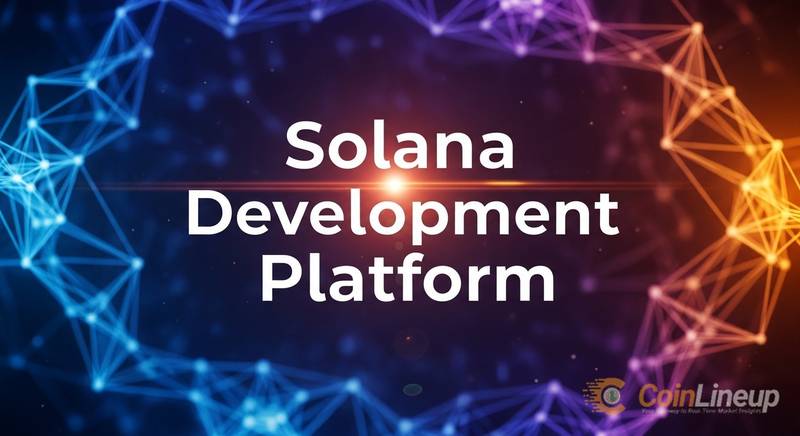
The Solana Foundation has launched the Solana Developer Platform (SDP), an API-based development environment designed to let institutional builders deploy on-chain applications without requiring deep blockchain expertise. The platform targets fintechs, asset managers, and enterprise developers with standardized REST and RPC endpoints that abstract away Solana’s low-level complexity.
SDP bundles managed infrastructure components, including node access, indexing, and wallet management APIs, into a unified interface that mirrors the web2-style tooling institutional engineering teams already use. The launch signals Solana’s most direct bid yet to capture enterprise development volume on its network.
What SDP Gives Institutional Developers
The Solana Developer Platform is an API-first abstraction layer sitting on top of Solana’s existing developer stack. Where tools like web3.js and the Anchor framework require blockchain-specific knowledge, including Solana’s account model, transaction signing, and compute unit management, SDP wraps these into familiar REST endpoints.
Solana Network — Key Metrics
65,000 TPS (peak throughput)
~$0.00025 avg. transaction fee
Source: Solana Foundation / solana.com
The platform launched with several high-profile infrastructure partners. Mastercard, Western Union, and Worldpay are among the institutional names attached to SDP’s rollout, providing payment rail integrations that enterprise builders can access through the platform’s API layer.
Modern Treasury has been selected as a payments infrastructure partner, handling payment operations and reconciliation workflows. Chainalysis is providing real-time compliance tooling integrated directly into SDP, addressing one of the key blockers that has historically kept regulated institutions from building on public blockchains.
The compliance integration is notable. Institutional dev teams operating under regulatory oversight need transaction screening and risk scoring baked into their infrastructure, not bolted on after the fact. SDP’s architecture appears to treat compliance as a first-class API service rather than an aftermarket addition.
Why Institutions Need an API Layer on Solana
Solana’s raw throughput and sub-cent transaction fees have long made it attractive on paper for high-volume institutional use cases. But the gap between network capability and developer accessibility has been a persistent friction point.
Enterprise engineering teams are built around REST APIs, managed services, and standard authentication patterns. Solana’s existing tooling requires developers to understand program-derived addresses, serialized transaction formats, and Rust-based smart contract development. SDP removes that translation layer.
Solana Ecosystem — Developer Footprint
2,000+ active dApps
3,000+ monthly active developers
Source: Solana Foundation / Electric Capital Developer Report
Competing smart contract platforms have pursued similar strategies. Ethereum’s ecosystem has seen enterprise abstraction layers from Infura and Alchemy gain traction, while Avalanche has built dedicated institutional subnets. SDP positions Solana to compete directly for that same institutional developer base, similar to how platforms like Gate have expanded institutional integrations across crypto infrastructure.
The timing also matters. After Solana’s 2025 memecoin cycle raised questions about network reliability and spam resilience, SDP serves as a counter-narrative, reframing Solana as enterprise-grade infrastructure rather than a retail speculation venue.
What SDP Means for Solana’s Institutional Roadmap
SDP builds on Solana’s existing institutional footprint. Visa, PayPal, and Franklin Templeton have all previously deployed products on Solana, but each built custom integration stacks. SDP standardizes that on-ramp, potentially reducing the time and cost for the next wave of institutional builders.
The partner lineup at launch, spanning payments (Mastercard, Western Union, Worldpay), treasury operations (Modern Treasury), and compliance (Chainalysis), suggests the Solana Foundation is targeting financial services as the primary beachhead for SDP adoption. These are not speculative crypto-native partnerships; they are established financial infrastructure providers.
Whether SDP connects to Solana’s earlier institutional experiments, including permissioned environment concepts, remains unclear from the initial announcement. The platform appears to operate on Solana’s public mainnet with compliance layers on top, rather than in a permissioned sidecar.
For context on broader blockchain infrastructure shifts, Balancer Labs’ recent shutdown illustrated how even established DeFi protocols face sustainability pressure, underscoring why institutional-grade managed platforms like SDP may represent a more durable development model. Meanwhile, proposed stablecoin regulations in Delaware highlight the regulatory environment that makes compliance-integrated platforms increasingly necessary for institutional adoption.
The concrete next steps to watch are partner-specific: which Mastercard or Western Union products ship on SDP first, whether the compliance tooling from Chainalysis meets regulatory scrutiny in practice, and how many institutional developers onboard in the first quarter after launch. Those milestones will determine whether SDP is a meaningful infrastructure shift or a marketing rebrand of existing Solana developer documentation and tooling.
Disclaimer: This article is for informational purposes only and does not constitute financial or investment advice. Cryptocurrency and digital asset markets carry significant risk. Always do your own research before making decisions.


About the author


Cardano Teams Seek $50M for Bitcoin DeFi, Vision 2030
Cardano teams are seeking nearly $50 million for Bitcoin DeFi projects and Vision 2030, marking a major funding request tied to the network's roadmap.
US Spot Bitcoin ETFs Add $1.9B in 7 Days, Led by BlackRock
US spot Bitcoin ETFs pulled in $1.9 billion over seven days, with BlackRock leading inflows. Here is what the streak signals for BTC demand.

GSR Debuts Active Multi-Asset Crypto Staking ETF on Nasdaq
GSR has debuted an active multi-asset crypto staking ETF on Nasdaq. Here is what the launch means, how the fund is positioned, and what investors should watch next.
BlackRock Bitcoin ETF Sees $900M Net Inflows in Five Days
BlackRock's Bitcoin ETF logged about $900 million in net inflows over five days, highlighting sustained investor demand and broader spot ETF momentum.

US Indo-Pacific Commander Tells Senate Bitcoin Is a Reality
A US Indo-Pacific commander told the Senate that Bitcoin is a reality. Here’s what the remark means for policy, adoption, and Bitcoin’s public narrative.

Crypto Hacks Hit $17B as Attackers Move From Code to Keys
Crypto hacks have surpassed $17 billion over the past decade, with attackers increasingly targeting private keys and access points instead of code exploits.
Related

Paris Blockchain Week 2026 Live: Cointelegraph on Ground
Paris Blockchain Week 2026 is underway at the Louvre in Paris, with Cointelegraph on the ground as crypto leaders and builders gather for two days of talks.

Ethereum Foundation Launches $1M Security Subsidy Program
Ethereum Foundation has launched a $1 million security subsidy program that covers up to 30% of blockchain audit costs. Here is what the initiative means.
Aethir Contains Bridge Hack While Losses Stay Below $90K
Aethir said it contained an ATH bridge hack and kept losses below $90K. Here is the key context, impact, and what users should watch next.

Ethereum Staking Ratio Hits All-Time High as $85B Is Secured
Ethereum's staking ratio has reached a record high, with roughly $85 billion in staked ETH now helping secure the network. Here's why the milestone matters.

CFTC Chair Michael Selig Says Financial Systems Are Outdated, Highlights Blockchain
SEO outline for a crypto news article on CFTC Chair Michael Selig saying current financial systems are outdated and pointing to blockchain networks.

iBoxx Treasury Index On-Chain via Canton Network
S&P Dow Jones Indices and Kaiko put the iBoxx U.S. Treasuries Index on Canton Network as a permissioned NFT for licensed, non-investable access to data.