


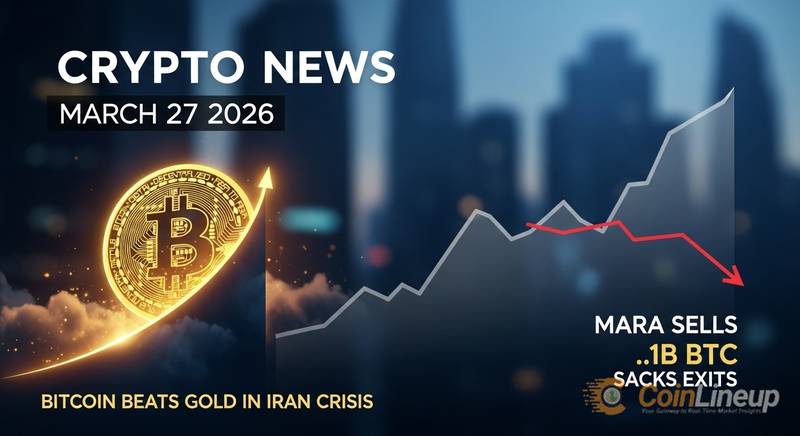

Bitcoin outperformed gold during the Iran conflict according to JPMorgan data released March 26, even as the Fear & Greed Index plunged to 13 and corporate holders MARA and GameStop made billion-dollar strategic pivots with their BTC treasuries.
Bitcoin Held Up Better Than Gold During Iran Crisis, JPMorgan Says
JPMorgan Managing Director Nikolaos Panigirtzoglou reported that gold ETFs lost roughly $11 billion in outflows during the first three weeks of March 2026, while Bitcoin ETFs recorded net inflows over the same period. Gold fell approximately 15% month-to-date; Bitcoin gained roughly 7%.
“Bitcoin has held up better than gold and silver during the Iran war period, drawing net inflows as precious-metal ETFs faced withdrawals,” Panigirtzoglou wrote in a research note compiled by PA News Lab. “Gold ETFs saw nearly $11 billion in outflows in the first three weeks of March, while bitcoin funds have continued to attract net inflows.”
The finding challenges the long-held assumption that gold is the dominant safe-haven asset during geopolitical crises. Trump postponed Iran strikes to April 6, citing “substantive negotiations,” but the damage to gold’s narrative was already visible in the flow data.
Despite this macro outperformance, Bitcoin traded at $68,686 on March 27, down 3.11% over 24 hours, with a market cap of $1.37 trillion and trading volume of $50.23 billion. The Fear & Greed Index sat at 13, deep in “Extreme Fear” territory, a level that historically signals panic-driven positioning among retail traders.
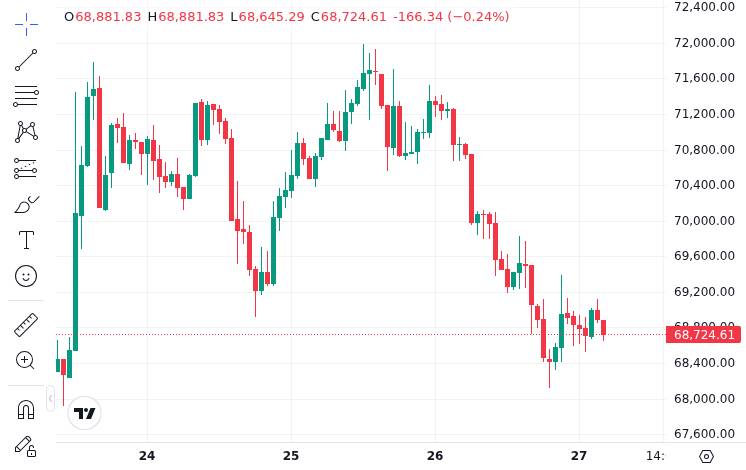
The paradox is notable: Bitcoin is outperforming gold on a macro flow basis while sentiment indicators flash extreme fear. That disconnect suggests institutional capital is treating BTC differently than retail traders, a dynamic that has preceded sharp reversals in past cycles.
MARA Sells $1.1B in Bitcoin; GameStop Pivots to Covered Calls
MARA Holdings sold 15,133 BTC for approximately $1.1 billion between March 4 and March 25, using the proceeds to repurchase $1.0 billion in face value of convertible notes at roughly a 9% discount. The trade captured approximately $88 million in value. MARA retains 38,689 BTC on its balance sheet.
The sale represents a deliberate deleveraging move, not a loss of conviction. By buying back debt at a discount, MARA reduced its future obligations while maintaining one of the largest corporate Bitcoin positions in the industry.
GameStop took the opposite approach. The company pledged 4,709 of its 4,710 BTC to Coinbase as collateral for an OTC covered call options strategy, with strike prices set between $105,000 and $110,000. Its BTC holdings are now recorded as a $368.3 million receivable, carrying a $59.7 million unrealized loss.
The contrast between the two strategies is significant. MARA is actively reducing leverage. GameStop is monetizing idle holdings by collecting options premiums. Both represent a shift away from passive “buy and hold” toward active corporate treasury management, a maturation that mirrors how traditional finance treats reserve assets.
This institutional recalibration comes at a time when liquidation cascades have punished overleveraged positions across the market. The companies’ moves suggest a growing preference for capital efficiency over simple accumulation.
David Sacks Exits White House; UK Sanctions $19.9B Crypto Marketplace
David Sacks stepped down as White House AI and crypto czar after exhausting his 130-day special government employee term. He will transition to co-chair the President’s Council of Advisors on Science and Technology (PCAST) alongside Michael Kratsios. No replacement AI or crypto czar has been announced.
Sacks’ departure leaves stablecoin and market structure legislation incomplete, creating a policy vacuum at a critical moment for the industry. The absence of a dedicated crypto policy lead in the White House raises questions about the timeline for regulatory clarity that institutional participants have been waiting for.
On the enforcement side, the UK government became the first country to sanction Xinbi, a Chinese-language crypto marketplace that processed $19.9 billion in transactions between 2021 and 2025. The platform was linked to Southeast Asian scam centers. The UK also sanctioned Legend Innovation Co, the operator of Cambodia’s #8 Park compound with capacity for 20,000 trafficked workers, along with two officials, Thet Li and Hu Xiaowei.
In DeFi security, the Moonwell governance attack demonstrated how cheaply protocols can be targeted. An attacker spent approximately $1,800 to acquire 40 million MFAM governance tokens, then attempted to seize over $1.08 million in user funds within roughly 11 minutes. Separately, Resolv Labs recovered about 57% of illegally minted USR tokens, removing 46 million of 80 million from circulation.
The $1,800-to-$1.08 million ratio in the Moonwell attack underscores a persistent vulnerability in token-weighted governance models, where low-liquidity governance tokens can be weaponized at minimal cost.
Disclaimer: This article is for informational purposes only and does not constitute financial or investment advice. Cryptocurrency and digital asset markets carry significant risk. Always do your own research before making decisions.


About the author


US Authorities Freeze $344M in Crypto Tied to Iran
US authorities froze $344 million in crypto tied to Iran, putting sanctions enforcement, seizure mechanics, and crypto compliance in focus.

Chainlink Data Services Go Live on AWS Marketplace
Chainlink data services are now live on AWS Marketplace. This article breaks down what the launch confirms, why the listing matters, and what it could signal for blockchain infrastructure distribution.
US Bankers Association Seeks 60-Day Delay for Stablecoin Rules
The US Bankers Association is urging a 60-day delay before stablecoin rules take effect. This outline focuses on the pause request, regulatory timing, and market implications.

Polymarket Paris Weather Glitch Sparks $37K Scrutiny
Polymarket faces scrutiny after traders reportedly made $37K from a Paris weather market glitch, raising fresh questions about trust and market rules.

PUSD Launches on ADI Chain in Middle East Expansion
PUSD launches on ADI Chain as part of a broader Middle East stablecoin expansion. This outline focuses on the launch, its regional context, and what readers should watch next.

Binance.US Spot Trading Fees Fall to 0% for Makers, 0.02% for Takers
Binance.US has cut spot trading fees to 0% for makers and 0.02% for takers. Here’s what changed, who benefits, and why the move matters.
Related
US Authorities Freeze $344M in Crypto Tied to Iran
US authorities froze $344 million in crypto tied to Iran, putting sanctions enforcement, seizure mechanics, and crypto compliance in focus.
Chainlink Data Services Go Live on AWS Marketplace
Chainlink data services are now live on AWS Marketplace. This article breaks down what the launch confirms, why the listing matters, and what it could signal for blockchain infrastructure distribution.

Coinbase to List Fluent (BLEND) USD Spot Pair
Coinbase is set to list Fluent (BLEND) against USD in spot trading. Here’s what the announcement means and what traders should watch next.

Cardano Teams Seek $50M for Bitcoin DeFi, Vision 2030
Cardano teams are seeking nearly $50 million for Bitcoin DeFi projects and Vision 2030, marking a major funding request tied to the network's roadmap.
US Bankers Association Seeks 60-Day Delay for Stablecoin Rules
The US Bankers Association is urging a 60-day delay before stablecoin rules take effect. This outline focuses on the pause request, regulatory timing, and market implications.
Polymarket Paris Weather Glitch Sparks $37K Scrutiny
Polymarket faces scrutiny after traders reportedly made $37K from a Paris weather market glitch, raising fresh questions about trust and market rules.