



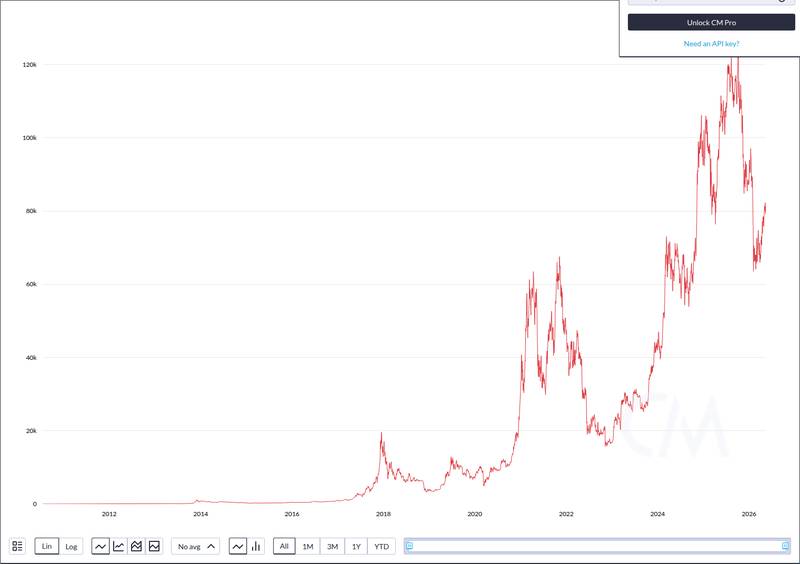
Bitcoin slipped back below the $82,000 resistance level as rising U.S. Treasury yields tightened liquidity across risk markets, putting renewed pressure on crypto prices.
The move came as Treasury yields climbed to fresh highs, drawing capital toward government bonds and away from speculative assets. For Bitcoin holders, the failed push above $82,000 signals that macro headwinds are currently outweighing crypto-specific demand.
How rising Treasury yields squeeze Bitcoin
Treasury yields represent the return investors earn by lending money to the U.S. government. When those yields rise, bonds become more attractive relative to assets like Bitcoin that produce no income. Money flows toward the safer, higher-yielding option.
Liquidity, in simple terms, is the amount of easy money sloshing around in financial markets. When yields rise, central bank policy tends to stay tight, and that liquidity shrinks. Less available capital means fewer dollars chasing risk assets, including crypto.
The U.S. Treasury’s daily yield curve data shows the upward trend across multiple maturities. As yields grind higher, Bitcoin faces a headwind that has nothing to do with blockchain fundamentals.
This dynamic is not unique to 2026. Bitcoin has historically struggled during periods of rising real yields, as institutional allocators rotate into fixed income. The current environment, with the Treasury actively managing its issuance calendar, adds another layer of supply pressure in the bond market.
Why $82,000 is a level worth watching
In market terms, resistance is a price level where selling pressure has repeatedly overwhelmed buyers. Bitcoin approached $82,000 and failed to hold above it, suggesting that sellers are clustered around that zone.
A failed breakout above resistance often triggers additional selling as short-term traders exit positions. This is especially relevant for newer holders who may have bought near recent highs, as the majority of top traders on platforms like Hyperliquid have been positioned long, making a rejection at resistance painful for leveraged longs.
The $82,000 level is not a permanent ceiling. It is a checkpoint. If Bitcoin reclaims and holds above it on a subsequent attempt, the failed breakout becomes a shakeout. If it continues to reject, the level strengthens as resistance.
What to watch from here
The most important variable for Bitcoin right now is not on-chain. It is macroeconomic. Traders should monitor Treasury yields and any signals from the Federal Reserve about liquidity conditions before assuming this pullback is purely crypto-driven.
Regulatory developments could also shift the landscape. The CLARITY Act moving through the Senate and Poland’s recent approval of its MiCA crypto bill represent structural progress for the industry, but neither will override a macro liquidity squeeze in the short term.
The practical checkpoint is straightforward: watch whether Bitcoin can reclaim $82,000 on its next attempt. A clean break above with volume would suggest the macro drag is fading. Continued rejection would indicate that rising yields still have the upper hand.
Disclaimer: This article is for informational purposes only and does not constitute financial or investment advice. Cryptocurrency and digital asset markets carry significant risk. Always do your own research before making decisions.

About the author


Bitcoin Price Falls Below $82K as Treasury Yields Rise
Bitcoin price fell below $82,000 resistance as US Treasury yields hit fresh highs and liquidity tightened, putting new pressure on the broader crypto market.

Poland’s Lower House Approves MiCA Crypto Bill
Poland's lower house approved a MiCA crypto bill, moving the country closer to EU-aligned digital asset rules and clearer market oversight.

Australia CGT Proposal Could Raise Crypto Tax Bills in 2027
Australia's proposed CGT changes may increase crypto tax bills from 2027. Here's what the plan could mean for investors and what to watch next.

Bitcoin Briefly Tops $82,000 on Gate
Bitcoin briefly traded above $82,000 on Gate, drawing attention to a short-lived move. Here is what happened, what it may signal, and what to watch.

Grove Launches $1 Billion Liquidity Network for Tokenized Treasury Funds
Grove has launched a $1 billion liquidity network aimed at tokenized Treasury funds, expanding onchain access, market depth, and settlement efficiency.

Circle Deepens Hyperliquid Tie-Up to Expand USDC Infrastructure
Circle is deepening its Hyperliquid partnership to expand USDC infrastructure. The outline centers on the announcement, user impact, and strategy.
Related

Nearly All Top Bitcoin Traders on Hyperliquid Are Long Today
Nearly all top Bitcoin traders on Hyperliquid are holding long positions today. Here’s what that positioning signal could mean for BTC sentiment and market risk.
Bitcoin Briefly Tops $82,000 on Gate
Bitcoin briefly traded above $82,000 on Gate, drawing attention to a short-lived move. Here is what happened, what it may signal, and what to watch.

Strategy Buys 535 BTC, Total Holdings Hit 818,869 BTC
Strategy bought 535 BTC for $43 million, lifting its total Bitcoin holdings to 818,869 BTC. Here’s what the latest treasury move means.
Morgan Stanley MSBT Sees Zero Outflows as Bitcoin ETF Inflows Hit 6 Weeks
Morgan Stanley's MSBT closed its first trading month with zero outflows while Bitcoin ETFs extended a six-week inflow streak, signaling steady demand.
Seven Bitcoin Mining Pools Join Stratum V2 Amid Rising Costs
Seven major Bitcoin mining pools are joining Stratum V2 as mining costs rise, signaling a strategic shift in efficiency, control, and pool operations.

CME Plans Bitcoin Volatility Futures Launch on June 1
CME plans to launch Bitcoin Volatility Futures on June 1. See what the product is, why it matters, and what it could mean for Bitcoin markets.