


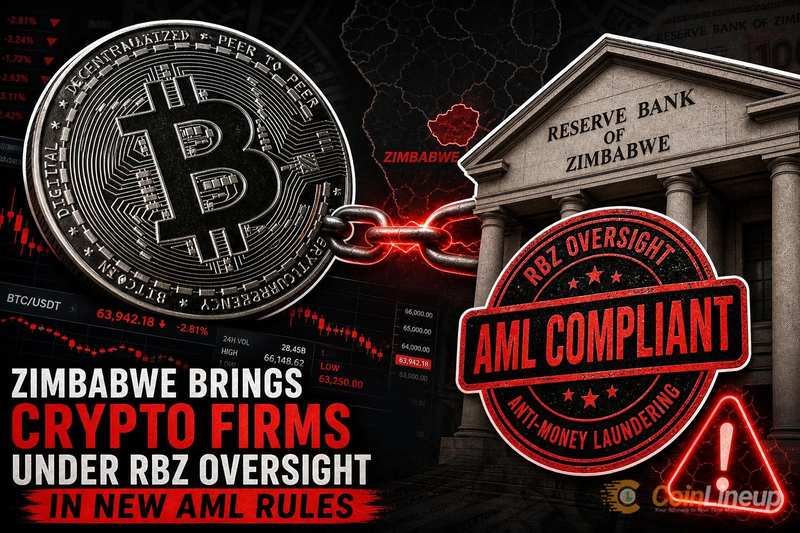
Zimbabwe has formally brought cryptocurrency businesses under central bank oversight through Statutory Instrument 99 of 2026, requiring all virtual asset service providers to register with the Reserve Bank of Zimbabwe’s Financial Intelligence Unit and comply with anti-money laundering obligations.
The regulation, titled the Money Laundering and Proceeds of Crime (Virtual Asset Service Providers Registration) Regulations, 2026, establishes a registration framework under Zimbabwe’s existing money-laundering law. VASPs must obtain a certificate from the FIU before operating, with an issuance fee of $500 and a renewal fee of $400. The application fee itself is waived.
Each registration certificate is valid for one year from the date of issuance. Firms may file for renewal within ninety days before their certificate expires.
What the New AML Rules Change for Crypto Firms in Zimbabwe
The statutory instrument goes beyond basic registration. Approved VASPs must display their certificate at all physical and digital service points, paired with a QR code linking to their official registry entry. This public-verification mechanism adds a layer of consumer-facing transparency uncommon in African crypto regulation.
Part V of the regulation introduces Travel Rule obligations, requiring VASPs to obtain, verify, and transmit originator and beneficiary information for transactions. For transfers to unhosted wallets exceeding USD 1,000, firms must collect proof of wallet ownership from the customer.
The RBZ laid the groundwork for these rules in 2024, when it completed its first assessment of money-laundering risks posed by virtual assets and VASPs. That assessment was submitted to the Minister of Finance, Mthuli Ncube, for publication-related consideration, as confirmed by independent reporting on the new framework.
Why RBZ Oversight Matters for Compliance and Operations
By embedding VASP regulation inside the Money Laundering and Proceeds of Crime Act rather than creating a standalone crypto-markets statute, Zimbabwe ties crypto compliance directly to existing financial-crime enforcement. The FIU, not a new agency, handles oversight, giving crypto firms the same AML accountability structure as traditional financial institutions.
The QR-code certificate display requirement and the unhosted-wallet proof threshold are details that competing coverage has largely overlooked. These provisions suggest the government is focused on traceability, not just registration. In a market where large token movements can trigger sharp price swings, regulators globally are tightening oversight of self-custody transfers.
The annual renewal cycle also gives the FIU a recurring compliance checkpoint. Firms that fail to maintain AML standards risk losing their certificate, effectively barring them from legal operation for the following year.
What This Signals for Zimbabwe’s Crypto Sector
Zimbabwe’s approach mirrors a broader trend across emerging markets, where regulators are choosing AML-first frameworks over comprehensive market-conduct regimes. The structure is narrower than what jurisdictions like the EU adopted with MiCA, but it establishes a formal legal basis for crypto businesses to operate.
For local exchanges and wallet providers, the immediate task is registration. The zero application fee lowers the barrier to entry, but the ongoing obligations, including KYC procedures, Travel Rule compliance, and certificate display, will require operational investment. As institutional players refine their custody and compliance infrastructure elsewhere, Zimbabwe’s smaller operators face a compressed timeline to build similar capabilities.
The regulation does not address token listings, market manipulation, or consumer protection beyond AML, leaving those areas for potential future instruments. How crypto industry consolidation reshapes compliance standards in other markets may influence Zimbabwe’s next steps. For now, the FIU registration framework establishes the baseline: crypto firms in Zimbabwe must identify their customers, track their transactions, and prove it annually.
Disclaimer: This article is for informational purposes only and does not constitute financial or investment advice. Cryptocurrency and digital asset markets carry significant risk. Always do your own research before making decisions.

About the author


Zimbabwe Brings Crypto Firms Under RBZ Oversight in New AML Rules
Zimbabwe is bringing crypto firms under RBZ oversight through new AML rules, signaling tighter compliance requirements for the country’s digital asset sector.

Tennessee Man Charged in Alleged $1.9M Crypto Ponzi Scheme
A Tennessee man is facing federal charges tied to an alleged $1.9 million crypto Ponzi scheme. Here is what the case alleges, what investors need to know, and why it matters.
Poland President Vetoes Crypto Market Regulation Bill for Third Time
Poland's president has vetoed a crypto market regulation bill for the third time, raising fresh questions about oversight, compliance, and the country's digital asset policy path.

Ripple and Bitso Bring MXNB Stablecoin to XRP Ledger
Ripple and Bitso are expanding their partnership to bring the MXNB stablecoin to the XRP Ledger. Here is what the move could mean for XRPL users.
Seized Alameda Funds Move to Coinbase Prime: What It Signals
Seized Alameda funds have moved to Coinbase Prime. This outline focuses on what moved, why the transfer matters, and what crypto market watchers should monitor next.

Ripple Partners With Bitso to Launch MXNB Stablecoin on XRPL
Ripple has partnered with Bitso to launch the MXNB stablecoin on the XRP Ledger, framing the peso-linked token around payments and blockchain settlement use.
Related

Grayscale Updates NEAR ETF Filing With BitGo Custody Details
Grayscale has updated its NEAR ETF filing to include BitGo custody details. Here is what changed, why the amendment matters, and what it could signal for NEAR investors.

Blockworks Acquires Messari: What the Deal Means for Crypto Media and Research
Blockworks acquires Messari in a deal that could reshape crypto media, research, and market intelligence. Here’s what the acquisition may mean.
Tennessee Man Charged in Alleged $1.9M Crypto Ponzi Scheme
A Tennessee man is facing federal charges tied to an alleged $1.9 million crypto Ponzi scheme. Here is what the case alleges, what investors need to know, and why it matters.

Seychelles Court Orders KuCoin Entities to Pay Swiss Investor Over $2M
A Seychelles court has ordered KuCoin entities to pay a Swiss investor more than $2 million, putting fresh legal pressure on the crypto exchange.
Poland President Vetoes Crypto Market Regulation Bill for Third Time
Poland's president has vetoed a crypto market regulation bill for the third time, raising fresh questions about oversight, compliance, and the country's digital asset policy path.

ZachXBT Traces $120.2M USDT Flows as Tether Freezes $72M
ZachXBT traced $120.2M in USDT flows tied to an XMR surge, while Tether froze $72M in USDT. Here is the key timeline, on-chain focus, and market context.