


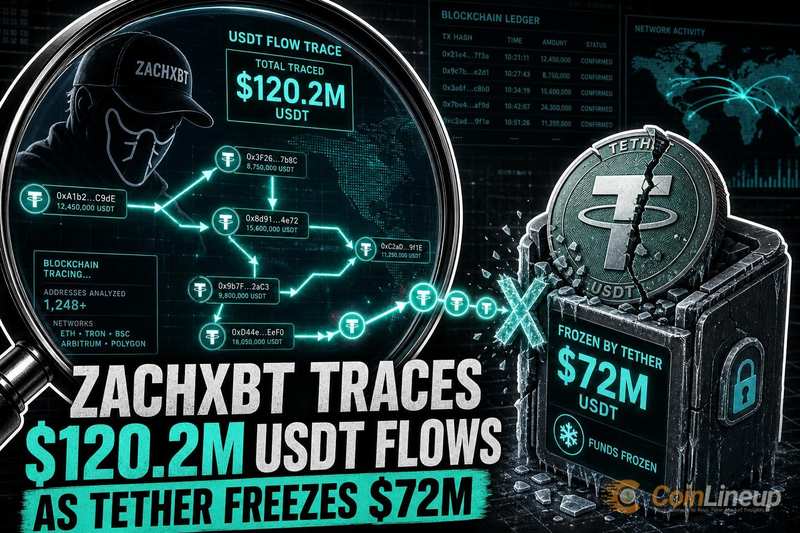
Blockchain investigator ZachXBT has traced 120.2 million USDT in fund flows reportedly tied to a sharp surge in Monero’s XMR token, while Tether moved to freeze $72 million in USDT linked to the activity.
The developments were reported by Wu Blockchain, citing on-chain tracing work published by ZachXBT. According to the report, a single address received the 120.2 million USDT, which was then swapped into XMR, Monero’s native privacy coin.
What ZachXBT Said About the $120.2M USDT Flows
KEY TAKEAWAYS
- ZachXBT traced 120.2 million USDT flowing to a single address before being swapped to XMR.
- Tether froze $72 million in USDT connected to the traced flows.
- The large swap into XMR coincided with a notable surge in Monero’s price.
ZachXBT, a pseudonymous on-chain sleuth known for tracing illicit crypto fund movements, identified that the USDT was received by a specific address and subsequently converted into Monero. The conversion of stablecoins into a privacy-focused cryptocurrency raised immediate flags across the crypto investigation community.
The tracing claim should be understood as ZachXBT’s reported findings based on on-chain analysis. Independent verification of the full flow path has not been publicly confirmed beyond the initial report.
Why the XMR Surge Became Part of the Story
Monero is a privacy-oriented cryptocurrency designed to obscure transaction details, making it a frequent choice for those seeking to move funds without leaving a transparent on-chain trail. A swap of this magnitude, over 120 million USDT into XMR, would represent significant buy pressure on a token with relatively lower liquidity compared to major cryptocurrencies.
The reported connection between the large USDT-to-XMR swap and the subsequent XMR price surge does not by itself prove causation. However, the scale of the conversion is consistent with the type of activity that could move Monero’s market. For crypto market watchers, particularly those tracking stablecoin movements as a signal for unusual activity, the pairing of a massive swap with a price spike in a privacy coin is a notable data point.
This incident adds to a broader pattern of large stablecoin movements drawing scrutiny. Readers following how stablecoins are expanding across different blockchains will recognize that the role of USDT in cross-chain flows continues to be a central theme in crypto markets.
Tether’s $72M Freeze and What It Signals
In a direct response to the traced activity, Tether froze $72 million in USDT. Tether, the issuer of USDT, has the ability to blacklist specific addresses on supported blockchains, rendering the frozen tokens immovable and unredeemable.
The freeze represents roughly 60% of the total 120.2 million USDT traced in the report. The gap between the traced amount and the frozen amount suggests that a portion of the funds may have already been converted or moved beyond Tether’s ability to intervene.
For traders and observers, the freeze action signals several things. Tether continues to cooperate with on-chain investigators and is willing to act swiftly when flagged. The speed of the freeze also underscores that holding large sums in centralized stablecoins carries counterparty risk, as issuers can unilaterally restrict access.
As major crypto projects continue to compete for market share, the ability of stablecoin issuers to freeze funds remains a critical differentiator between centralized stablecoins like USDT and decentralized alternatives. Observers tracking evolving regulatory frameworks in crypto may see this incident as further evidence that enforcement capabilities around stablecoins are tightening.
What happens next depends on whether further details emerge about the origin of the funds and whether law enforcement agencies pursue formal action. The addresses involved can be monitored through public blockchain explorers such as Tronscan for any additional movement of the remaining unfrozen tokens.
Disclaimer: This article is for informational purposes only and does not constitute financial or investment advice. Cryptocurrency and digital asset markets carry significant risk. Always do your own research before making decisions.

About the author


ZachXBT Traces $120.2M USDT Flows as Tether Freezes $72M
ZachXBT traced $120.2M in USDT flows tied to an XMR surge, while Tether froze $72M in USDT. Here is the key timeline, on-chain focus, and market context.

BlackRock Files SEC Registration for Bitcoin Income ETF
BlackRock has filed SEC registration paperwork for a Bitcoin income ETF. Here is what the filing says, how the product may work, and why it matters.
U.S. Treasury Expands Iran Crypto Sanctions to Procurement Networks
The U.S. Treasury has widened Iran-related crypto sanctions to cover procurement networks, raising fresh compliance and enforcement questions for digital asset platforms and market participants.

Binance’s Philippines Return Faces BSP License Gap Warning
Binance's reported Philippines return faces scrutiny over a BSP license gap, with the core issue centered on regulatory compliance, market access, and local risk warnings.

BlackRock Updates Bitcoin Premium Income ETF Filing With Covered Calls
BlackRock has updated its filing for a Bitcoin Premium Income ETF with a covered-call strategy. Here is what changed and what it could mean.

Solana RWA Value Hits $2.7 Billion ATH as Tokenized Assets Grow
Solana's real-world asset value has climbed to a record $2.7 billion. This outline covers the growth drivers, market context, and what the milestone means for Solana's RWA sector.
Related

SEC Proposal to Scrap NMS Rules 611 and 610(e) Could Reshape Tokenized U.S. Stock Trading in DeFi
Analyze how a proposed SEC rollback of NMS Rules 611 and 610(e) could influence tokenized U.S. stock trading in DeFi, market structure, and crypto platform strategy.

Ripple and Bitso Bring MXNB Stablecoin to XRP Ledger
Ripple and Bitso are expanding their partnership to bring the MXNB stablecoin to the XRP Ledger. Here is what the move could mean for XRPL users.
Seized Alameda Funds Move to Coinbase Prime: What It Signals
Seized Alameda funds have moved to Coinbase Prime. This outline focuses on what moved, why the transfer matters, and what crypto market watchers should monitor next.
U.S. Treasury Expands Iran Crypto Sanctions to Procurement Networks
The U.S. Treasury has widened Iran-related crypto sanctions to cover procurement networks, raising fresh compliance and enforcement questions for digital asset platforms and market participants.

Coinbase launches Coinbase for Agents for AI trading
Coinbase has launched Coinbase for Agents, a new push into AI trading and portfolio management. Here is what the product does, why it matters, and what to watch next.
Ripple Partners With Bitso to Launch MXNB Stablecoin on XRPL
Ripple has partnered with Bitso to launch the MXNB stablecoin on the XRP Ledger, framing the peso-linked token around payments and blockchain settlement use.