


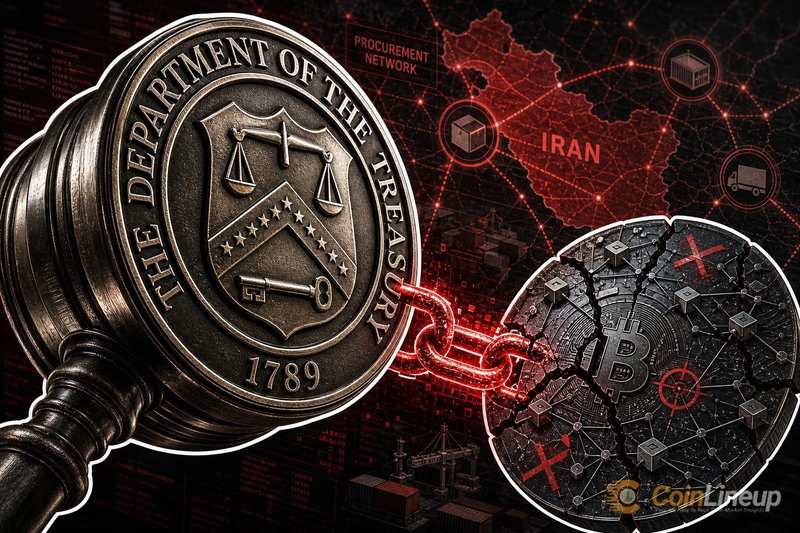
The U.S. Treasury Department has expanded its Iran-related crypto sanctions to target procurement networks, broadening the enforcement perimeter beyond previously designated entities and raising new compliance questions for digital asset platforms.
The action, detailed in a Treasury press release, extends sanctions designations to intermediary procurement structures linked to Iran. Rather than focusing solely on individual wallets or exchanges, the move targets the broader supply and funding chains that facilitate sanctioned activity through digital assets.
Procurement networks in this context refer to webs of entities, individuals, and shell companies that acquire goods, services, or financial access on behalf of sanctioned parties. These networks often layer transactions across multiple jurisdictions and payment rails, including cryptocurrency, to obscure the ultimate beneficiary.
Why procurement networks complicate crypto compliance
Traditional sanctions screening focuses on matching counterparty names and wallet addresses against the OFAC Specially Designated Nationals (SDN) list. Procurement networks challenge this approach because the entities transacting may not yet be listed, even as they serve sanctioned end users.
Blockchain analytics firms have increasingly flagged this gap. Chainalysis has documented how Iranian crypto exchanges and adjacent services use layered transaction patterns to evade detection, reinforcing why OFAC’s expanded designations now reach deeper into support structures.
For exchanges and payment processors, this means screening only direct counterparties may no longer satisfy regulatory expectations. Firms that handle cross-border flows will likely need to evaluate indirect exposure, examining whether upstream or downstream entities in a transaction chain have procurement ties to sanctioned programs.
The shift toward targeting networked actors rather than isolated wallets mirrors broader trends in crypto compliance. As platforms develop more sophisticated AI-driven compliance and trading infrastructure, the ability to map relationship chains across wallets and entities becomes a critical differentiator.
What the sanctions expansion means for exchanges and crypto firms
Broader sanctions designations typically increase due diligence expectations across the industry. Compliance teams at exchanges and custodians may need to enhance transaction monitoring rules to flag patterns consistent with procurement activity, not just known blacklisted addresses.
It is important to distinguish between regulatory risk and immediate market impact. This designation does not impose new rules on all crypto users. It adds specific entities and networks to the SDN list, which means direct exposure is limited to firms and individuals transacting with those newly listed parties.
However, the signal is clear: OFAC is moving toward a network-based enforcement model for crypto-linked sanctions. Platforms operating in jurisdictions with strict sanctions compliance regimes should review their exposure mapping and ensure their monitoring tools can identify indirect relationships, not just direct wallet matches. Even participants focused on emerging tokens and smaller-cap opportunities should be aware that sanctions compliance applies regardless of asset size.
The OFAC FAQ on virtual currency remains the baseline reference for how digital asset businesses should approach sanctions obligations. Firms navigating the increasingly complex intersection of on-chain trading strategies and regulatory requirements should consult that guidance and assess whether their current screening capabilities account for the procurement network topology now covered by the expanded designations.
Disclaimer: This article is for informational purposes only and does not constitute financial or investment advice. Cryptocurrency and digital asset markets carry significant risk. Always do your own research before making decisions.

About the author

U.S. Treasury Expands Iran Crypto Sanctions to Procurement Networks
The U.S. Treasury has widened Iran-related crypto sanctions to cover procurement networks, raising fresh compliance and enforcement questions for digital asset platforms and market participants.

Binance’s Philippines Return Faces BSP License Gap Warning
Binance's reported Philippines return faces scrutiny over a BSP license gap, with the core issue centered on regulatory compliance, market access, and local risk warnings.
BlackRock Updates Bitcoin Premium Income ETF Filing With Covered Calls
BlackRock has updated its filing for a Bitcoin Premium Income ETF with a covered-call strategy. Here is what changed and what it could mean.

Solana RWA Value Hits $2.7 Billion ATH as Tokenized Assets Grow
Solana's real-world asset value has climbed to a record $2.7 billion. This outline covers the growth drivers, market context, and what the milestone means for Solana's RWA sector.

Token of Power exploit drains $1.58M from Balancer pool
Token of Power suffered an exploit that drained $1.58 million from a Balancer pool. This outline focuses on what happened, the immediate impact, and what comes next.

Bernstein Says Bitcoin’s Quiet Cycle May Be Healthier Than It Looks
Bernstein argues Bitcoin's subdued cycle may signal resilience, not weakness. Here's the key thesis, the pressure points, and what investors should watch.
Related

Coinbase launches Coinbase for Agents for AI trading
Coinbase has launched Coinbase for Agents, a new push into AI trading and portfolio management. Here is what the product does, why it matters, and what to watch next.
Ripple Partners With Bitso to Launch MXNB Stablecoin on XRPL
Ripple has partnered with Bitso to launch the MXNB stablecoin on the XRP Ledger, framing the peso-linked token around payments and blockchain settlement use.
Citigroup to Offer Tokenized Private Shares to Wealthy Clients: WSJ
Citigroup is reportedly preparing tokenized private share offerings for wealthy clients, signaling deeper Wall Street interest in blockchain-based private markets.
Binance’s Philippines Return Faces BSP License Gap Warning
Binance's reported Philippines return faces scrutiny over a BSP license gap, with the core issue centered on regulatory compliance, market access, and local risk warnings.
BitMine Nears 5% ETH Target as Tom Lee Signals Slower Buying Pace
BitMine is approaching its 5% ETH accumulation target while Tom Lee signals a slower buying pace. Here is what the shift could mean for Ethereum and market watchers.
Delaware and New Jersey Advance Crypto ATM Ban Bills
Delaware and New Jersey are moving forward with crypto ATM ban bills, signaling tougher state scrutiny of kiosk operators, fraud risks, and compliance standards.