


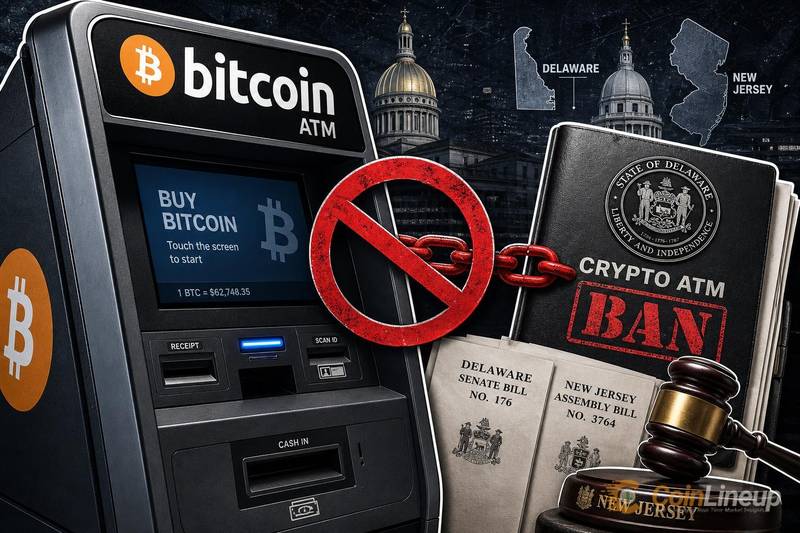

Delaware and New Jersey are both advancing bills that would restrict or ban crypto ATMs, marking a coordinated state-level push to curb fraud tied to cryptocurrency kiosks.
Delaware’s House Bill 441 and New Jersey’s Senate Bill 2141 represent parallel efforts by two neighboring states to impose tighter controls on crypto ATM operations. Both measures are at the bill stage, not yet enacted into law.
What Delaware and New Jersey Are Proposing
The two bills target cryptocurrency kiosks, the physical machines that allow users to buy or sell digital assets with cash or debit cards. Delaware’s HB 441 moved through the state legislature as lawmakers weighed new restrictions on how these machines operate within state borders.
New Jersey’s S 2141 appeared in the state’s legislative digest, signaling active consideration by Garden State lawmakers. The simultaneous movement in both states points to a regional push for stricter oversight of crypto kiosk operators.
Key Takeaways
- Delaware (HB 441) and New Jersey (S 2141) are both advancing crypto ATM restriction bills.
- Neither bill has been signed into law yet; both remain in the legislative process.
- The measures reflect growing state-level concern over fraud risks at crypto kiosks.
Why States Are Targeting Crypto ATMs
Consumer fraud is the primary driver behind these bills. The FTC has documented how scammers direct victims to bitcoin ATMs as a payment portal for fraud schemes, exploiting the speed and irreversibility of crypto transactions to steal funds before victims realize what happened.
Crypto ATMs typically charge fees far above standard exchange rates, and many operate with minimal identity verification. Lawmakers in both states appear to view current compliance and consumer safeguards as insufficient to protect residents from scam-driven losses.
The legislative push mirrors broader regulatory scrutiny across the crypto industry. Just as Nigeria’s Senate has advanced licensing requirements for crypto exchanges, U.S. state lawmakers are seeking to impose stricter standards on crypto-adjacent businesses. The trend also comes as the broader tech and crypto landscape faces intensifying regulatory and competitive pressures on multiple fronts.
What the Bills Could Mean for Operators and Users
If either bill passes, crypto ATM operators in Delaware or New Jersey would face direct business disruption. Companies running kiosks in those states could be forced to shut down machines, exit the market entirely, or significantly overhaul their compliance frameworks to meet new requirements.
For everyday users who rely on crypto ATMs for quick purchases or cash conversions, the bills would remove a local access point. This is particularly relevant for users without traditional banking relationships or those who prefer cash-based crypto transactions.
The outcome could also influence neighboring states. If Delaware and New Jersey successfully pass restrictions, other mid-Atlantic states may consider similar measures, much like how evolving regulatory frameworks in one jurisdiction often prompt action elsewhere.
Committee votes, amendments, and floor debates in both state legislatures in the coming weeks will determine whether these bills advance further or stall.
Disclaimer: This article is for informational purposes only and does not constitute financial or investment advice. Cryptocurrency and digital asset markets carry significant risk. Always do your own research before making decisions.

About the author

Delaware and New Jersey Advance Crypto ATM Ban Bills
Delaware and New Jersey are moving forward with crypto ATM ban bills, signaling tougher state scrutiny of kiosk operators, fraud risks, and compliance standards.

Kalshi Adds Solana Perpetual Futures as DOGE, SHIB Await Approval
Kalshi launches Solana perpetual futures while DOGE and SHIB contracts await approval, signaling broader interest in crypto derivatives.

CME Launches Nasdaq Crypto Index Futures for BTC, ETH, XRP, SOL
CME has launched cash-settled Nasdaq crypto index futures tied to Bitcoin, Ethereum, XRP and SOL. Here’s what the new contracts cover and why the rollout matters.

Humanity Protocol’s H Token Falls 83% After Reported $30M Private Key Breach
Humanity Protocol's H token plunged 83% after a reported $30 million private key breach. Here is the core incident, market reaction, and what it means next.

Yuga Labs Rescues $570,000 in NFTs After Floor Protocol Exploit
Yuga Labs stepped in after the Floor Protocol exploit to recover about $570,000 in NFTs. Here’s what happened, how the rescue worked, and why it matters.

Coinbase, Ripple and 200+ Crypto Firms Urge Senate on CLARITY Act
Coinbase, Ripple and more than 200 crypto firms are pressing the Senate to act on the CLARITY Act. Here is what the push means for U.S. crypto regulation.
Related

OpenAI Token Price Cuts Could Intensify Its Battle With Anthropic
OpenAI is reportedly weighing major token price cuts to win back users from Anthropic. Here is the SEO outline focused on pricing pressure, market impact, and what users should watch next.
Coinbase, Ripple and 200+ Crypto Firms Urge Senate on CLARITY Act
Coinbase, Ripple and more than 200 crypto firms are pressing the Senate to act on the CLARITY Act. Here is what the push means for U.S. crypto regulation.

Top Crypto News for June 6: Bitcoin Selling Pressure Beyond Saylor Sale
A June 6 crypto news roundup focused on Bitcoin, trader reaction to Saylor's 32 BTC sale, and why broader selling pressure may matter more.

Helium CEO Amir Haleem Steps Down: What It Means for Helium
Helium CEO Amir Haleem is stepping down. Explore what the leadership change means for Helium, its network direction, and the wider crypto market.

Failed 2016 Ethereum ICO Unlocks 1,003 ETH Through Self-Exploit
A failed 2016 Ethereum ICO has recovered 1,003 ETH through a self-exploit. Here’s what happened, how the unlock worked, and why it matters.

Bitmine Bought 26,497 ETH Last Week, Raising Holdings to 5.42M ETH
Bitmine added 26,497 ETH last week, lifting total holdings to 5.42M ETH. Here is what the latest accumulation means for Ethereum exposure and market attention.