


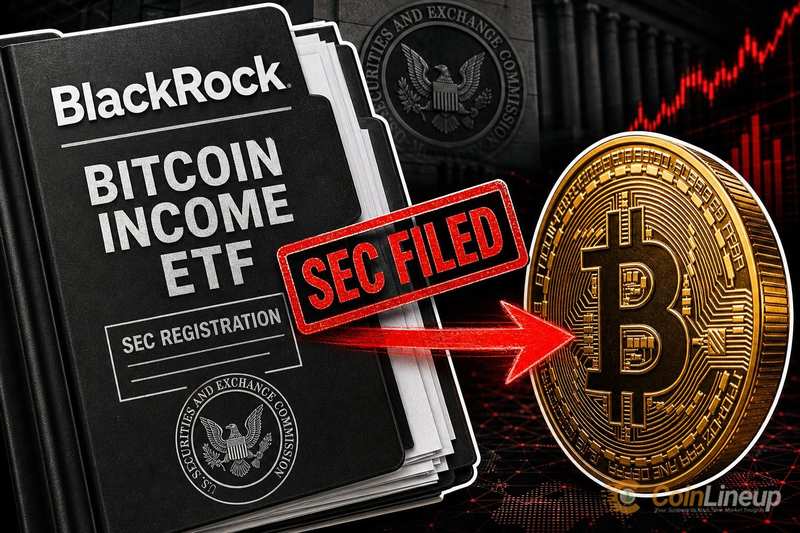
BlackRock has filed registration paperwork with the U.S. Securities and Exchange Commission for a Bitcoin income ETF, signaling the asset manager’s push beyond standard spot Bitcoin fund offerings into yield-oriented products.
What BlackRock filed with the SEC
The filing, submitted as an S-1 registration statement, outlines a proposed fund designed to combine Bitcoin exposure with an income-generating strategy. An S-1 is a preliminary registration document, not a product launch; the SEC must review and declare the filing effective before the fund can begin trading.
An amended S-1/A filing has since appeared in SEC archives, indicating the registration process remains active and the issuer has continued updating the prospectus language. These amendments are routine as issuers respond to SEC staff comments.
How a Bitcoin income ETF could work
A standard spot Bitcoin ETF simply holds Bitcoin and tracks its price. An income-focused ETF layers a yield strategy on top of that exposure, typically through options overlays such as covered-call writing on Bitcoin or related derivatives.
In a covered-call structure, the fund sells call options against its Bitcoin position, collecting premium that can be distributed to shareholders as income. The trade-off is that upside participation gets capped at the strike price of the sold options, meaning investors may sacrifice some gains during sharp rallies in exchange for regular yield.
This approach has become common in equity ETFs. Applying it to Bitcoin introduces additional complexity given the cryptocurrency’s higher volatility, which can produce larger option premiums but also greater risk of the position being called away during price surges. Investors tracking how leading digital assets have performed in 2026 will recognize that Bitcoin’s swings make the income trade-off particularly significant.
Why BlackRock’s move matters for the Bitcoin ETF market
BlackRock operates the iShares Bitcoin Trust, which has grown into one of the largest spot Bitcoin ETFs by assets. Filing for an income variant suggests the firm sees demand from investors who want Bitcoin allocation but prefer a product that generates periodic distributions rather than relying solely on price appreciation.
The filing reflects a broader shift among ETF issuers who are expanding the Bitcoin product stack beyond plain spot exposure. As CoinDesk reported, BlackRock is doubling down on Bitcoin fund offerings with this income-focused approach. This could appeal particularly to institutional allocators and retirement-oriented investors who evaluate products partly on yield characteristics.
The move also intensifies competition among Bitcoin ETF providers. With BlackRock entering the income segment, rival issuers may face pressure to develop similar strategy-based products, much like the competitive dynamics already reshaping token markets across the broader crypto landscape.
A registration filing does not guarantee approval or a specific launch date. The SEC review process can involve multiple rounds of comments and amendments, and market conditions or regulatory priorities could affect timing. The current environment involves active policy engagement across multiple federal agencies, as illustrated by recent U.S. Treasury actions expanding crypto-related sanctions to procurement networks.
Disclaimer: This article is for informational purposes only and does not constitute financial or investment advice. Cryptocurrency and digital asset markets carry significant risk. Always do your own research before making decisions.

About the author


BlackRock Files SEC Registration for Bitcoin Income ETF
BlackRock has filed SEC registration paperwork for a Bitcoin income ETF. Here is what the filing says, how the product may work, and why it matters.

U.S. Treasury Expands Iran Crypto Sanctions to Procurement Networks
The U.S. Treasury has widened Iran-related crypto sanctions to cover procurement networks, raising fresh compliance and enforcement questions for digital asset platforms and market participants.

Binance’s Philippines Return Faces BSP License Gap Warning
Binance's reported Philippines return faces scrutiny over a BSP license gap, with the core issue centered on regulatory compliance, market access, and local risk warnings.

BlackRock Updates Bitcoin Premium Income ETF Filing With Covered Calls
BlackRock has updated its filing for a Bitcoin Premium Income ETF with a covered-call strategy. Here is what changed and what it could mean.

Solana RWA Value Hits $2.7 Billion ATH as Tokenized Assets Grow
Solana's real-world asset value has climbed to a record $2.7 billion. This outline covers the growth drivers, market context, and what the milestone means for Solana's RWA sector.

Token of Power exploit drains $1.58M from Balancer pool
Token of Power suffered an exploit that drained $1.58 million from a Balancer pool. This outline focuses on what happened, the immediate impact, and what comes next.
Related
BlackRock Updates Bitcoin Premium Income ETF Filing With Covered Calls
BlackRock has updated its filing for a Bitcoin Premium Income ETF with a covered-call strategy. Here is what changed and what it could mean.

Bernstein Says Bitcoin’s Quiet Cycle May Be Healthier Than It Looks
Bernstein argues Bitcoin's subdued cycle may signal resilience, not weakness. Here's the key thesis, the pressure points, and what investors should watch.

Saif Faiq Pleads Guilty in Bitcoin Kidnapping Plot, Faces Up to 20 Years
Saif Faiq pleads guilty in a Bitcoin kidnapping plot case and could face up to 20 years in prison. Here is what the plea means and what comes next.

Strategy Buys 1,550 Bitcoin as Cash Reserve Tops $1B
Strategy purchased 1,550 Bitcoin for $101.3 million, marking another treasury move as its cash reserve reaches the $1 billion milestone.
Strategy Buys 1,550 BTC for $101.3M, Holdings Reach 845,256 BTC
Strategy bought 1,550 BTC for $101.3 million, lifting its total bitcoin holdings to 845,256 BTC as the company extends its treasury strategy.

Judge Stays Lawsuit Over Ownership of Nearly 40,000 Dormant Bitcoin
A New York Supreme Court judge has stayed a lawsuit tied to the ownership of nearly 40,000 dormant Bitcoin, shifting focus to the legal dispute and next steps.