


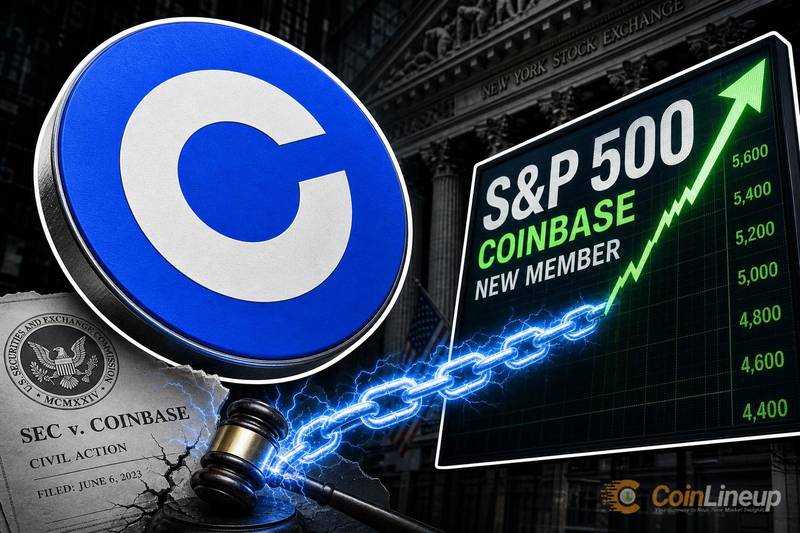
Coinbase has been added to the S&P 500, marking the first time a cryptocurrency-focused company has entered the benchmark index. The milestone arrives roughly three years after the SEC filed a landmark lawsuit against the exchange, underscoring a dramatic shift in how traditional finance views the crypto industry.
Why Coinbase Joining the S&P 500 Matters
S&P Global confirmed on May 12, 2025, that Coinbase Global would join the S&P 500, replacing Discover Financial Services in the index. The inclusion means that every index fund and ETF tracking the S&P 500 must now hold Coinbase shares, funneling passive investment flows into a crypto-native company.
Coinbase shares jumped 8% in post-market trading following the announcement. For an industry that has spent years seeking legitimacy from institutional gatekeepers, the move represents a concrete endorsement of Coinbase’s financial standing.
S&P 500 membership requires companies to meet strict criteria around market capitalization, profitability, and liquidity. Coinbase clearing those thresholds signals that the exchange has moved well beyond its early-stage growth phase into a position comparable to established financial services firms.
From SEC Lawsuit to Blue-Chip Benchmark
The contrast with Coinbase’s recent history is stark. In June 2023, the SEC filed suit against Coinbase, alleging the company operated as an unregistered securities exchange, broker, and clearing agency. The lawsuit cast a regulatory shadow over the company’s stock and raised questions about its long-term viability as a public company.
Three years later, that narrative has effectively reversed. Rather than being pushed to the margins of traditional finance, Coinbase now sits alongside companies like Apple, JPMorgan, and Microsoft in the most widely tracked equity index in the world.
The SEC itself has undergone leadership changes during this period. In February 2025, the commission signaled a shifting approach to crypto regulation under new leadership, contributing to a more favorable environment for digital asset companies operating in the United States.
What the Move Signals for Crypto Stocks
Coinbase’s inclusion is likely to draw attention to the broader universe of crypto-related public equities. As the most prominent pure-play crypto stock now sitting in the S&P 500, its performance will be more visible to traditional investors who previously had limited exposure to the sector.
The development arrives during a period of evolving institutional engagement with crypto, even as regulatory frameworks remain in flux across jurisdictions. Some countries are still working out the basics of crypto taxation, as seen in Greece’s proposed 15% crypto capital gains tax with a 500-euro exemption.
For the broader market, the move could influence how fund managers think about crypto exposure. Passive funds tracking the S&P 500 manage trillions of dollars in assets. With Coinbase now embedded in that flow, institutional crypto exposure has expanded by default, complementing the growing role of products like spot Bitcoin ETFs that have reshaped how traditional investors access digital assets.
The timing also matters in the context of shifting ETF sentiment. Recent weeks have seen significant outflows from Bitcoin ETF products, making Coinbase’s S&P 500 entry a notable counterpoint to broader caution in crypto-adjacent markets.
Coinbase also continues to build its infrastructure footprint through Base, its Layer 2 network on Ethereum, positioning the company as both a regulated exchange and a builder in the broader crypto ecosystem. Whether this dual identity strengthens or complicates its standing among S&P 500 peers will become clearer as the company reports earnings alongside its new index constituents.
Disclaimer: This article is for informational purposes only and does not constitute financial or investment advice. Cryptocurrency and digital asset markets carry significant risk. Always do your own research before making decisions.

About the author


Coinbase Joins the S&P 500 Three Years After SEC Lawsuit
Coinbase has reached the S&P 500 three years after its SEC lawsuit, highlighting a major shift in market standing for the leading crypto exchange.

House Committee Unveils Seven Crypto Tax Proposals Affecting DeFi
An SEO outline for coverage of the House committee's seven crypto tax proposals, focusing on what was unveiled, why DeFi is affected, and the main policy stakes to explain.

ZachXBT warns traders to avoid Rain Protocol over $8.8B valuation
ZachXBT warns traders to avoid Rain Protocol over its $8.8 billion valuation. The outline focuses on the warning, valuation concerns, and trader impact.

Bloomberg: US House Committee May Release Crypto Tax Legislation Friday
Bloomberg reports that a key US House committee may release crypto tax legislation as early as Friday. Here is why the timing matters and what the market should watch next.

Kalshi Debuts CFTC-Regulated Ethereum Perpetual Futures
Kalshi has debuted CFTC-regulated Ethereum perpetual futures, opening a new regulated path to ETH exposure. Here is what the launch means.

Coinbase Launches Pre-IPO Perpetual Futures Starting With SpaceX
Coinbase is launching pre-IPO perpetual futures, beginning with SpaceX. Here is what the product is, why SpaceX leads, and what it means for traders.
Related

Greece Proposes 15% Crypto Capital Gains Tax With 500-Euro Exemption
Greece has proposed a 15% tax on crypto capital gains, with a 500-euro exemption aimed at shielding smaller investors from the full burden.

Pump.fun Launches GO, a Crypto Bounty Platform
Pump.fun has launched GO, a crypto bounty platform. This outline focuses on what GO is, why the launch matters, and the immediate industry angle supported by the announcement headline.

Helium CEO Amir Haleem Steps Down: What It Means for Helium
Helium CEO Amir Haleem is stepping down. Explore what the leadership change means for Helium, its network direction, and the wider crypto market.
House Committee Unveils Seven Crypto Tax Proposals Affecting DeFi
An SEO outline for coverage of the House committee's seven crypto tax proposals, focusing on what was unveiled, why DeFi is affected, and the main policy stakes to explain.

Ripple-backed SBI VC Trade to manage WIZE’s Solana treasury
Ripple-backed SBI VC Trade will manage WIZE's Solana treasury, putting the spotlight on institutional crypto treasury oversight and SOL exposure.
ZachXBT warns traders to avoid Rain Protocol over $8.8B valuation
ZachXBT warns traders to avoid Rain Protocol over its $8.8 billion valuation. The outline focuses on the warning, valuation concerns, and trader impact.