

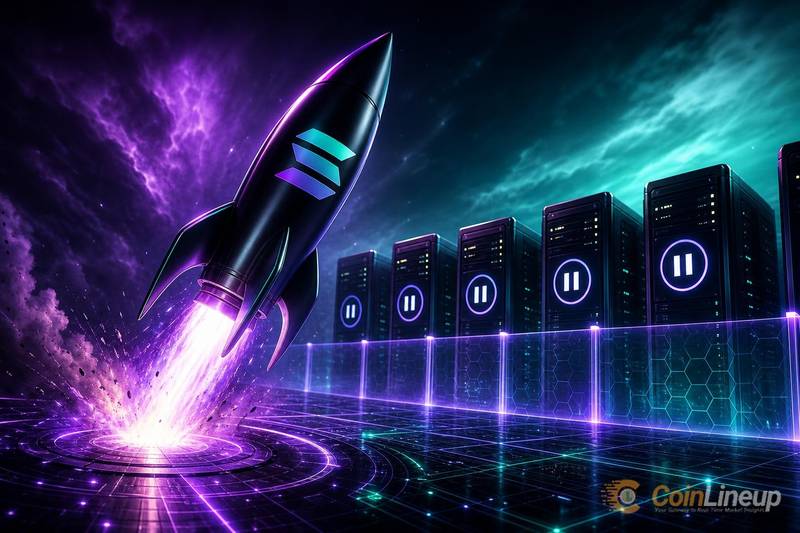

Firedancer, the independent validator client built for Solana by Jump Crypto, has officially launched on mainnet, but the rollout remains restricted and validators cannot yet run it in production.
What Firedancer launching on mainnet actually means
Firedancer is a from-scratch validator client written in C, designed to increase Solana’s throughput and reduce the network’s reliance on a single client implementation. Its arrival on mainnet is a long-anticipated infrastructure milestone.
Going live on mainnet does not mean validators can immediately switch over. Bankless confirmed that Firedancer is now running on Solana’s mainnet, but the deployment is limited rather than broadly available to the validator set.
A mainnet deployment proves the client can operate on the live network, but it is not the same as production readiness for the roughly 1,500 validators that secure Solana. The phased approach mirrors how other blockchain networks have introduced alternative clients, prioritizing stability over speed.
Why validators still have to wait
The Firedancer team has been winding down its delegation program, signaling a shift in how the client’s rollout is being managed. The delegation program previously helped bootstrap Firedancer nodes by directing stake toward early adopters.
Validator access is being staged rather than opened all at once. Running a new client on mainnet carries risk: bugs, consensus mismatches, or performance regressions could affect blocks produced by Firedancer nodes. A controlled rollout lets the team monitor behavior under real conditions before wider adoption.
For validators watching the rollout, the key signals to track are updates to the Firedancer getting-started documentation and any changes to stake delegation policies that would indicate broader access is being enabled.
What this means for Solana next
Having a second independent client running on mainnet is a meaningful step for Solana’s resilience. Client diversity reduces the risk that a single software bug could halt the entire network, a vulnerability that has historically affected Solana during outage events. In a period where networks like THORChain have faced emergency halts due to exploits, client diversity is an increasingly relevant infrastructure priority.
The Solana Foundation acknowledged the milestone on X, underscoring the significance of the deployment for the network’s long-term infrastructure roadmap.
The validator ecosystem will be watching for the transition from limited mainnet presence to full production availability. That shift will likely depend on sustained uptime, successful block production, and community confidence in the client’s stability. Large market participants already taking aggressive positions on layer-1 tokens may view Firedancer’s progress as a factor in Solana’s risk profile.
Whether validators begin migrating in meaningful numbers will determine if this launch translates into measurable network performance gains. Alongside developments like new ETF filings for layer-1 assets, Firedancer’s rollout adds another data point to Solana’s evolving institutional narrative.
Disclaimer: This article is for informational purposes only and does not constitute financial or investment advice. Cryptocurrency and digital asset markets carry significant risk. Always do your own research before making decisions.

About the author

Firedancer Goes Live on Solana Mainnet, but Validators Must Wait
Firedancer has reached Solana mainnet, but validator access is still pending. Here is what launched, why the rollout is limited, and what comes next.

Whale Opens 25x ETH Long After $32M Loss: Market Impact
A crypto whale, down $32M, has opened a 25x ETH long worth $2.7M. Here’s what the trade means for Ethereum sentiment, risk, and market focus.

Nearly All Top Bitcoin Traders on Hyperliquid Are Long Today
Nearly all top Bitcoin traders on Hyperliquid are holding long positions today. Here’s what that positioning signal could mean for BTC sentiment and market risk.

Polymarket CFTC Talks Focus on Prediction Market Pricing
Polymarket's talks with the CFTC are reportedly focused on how public prediction market pricing works, why it matters, and what it could mean for crypto traders.

Victims Ask US Court to Order Tether to Hand Over Frozen Iran-Linked USDT
Victims have asked a US court to order Tether to hand over frozen Iran-linked USDT, putting stablecoin compliance and legal accountability in focus.
Binance to Remove 20 Alpha Tokens After Review on May 14
Binance will remove 20 Alpha tokens after a review on May 14. Here is what the decision means, which details matter most, and what traders should watch next.
Related

VanEck and Grayscale Update SEC Filings for BNB ETFs
VanEck and Grayscale have updated SEC filings tied to BNB ETFs. Here is what changed, why the filings matter, and what crypto investors should watch next.

Ether ETFs See $255M+ in Weekly Net Outflows
Ether ETFs posted more than $255 million in weekly net outflows, highlighting investor caution, fund flow pressure, and near-term sentiment around ETH.
Polymarket CFTC Talks Focus on Prediction Market Pricing
Polymarket's talks with the CFTC are reportedly focused on how public prediction market pricing works, why it matters, and what it could mean for crypto traders.

Australia CGT Proposal Could Raise Crypto Tax Bills in 2027
Australia's proposed CGT changes may increase crypto tax bills from 2027. Here's what the plan could mean for investors and what to watch next.

Circle Deepens Hyperliquid Tie-Up to Expand USDC Infrastructure
Circle is deepening its Hyperliquid partnership to expand USDC infrastructure. The outline centers on the announcement, user impact, and strategy.
Binance to Remove 20 Alpha Tokens After Review on May 14
Binance will remove 20 Alpha tokens after a review on May 14. Here is what the decision means, which details matter most, and what traders should watch next.