


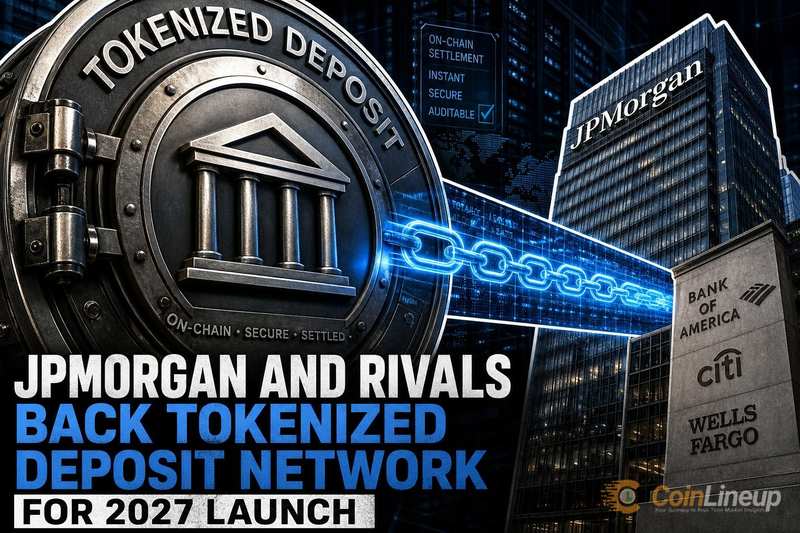
JPMorgan, Bank of America, Citi and other major financial institutions are building a tokenized deposit network targeting a 2027 launch, marking one of the largest coordinated moves by traditional banks into blockchain-based payments infrastructure.
What the tokenized deposit network involves
On April 30, 2026, FIS and a group of leading financial institutions announced plans to build their own digital tokenized money network. The consortium includes JPMorgan, Bank of America and Citi, according to CoinDesk reporting from the same date.
The network is designed for institutional use, not retail consumers. It aims to bring tokenized commercial bank deposits onto shared rails, allowing faster settlement between participating banks.
The target timeline is 2027, meaning the project is in its planning and development phase. No live product exists yet.
Why tokenized deposits differ from stablecoins
A tokenized deposit is a digital representation of a commercial bank deposit on a blockchain or distributed ledger. Unlike stablecoins, which are issued by non-bank entities and backed by reserves, tokenized deposits remain liabilities of regulated banks.
This distinction matters for institutional payments. Banks can settle obligations directly using tokenized versions of deposits they already hold, removing the need for intermediary clearing steps that currently slow cross-border and interbank transfers.
JPMorgan has prior experience in this space. The bank has operated a USD deposit token for institutional clients, giving it a foundation to build on within a broader multi-bank network. As banks explore ways to modernize payment rails, efforts like these sit alongside developments in areas where blockchain-native projects are also competing for institutional attention.
Tokenized deposits also differ from central bank digital currencies. CBDCs would be direct liabilities of a central bank, while tokenized deposits keep commercial banks in their traditional intermediary role.
What could define or delay a 2027 rollout
Several factors will determine whether the network launches on schedule. Interoperability is a primary challenge: participating banks must agree on shared technical standards, governance rules and compliance frameworks.
The Bank for International Settlements has been exploring related concepts through Project Agora, which examines how tokenized commercial bank money could work alongside central bank money in cross-border payments. The lessons from that project could shape how this private-sector network handles settlement finality and regulatory alignment.
Regulatory approval across multiple jurisdictions adds complexity. Each participating bank operates under different national regulators, and a shared tokenized deposit network would need consistent legal treatment of on-chain settlement across borders.
The 2027 date should be understood as a target, not a commitment. In the broader digital asset space, where projects ranging from established tokens like ETH and XRP to newer entrants compete for market share, a bank-backed tokenized deposit network would represent a fundamentally different approach, one built on existing regulatory frameworks rather than decentralized governance.
What happens between now and 2027 will depend on whether these banks can resolve governance structures, finalize technical architecture and secure regulatory clarity in their primary operating jurisdictions.
Disclaimer: This article is for informational purposes only and does not constitute financial or investment advice. Cryptocurrency and digital asset markets carry significant risk. Always do your own research before making decisions.

About the author

JPMorgan and Rivals Back Tokenized Deposit Network for 2027 Launch
JPMorgan and rival banks are backing a tokenized deposit network aimed at a 2027 launch. Here is what the plan could mean for institutional blockchain payments.

When ETH and XRP Disappoint, BlockDAG’s Live Legacy Sale at $0.00000044 Becomes the Obvious Move
XRP struggles and ETH price prediction turns bearish, while BlockDAG's Legacy Sale at $0.00000044 offers one of the most structured entry points among top crypto coins right now.

XRP & Internet Computer Stall on the Charts, Traders Flock to BlockDAG’s $0.00000044 Legacy Sale for Huge ROI Potential!
Explore how XRP and Internet Computer forecasts shift while BlockDAG launches its Legacy Sale at $0.00000044 alongside an exclusive $0.001 Buyback Program opportunity.

BlockDAG’s $0.001 Buyback Access Sparks Interest as TRON and Chainlink Face Market Pressure
Explore Tron holding near $0.35, Chainlink trading around $9, and BlockDAG’s active Legacy Sale at $0.00000044 with access to a $0.001 Buyback Program.

BlockDAG Kicks Off Legacy Sale Phase at Just $0.00000044! Zcash Faces Heavy Resistance & Sui Holds Key Support
Discover how BlockDAG’s $0.001 buyback triggers a rush, while finding out how Zcash faces strong resistance, and Sui tests crucial support baselines.

Wyoming AI Data Center Rules Tighten as Bitcoin Power Demand Grows
Wyoming’s new AI data center rules arrive as Bitcoin mining power demand grows, putting energy policy, grid pressure, and crypto infrastructure in focus.
Related

Kalshi Debuts CFTC-Regulated Ethereum Perpetual Futures
Kalshi has debuted CFTC-regulated Ethereum perpetual futures, opening a new regulated path to ETH exposure. Here is what the launch means.
XRPL Builder Rejects XRP Price Predictions as Community Watches Signals
An XRPL builder known as Mr. Cauliman is pushing back on bold XRP price predictions, arguing that silence and real builder signals matter more than hype.

Coinbase Launches Pre-IPO Perpetual Futures Starting With SpaceX
Coinbase is launching pre-IPO perpetual futures, beginning with SpaceX. Here is what the product is, why SpaceX leads, and what it means for traders.
Wyoming AI Data Center Rules Tighten as Bitcoin Power Demand Grows
Wyoming’s new AI data center rules arrive as Bitcoin mining power demand grows, putting energy policy, grid pressure, and crypto infrastructure in focus.
CFTC Scraps No-Deny Settlement Rule After SEC’s May Move
The CFTC has dropped its no-deny settlement rule, following the SEC's May decision. Here's what changed, why it matters, and what it could mean for crypto enforcement.
Helium Mobile acquisition leaves HNT network intact
Helium Mobile's acquisition does not automatically alter the HNT network. Here's what stays intact, why it matters, and what users should watch next.