


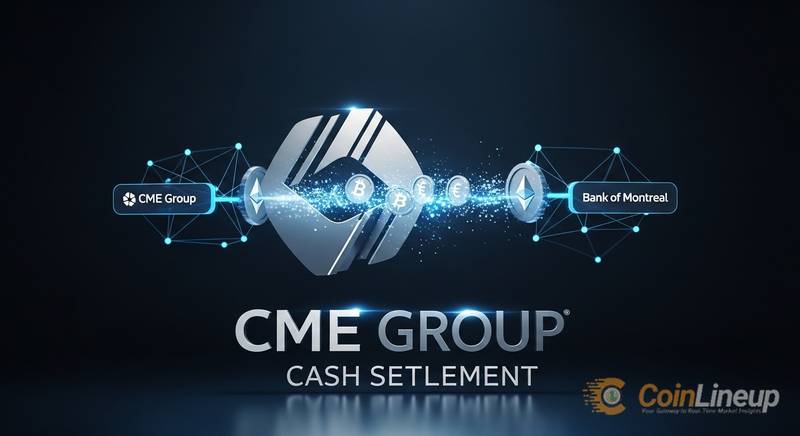
CME Group, the world’s largest derivatives exchange, and Bank of Montreal (BMO) have announced a tokenized cash settlement service designed to bring 24/7 blockchain-based clearing to institutional futures and options markets. The partnership, which also involves Google Cloud as infrastructure provider, positions BMO as the first major bank to deliver tokenized cash and deposit services on CME’s settlement rails.
$1T+
CME Group average daily notional trading volume, the institutional scale behind the new tokenized cash settlement service.
How CME and BMO’s Tokenized Cash Settlement Works
Tokenized cash, in this context, is not a stablecoin or a central bank digital currency. It is a blockchain-based digital representation of fiat currency used specifically as a collateral and settlement instrument for derivatives clearing obligations.
Traditional derivatives settlement operates on T+1 or T+2 cycles, requiring intermediary clearing steps that tie up capital and introduce delays. Tokenized settlement compresses that window by enabling near-real-time delivery-versus-payment on distributed ledger infrastructure, according to reporting from Crypto.news.
BMO serves a dual role as both launch partner and CME clearing member. As one of Canada’s Big Five banks with deep institutional trading operations, BMO’s participation gives the service immediate credibility among the clearing members and large counterparties the platform targets.
Google Cloud provides the underlying infrastructure, handling the compute and networking layer that supports the tokenized settlement system. The service initially targets CME’s institutional participants in futures and options markets, where settlement speed and capital efficiency matter most.
The move echoes a broader shift in how traditional finance approaches blockchain-based settlement. Unlike retail-facing crypto products, this service operates entirely within regulated institutional clearing frameworks.
Why Tokenized Settlement Reduces Risk for Institutional Traders
The core value proposition centers on counterparty risk reduction. In traditional clearing, a 24-to-48-hour gap exists between trade execution and final settlement. During that window, a counterparty default can leave the other side exposed to significant losses.
Tokenized settlement enables atomic or near-atomic delivery-versus-payment, effectively eliminating that exposure gap. For a clearinghouse processing trillions in notional value daily, even marginal compression of the settlement window translates to meaningful capital savings across the system.
The service enables round-the-clock settlement, operating on a 24/7 basis rather than being constrained to traditional banking hours. This is particularly relevant for derivatives markets where global participants trade across time zones and weekend exposure remains a persistent concern.
Institutional demand for tokenized collateral has accelerated alongside milestones from major asset managers. BlackRock’s BUIDL fund and Franklin Templeton’s on-chain money market fund have established precedent for institutional-grade tokenized cash equivalents, validating the concept that CME and BMO are now applying to derivatives clearing.
For institutional traders tracking how capital flows are shifting across asset classes, the tokenized settlement layer represents infrastructure that could eventually support faster collateral movement between traditional and digital markets.
$16 Trillion
Projected tokenized asset market size by 2030 (BCG / ADDX, 2022), the addressable market CME and BMO are positioning to serve with tokenized cash infrastructure.
Where CME-BMO Fits in the Institutional Tokenization Wave
CME’s entry into tokenized settlement carries outsized significance because of its status as a systemically important financial market infrastructure. When a venue of this scale adopts blockchain-based settlement, it signals a level of regulatory comfort that smaller pilots cannot.
The partnership joins a growing roster of institutional tokenization efforts. JPMorgan’s Onyx platform and Tokenized Collateral Network (TCN) have been processing billions in intraday repo transactions. HSBC and BNY Mellon have developed or piloted their own tokenized asset platforms. The Bank for International Settlements has published frameworks for tokenized settlement through its Unified Ledger concept.
What distinguishes the CME-BMO service is its direct application to derivatives clearing rather than securities settlement or fund tokenization. Derivatives markets carry unique complexity around margin requirements, daily mark-to-market, and variation margin flows, all areas where real-time tokenized settlement offers structural advantages.
The launch raises competitive pressure on other major clearinghouses. LCH and ICE Clear may need to develop comparable offerings if CME demonstrates operational success and attracts additional clearing members beyond BMO. Whether CME plans to expand access to other banking partners has not been publicly detailed.
Regulatory engagement likely played a role in enabling the launch, given CME’s oversight by the CFTC. The involvement of a regulated Canadian bank and a major cloud provider suggests the service was structured to meet existing compliance frameworks rather than requiring new regulatory carve-outs.
For market participants watching how volatility and liquidation events stress traditional settlement infrastructure, the tokenized cash service represents a concrete step toward more resilient clearing. As blockchain technology continues gaining traction across both crypto-native and traditional finance, CME’s move may mark the point where tokenized settlement shifts from pilot to production in the world’s largest derivatives market.
Disclaimer: This article is for informational purposes only and does not constitute financial or investment advice. Cryptocurrency and digital asset markets carry significant risk. Always do your own research before making decisions.


About the author


New York Seeks $3.4B in Crypto Fines Over Prediction Apps
New York is seeking $3.4 billion in crypto fines tied to prediction apps. This outline tracks the claims, the products involved, and the broader fallout.

Top Crypto News for Apr 22: 24H Roundup and CLARITY Act Fight
Read the top crypto news for Wed, Apr 22, with a 24-hour roundup focused on reported bank lobbying against the CLARITY Act and what to watch next.

Umbra Front End Offline After Hackers Move Stolen Funds
Umbra took its front end offline after hackers moved stolen funds through the protocol. Here's what happened, why it acted, and what users should watch.

North Korea-Linked Hackers Stole $500M+ in Crypto in April
A reported wave of North Korea-linked crypto thefts in April topped $500 million, raising fresh questions about exchange security, laundering routes, and investor risk.

New York targets Coinbase and Gemini in compliance dispute
New York has moved against Coinbase and Gemini in a compliance dispute. Here’s what the action centers on, why it matters, and what to watch next.

Arbitrum Freezes 30,766 ETH Tied to KelpDAO Exploit
Arbitrum Security Council froze 30,766 ETH linked to the KelpDAO exploit. See what triggered the move, what is confirmed, and what happens next.
Related

Paris Blockchain Week 2026 Live: Cointelegraph on Ground
Paris Blockchain Week 2026 is underway at the Louvre in Paris, with Cointelegraph on the ground as crypto leaders and builders gather for two days of talks.

Ethereum Foundation Launches $1M Security Subsidy Program
Ethereum Foundation has launched a $1 million security subsidy program that covers up to 30% of blockchain audit costs. Here is what the initiative means.

Aethir Contains Bridge Hack While Losses Stay Below $90K
Aethir said it contained an ATH bridge hack and kept losses below $90K. Here is the key context, impact, and what users should watch next.

Ethereum Staking Ratio Hits All-Time High as $85B Is Secured
Ethereum's staking ratio has reached a record high, with roughly $85 billion in staked ETH now helping secure the network. Here's why the milestone matters.

CFTC Chair Michael Selig Says Financial Systems Are Outdated, Highlights Blockchain
SEO outline for a crypto news article on CFTC Chair Michael Selig saying current financial systems are outdated and pointing to blockchain networks.

iBoxx Treasury Index On-Chain via Canton Network
S&P Dow Jones Indices and Kaiko put the iBoxx U.S. Treasuries Index on Canton Network as a permissioned NFT for licensed, non-investable access to data.