


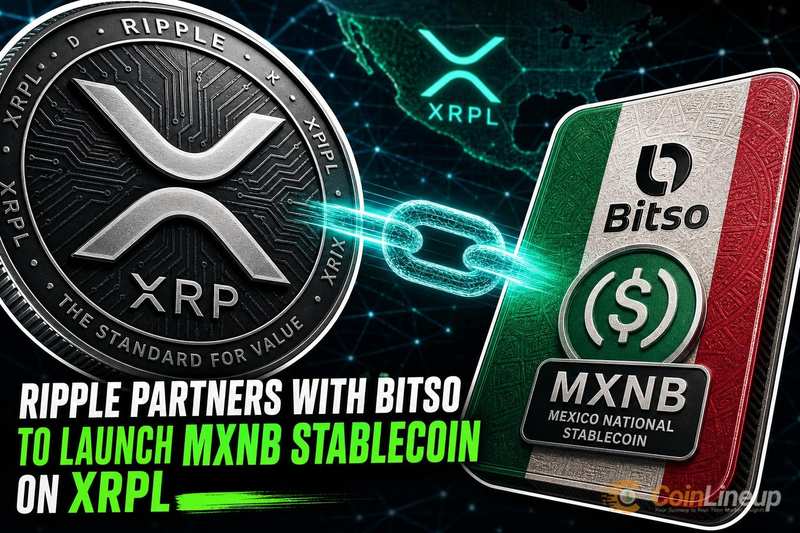
Ripple has partnered with Bitso to launch the MXNB stablecoin on the XRP Ledger, positioning the peso-linked token as a tool for enterprise payment settlement in Latin America.
The announcement, disclosed through a BusinessWire press release, frames the collaboration as an expansion of an existing relationship between the two companies. Ripple, the blockchain infrastructure firm behind the XRP Ledger, and Bitso, one of Latin America’s largest crypto platforms, are directing MXNB specifically toward payments rather than speculative trading.
What the Ripple-Bitso MXNB Partnership Involves
MXNB is a Mexican peso-linked stablecoin built on XRPL. The token is designed for enterprise stablecoin settlement, according to the announcement. This places it within a growing category of fiat-pegged tokens aimed at cross-border and domestic payment rails.
Ripple has previously worked with Bitso on payment corridor infrastructure, as documented in a Ripple case study on the partnership. The MXNB launch represents a deepening of that relationship, moving from general payment facilitation to issuing a dedicated stablecoin on-chain.
The choice of XRPL as the settlement layer is notable. The XRP Ledger supports permissioned decentralized exchange functionality, which could allow regulated entities to interact with MXNB within compliance frameworks. This comes as broader institutional interest in tokenized assets grows, with firms like Citigroup exploring tokenized shares for institutional clients.
Why a Peso-Linked Stablecoin on XRPL Matters for Payments
Most stablecoin activity to date has centered on dollar-pegged tokens like USDT and USDC. A peso-denominated stablecoin on XRPL opens a different corridor, one where senders and receivers can settle in local currency without intermediate conversion steps.
The payments framing is deliberate. Rather than positioning MXNB as a trading pair or DeFi primitive, Ripple and Bitso are targeting settlement use cases. This aligns with how XRP has historically been positioned in the payments infrastructure layer.
Latin America represents one of the more active regions for crypto-based remittances and cross-border transfers. A stablecoin pegged to the Mexican peso, issued by a regulated platform like Bitso, could serve as a more direct on-ramp for businesses settling in pesos without relying on dollar-denominated intermediaries.
What to Watch After the MXNB Launch
The announcement leaves several implementation details unaddressed. Rollout timing, initial supported corridors, and integration partners beyond Bitso have not been specified in the press release.
Readers tracking MXNB adoption should watch for concrete signals: which payment processors or banks integrate the token, what transaction volumes emerge in the first months, and whether regulatory frameworks in key Latin American markets accommodate or restrict its use.
Ripple confirmed the partnership through its official X account. The company did not disclose projected adoption targets or specific launch dates for MXNB availability on Bitso’s platform.
Disclaimer: This article is for informational purposes only and does not constitute financial or investment advice. Cryptocurrency and digital asset markets carry significant risk. Always do your own research before making decisions.

About the author

Ripple Partners With Bitso to Launch MXNB Stablecoin on XRPL
Ripple has partnered with Bitso to launch the MXNB stablecoin on the XRP Ledger, framing the peso-linked token around payments and blockchain settlement use.
BitMine Nears 5% ETH Target as Tom Lee Signals Slower Buying Pace
BitMine is approaching its 5% ETH accumulation target while Tom Lee signals a slower buying pace. Here is what the shift could mean for Ethereum and market watchers.

Delaware and New Jersey Advance Crypto ATM Ban Bills
Delaware and New Jersey are moving forward with crypto ATM ban bills, signaling tougher state scrutiny of kiosk operators, fraud risks, and compliance standards.

Kalshi Adds Solana Perpetual Futures as DOGE, SHIB Await Approval
Kalshi launches Solana perpetual futures while DOGE and SHIB contracts await approval, signaling broader interest in crypto derivatives.

CME Launches Nasdaq Crypto Index Futures for BTC, ETH, XRP, SOL
CME has launched cash-settled Nasdaq crypto index futures tied to Bitcoin, Ethereum, XRP and SOL. Here’s what the new contracts cover and why the rollout matters.

Humanity Protocol’s H Token Falls 83% After Reported $30M Private Key Breach
Humanity Protocol's H token plunged 83% after a reported $30 million private key breach. Here is the core incident, market reaction, and what it means next.
Related

Citigroup to Offer Tokenized Private Shares to Wealthy Clients: WSJ
Citigroup is reportedly preparing tokenized private share offerings for wealthy clients, signaling deeper Wall Street interest in blockchain-based private markets.

Binance’s Philippines Return Faces BSP License Gap Warning
Binance's reported Philippines return faces scrutiny over a BSP license gap, with the core issue centered on regulatory compliance, market access, and local risk warnings.
BitMine Nears 5% ETH Target as Tom Lee Signals Slower Buying Pace
BitMine is approaching its 5% ETH accumulation target while Tom Lee signals a slower buying pace. Here is what the shift could mean for Ethereum and market watchers.
Delaware and New Jersey Advance Crypto ATM Ban Bills
Delaware and New Jersey are moving forward with crypto ATM ban bills, signaling tougher state scrutiny of kiosk operators, fraud risks, and compliance standards.

OpenAI Token Price Cuts Could Intensify Its Battle With Anthropic
OpenAI is reportedly weighing major token price cuts to win back users from Anthropic. Here is the SEO outline focused on pricing pressure, market impact, and what users should watch next.

Nigeria Senate Advances Crypto Regulation Bill to License Exchanges
Nigeria's Senate is advancing a crypto regulation bill focused on licensing exchanges. Here is the SEO outline covering the bill, scope, and industry impact.