


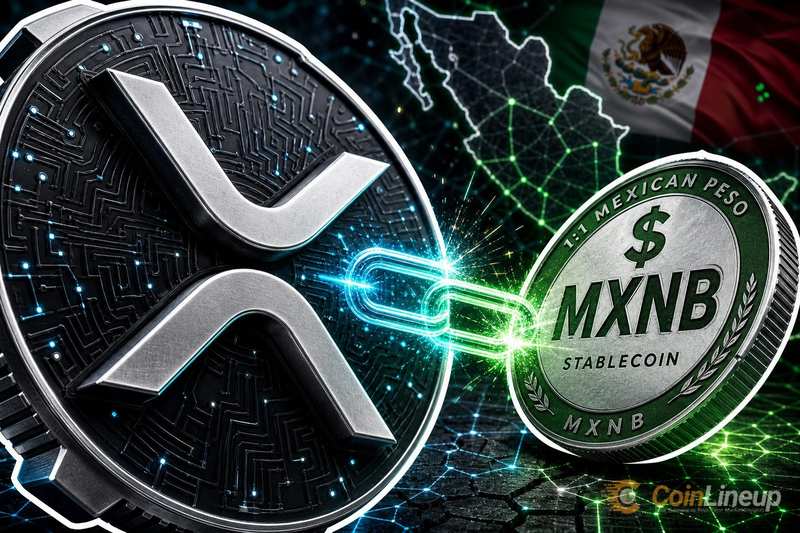
Ripple and Bitso are expanding their long-standing payments partnership to bring Bitso’s MXN-backed stablecoin, MXNB, to the XRP Ledger. The move integrates MXNB into Ripple’s permissioned decentralized exchange infrastructure, targeting enterprise liquidity and cross-border settlement across the U.S.-Mexico corridor.
What Ripple and Bitso Announced
Ripple said on June 11, 2026 that Bitso’s regulated MXNB stablecoin will be issued on the XRP Ledger and integrated into Ripple’s Payments on Decentralized Exchange infrastructure. MXNB will work alongside RLUSD to support enterprise liquidity and settlement flows for cross-border payments between the United States and Mexico.
MXNB is pegged 1:1 to the Mexican peso and is issued by Juno, a Bitso company. The stablecoin already transacts on Arbitrum, Ethereum, and Avalanche, making the XRPL integration a network expansion rather than MXNB’s first issuance.
Ripple says Bitso serves more than 10 million users and works with over 2,000 institutional clients, giving the partnership meaningful distribution scale on both the retail and enterprise sides.
Why MXNB on the XRP Ledger Matters
The XRPL’s permissioned DEX allows regulated businesses to trade onchain with vetted counterparties through credentialed access and permissioned domains. This compliance-focused architecture aligns MXNB’s launch with institutional settlement rather than open retail liquidity pools.
Pairing MXNB with Ripple’s existing RLUSD stablecoin creates a direct peso-dollar settlement rail on a single ledger. For enterprises moving funds across the U.S.-Mexico corridor, this could reduce the number of intermediaries and settlement steps compared to traditional correspondent banking.
Bitso’s institutional client base of over 2,000 organizations suggests the integration is aimed at businesses that already use Bitso for cross-border payments, not speculative retail traders. The enterprise-settlement focus distinguishes this from the broader stablecoin ecosystem competition playing out across other chains.
MXNB’s existing presence on Arbitrum, Ethereum, and Avalanche means the stablecoin already has multi-chain infrastructure in place. Adding XRPL extends its reach into a network purpose-built for payments and cross-currency settlement, which could strengthen its positioning against peso-denominated alternatives.
What the Partnership Expansion Signals for the Crypto Sector
The announcement frames the MXNB integration as a partnership expansion, not a standalone product launch. Ripple and Bitso have worked together on cross-border payments for years, and the stablecoin addition builds on that existing infrastructure rather than starting from scratch.
Ripple describes MXNB as operating under strict stablecoin regulations with AML and KYC controls, a positioning that reflects the broader industry push toward regulated stablecoin issuance. As institutional crypto infrastructure continues to mature, compliance-native stablecoins could become a requirement rather than a differentiator for enterprise adoption.
The move also strengthens the XRP Ledger’s stablecoin roster. With RLUSD already on the network, MXNB adds a second fiat-backed stablecoin and opens a direct peso-dollar pair within the permissioned DEX. That gives XRPL a concrete use case in one of the highest-volume remittance corridors in the world.
XRP traded at $1.14 at press time, up roughly 2.5% over the past 24 hours, with a market cap near $71 billion. The broader crypto market sentiment remained cautious, with the Fear and Greed Index sitting at 12, deep in “Extreme Fear” territory.
Whether the MXNB integration drives meaningful settlement volume on XRPL will depend on enterprise adoption rates and how effectively the permissioned DEX handles real-world liquidity demands. The infrastructure is now in place; usage data in the coming months will determine whether the corridor bet pays off.
Disclaimer: This article is for informational purposes only and does not constitute financial or investment advice. Cryptocurrency and digital asset markets carry significant risk. Always do your own research before making decisions.

About the author


Ripple and Bitso Bring MXNB Stablecoin to XRP Ledger
Ripple and Bitso are expanding their partnership to bring the MXNB stablecoin to the XRP Ledger. Here is what the move could mean for XRPL users.
Seized Alameda Funds Move to Coinbase Prime: What It Signals
Seized Alameda funds have moved to Coinbase Prime. This outline focuses on what moved, why the transfer matters, and what crypto market watchers should monitor next.
Ripple Partners With Bitso to Launch MXNB Stablecoin on XRPL
Ripple has partnered with Bitso to launch the MXNB stablecoin on the XRP Ledger, framing the peso-linked token around payments and blockchain settlement use.
BitMine Nears 5% ETH Target as Tom Lee Signals Slower Buying Pace
BitMine is approaching its 5% ETH accumulation target while Tom Lee signals a slower buying pace. Here is what the shift could mean for Ethereum and market watchers.

Delaware and New Jersey Advance Crypto ATM Ban Bills
Delaware and New Jersey are moving forward with crypto ATM ban bills, signaling tougher state scrutiny of kiosk operators, fraud risks, and compliance standards.

Kalshi Adds Solana Perpetual Futures as DOGE, SHIB Await Approval
Kalshi launches Solana perpetual futures while DOGE and SHIB contracts await approval, signaling broader interest in crypto derivatives.
Related
Seized Alameda Funds Move to Coinbase Prime: What It Signals
Seized Alameda funds have moved to Coinbase Prime. This outline focuses on what moved, why the transfer matters, and what crypto market watchers should monitor next.

U.S. Treasury Expands Iran Crypto Sanctions to Procurement Networks
The U.S. Treasury has widened Iran-related crypto sanctions to cover procurement networks, raising fresh compliance and enforcement questions for digital asset platforms and market participants.

Coinbase launches Coinbase for Agents for AI trading
Coinbase has launched Coinbase for Agents, a new push into AI trading and portfolio management. Here is what the product does, why it matters, and what to watch next.
Ripple Partners With Bitso to Launch MXNB Stablecoin on XRPL
Ripple has partnered with Bitso to launch the MXNB stablecoin on the XRP Ledger, framing the peso-linked token around payments and blockchain settlement use.

Citigroup to Offer Tokenized Private Shares to Wealthy Clients: WSJ
Citigroup is reportedly preparing tokenized private share offerings for wealthy clients, signaling deeper Wall Street interest in blockchain-based private markets.

Binance’s Philippines Return Faces BSP License Gap Warning
Binance's reported Philippines return faces scrutiny over a BSP license gap, with the core issue centered on regulatory compliance, market access, and local risk warnings.