


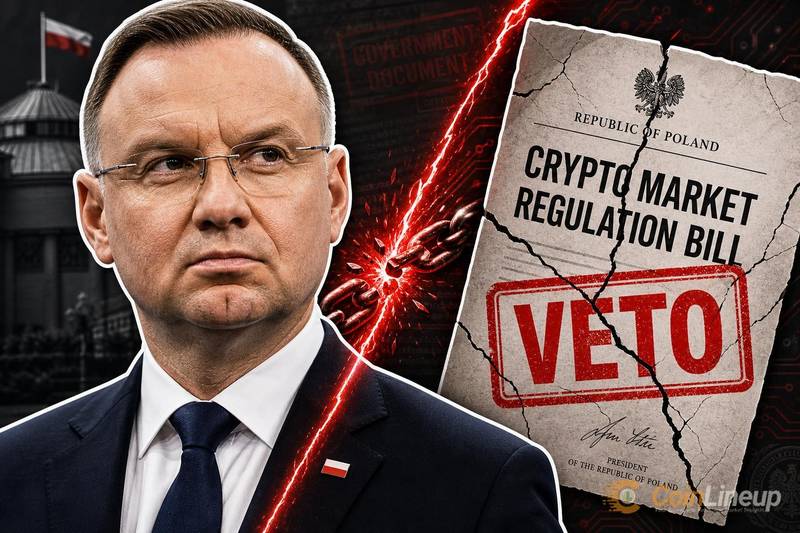

Poland’s president has vetoed a crypto market regulation bill for the third time, extending a pattern of executive resistance that leaves the country’s digital asset framework in limbo.
Third Presidential Block Stalls Poland’s Crypto Framework
The Polish president rejected the crypto market regulation bill again, according to the presidential office. The veto, the third of its kind, prevents the legislation from advancing in its current form and sends it back to the legislative process.
The bill aimed to establish a domestic regulatory framework for crypto assets, covering licensing requirements, compliance obligations, and operating rules for exchanges and other digital asset service providers. Previous vetoes were also documented on the presidential website, confirming this is a sustained pattern rather than a one-off disagreement.
The repeated rejection is notable against the backdrop of the EU’s Markets in Crypto-Assets (MiCA) regulation, which Poland, as a member state, is expected to implement. A February 2026 legal analysis highlighted the tension between Poland’s stalled domestic legislation and its MiCA obligations.
What the Stalemate Means for Crypto Firms in Poland
Without a clear regulatory framework, crypto exchanges, brokers, and service providers operating in Poland face prolonged uncertainty over licensing and compliance requirements. Businesses that had been preparing for new rules must now reassess their timelines.
The lack of regulatory clarity can also weigh on investor confidence. As institutional capital increasingly moves into digital assets across Europe, Poland risks falling behind neighboring EU states that have already aligned their domestic laws with MiCA.
For firms focused on compliance and regulatory alignment, the repeated vetoes signal that Poland’s policy environment remains unpredictable. This could push crypto businesses to establish operations in jurisdictions with more settled frameworks.
What Comes Next
Polish lawmakers now face a decision: revise the bill to address the president’s objections, attempt to override the veto with a sufficient parliamentary majority, or pursue an alternative legislative approach entirely.
The veto extends the timeline for any new crypto market rules tied to this specific bill. Industry participants will watch closely for signals on whether a compromise version can advance, particularly given the pressure from EU-level MiCA deadlines.
The situation also raises questions about broader digital asset oversight and enforcement in Poland. Until the legislative impasse is resolved, the country’s crypto sector operates without the dedicated regulatory architecture that the bill was designed to provide.
Disclaimer: This article is for informational purposes only and does not constitute financial or investment advice. Cryptocurrency and digital asset markets carry significant risk. Always do your own research before making decisions.

About the author

Poland President Vetoes Crypto Market Regulation Bill for Third Time
Poland's president has vetoed a crypto market regulation bill for the third time, raising fresh questions about oversight, compliance, and the country's digital asset policy path.

Ripple and Bitso Bring MXNB Stablecoin to XRP Ledger
Ripple and Bitso are expanding their partnership to bring the MXNB stablecoin to the XRP Ledger. Here is what the move could mean for XRPL users.
Seized Alameda Funds Move to Coinbase Prime: What It Signals
Seized Alameda funds have moved to Coinbase Prime. This outline focuses on what moved, why the transfer matters, and what crypto market watchers should monitor next.

Ripple Partners With Bitso to Launch MXNB Stablecoin on XRPL
Ripple has partnered with Bitso to launch the MXNB stablecoin on the XRP Ledger, framing the peso-linked token around payments and blockchain settlement use.
BitMine Nears 5% ETH Target as Tom Lee Signals Slower Buying Pace
BitMine is approaching its 5% ETH accumulation target while Tom Lee signals a slower buying pace. Here is what the shift could mean for Ethereum and market watchers.

Delaware and New Jersey Advance Crypto ATM Ban Bills
Delaware and New Jersey are moving forward with crypto ATM ban bills, signaling tougher state scrutiny of kiosk operators, fraud risks, and compliance standards.
Related

Binance’s Philippines Return Faces BSP License Gap Warning
Binance's reported Philippines return faces scrutiny over a BSP license gap, with the core issue centered on regulatory compliance, market access, and local risk warnings.
Delaware and New Jersey Advance Crypto ATM Ban Bills
Delaware and New Jersey are moving forward with crypto ATM ban bills, signaling tougher state scrutiny of kiosk operators, fraud risks, and compliance standards.

OpenAI Token Price Cuts Could Intensify Its Battle With Anthropic
OpenAI is reportedly weighing major token price cuts to win back users from Anthropic. Here is the SEO outline focused on pricing pressure, market impact, and what users should watch next.

Coinbase, Ripple and 200+ Crypto Firms Urge Senate on CLARITY Act
Coinbase, Ripple and more than 200 crypto firms are pressing the Senate to act on the CLARITY Act. Here is what the push means for U.S. crypto regulation.

Top Crypto News for June 6: Bitcoin Selling Pressure Beyond Saylor Sale
A June 6 crypto news roundup focused on Bitcoin, trader reaction to Saylor's 32 BTC sale, and why broader selling pressure may matter more.

Helium CEO Amir Haleem Steps Down: What It Means for Helium
Helium CEO Amir Haleem is stepping down. Explore what the leadership change means for Helium, its network direction, and the wider crypto market.