


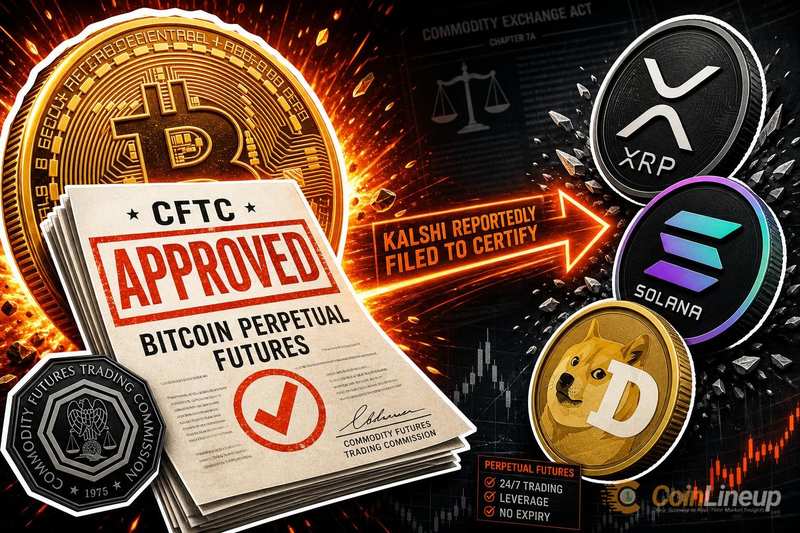
Kalshi has reportedly filed to certify perpetual futures contracts tied to XRP, Solana and Dogecoin, a move that follows the prediction market platform’s earlier Bitcoin-related approval from the Commodity Futures Trading Commission.
What Kalshi reportedly filed after Bitcoin approval
According to filings listed on the CFTC’s trading organization products page, Kalshi reportedly submitted certification documents for perpetual futures contracts linked to three major altcoins: XRP, Solana and Dogecoin.
The filings appear to build on Kalshi’s earlier success in securing approval for Bitcoin-related products. Separate certification documents filed with the CFTC outline the proposed perpetual futures contracts, though the exact timeline for regulatory review remains unclear.
Kalshi, best known as a CFTC-regulated event contracts platform, has been expanding its product lineup into crypto derivatives. The reported filing for altcoin perpetual futures represents a notable step beyond its initial Bitcoin offerings.
Why XRP, Solana and Dogecoin perpetual futures matter
Perpetual futures are derivative contracts that let traders speculate on an asset’s price without an expiration date. Unlike traditional futures that settle on a fixed date, perpetuals use a funding rate mechanism to keep contract prices close to the underlying spot price.
The choice of XRP, Solana and Dogecoin is notable. All three rank among the most actively traded cryptocurrencies, and each carries a distinct market profile, from cross-border payments to high-throughput smart contracts to meme-driven retail speculation.
Offering perpetual futures on these assets through a CFTC-regulated venue would give U.S. traders access to products that have historically been available only on offshore exchanges. This distinction matters at a time when regulatory clarity around crypto derivatives remains a central concern, similar to the scrutiny surrounding large institutional movements in Bitcoin ETF products.
What the reported filing could mean for Kalshi and crypto markets
A certification filing is a procedural step, not an approval. Under CFTC rules, a designated contract market can self-certify new products, but the commission retains the authority to review and potentially stay the listing if it finds the product does not comply with the Commodity Exchange Act.
If the contracts ultimately launch, Kalshi would join a small group of regulated U.S. platforms offering crypto perpetual futures. The development arrives alongside growing institutional interest in digital assets, as illustrated by recent large-scale ETH accumulation by firms like Bitmine.
For traders monitoring the expanding landscape of regulated crypto products in the United States, Kalshi’s reported altcoin filings add another data point to a broader trend. The outcome may also carry implications for how platforms approach novel token-linked derivatives, a space that has drawn attention since events like the rediscovery of dormant Ethereum assets highlighted the evolving nature of on-chain finance.
Disclaimer: This article is for informational purposes only and does not constitute financial or investment advice. Cryptocurrency and digital asset markets carry significant risk. Always do your own research before making decisions.

About the author

Kalshi Reportedly Filed to Certify XRP, Solana and Dogecoin Perpetual Futures After Bitcoin Approval
Kalshi reportedly moved to certify XRP, Solana and Dogecoin perpetual futures after its Bitcoin-related approval. Here is what the filing could signal for crypto traders and prediction-style markets.

Mystery Whale Pays $30M to Exit BlackRock Bitcoin ETF — What It Means
A mystery whale paid $30 million to exit BlackRock's Bitcoin ETF (IBIT). Here's what the on-chain data reveals and what it signals for institutional Bitcoin flows.
Kraken Eyes CFTC-Regulated Bitcoin Perpetuals After Kalshi Ruling
Kraken is preparing CFTC-regulated Bitcoin perpetuals after the CFTC cleared a Kalshi contract, signaling a potential shift for US crypto derivatives.

UK Applies Sanctioned-Bank Treatment to Crypto Network Over $90B Claim
The UK has moved to treat a crypto network like a sanctioned bank after allegations it processed $90 billion tied to Russia-linked activity. Here is the core SEO outline.

Bitcoin Perps Get US Green Light, but One Catch Could Decide What Happens Next
Bitcoin perpetual futures have a US green light, but one unresolved catch could shape trader access, liquidity, and the market response.

Coinbase Opens Regulated Deribit Options for U.S. Institutions
Coinbase has opened access to regulated Deribit options for U.S. institutions, expanding institutional crypto derivatives access and market reach.
Related

Failed 2016 Ethereum ICO Unlocks 1,003 ETH Through Self-Exploit
A failed 2016 Ethereum ICO has recovered 1,003 ETH through a self-exploit. Here’s what happened, how the unlock worked, and why it matters.

Bitmine Bought 26,497 ETH Last Week, Raising Holdings to 5.42M ETH
Bitmine added 26,497 ETH last week, lifting total holdings to 5.42M ETH. Here is what the latest accumulation means for Ethereum exposure and market attention.
UK Applies Sanctioned-Bank Treatment to Crypto Network Over $90B Claim
The UK has moved to treat a crypto network like a sanctioned bank after allegations it processed $90 billion tied to Russia-linked activity. Here is the core SEO outline.
How Crypto Started Reshaping American Elections
Explore the turning point when crypto began reshaping American elections, why it mattered politically, and what it signals for digital asset influence in U.S. campaigns.
Messari: XRP Ledger Activity Rose 35% Despite XRP Price Slump
A Messari report says XRP Ledger activity climbed 35% even as XRP price weakened. Here’s what the data suggests about XRPL usage, network traction, and market sentiment.

Dash Says Crypto Forgot Its Original Killer App: Digital Cash
Dash argues crypto has drifted from its original purpose and says digital cash still matters most for real-world payments and adoption.