



Visa has added Polygon to its global stablecoin settlement program, expanding the number of blockchain networks available for processing payments through its infrastructure. The move is part of a broader push by the payments giant to accelerate stablecoin-based settlement across multiple chains.
What Visa Changed in Its Stablecoin Settlement Program
Visa announced that it is adding five blockchains to its stablecoin settlement infrastructure, with Polygon among the newly supported networks. The expansion builds on the company’s existing program, which already facilitated settlements using stablecoins on select chains, according to Visa’s investor relations announcement.
The additions are infrastructure upgrades rather than consumer-facing product launches. Settlement, in this context, refers to the back-end process of finalizing transactions between financial institutions, not retail crypto trading or speculation.
Adding a network to a global settlement program matters because it creates new routing options for stablecoin-denominated payments. Each supported chain gives Visa’s partner institutions an additional rail for moving value, reducing dependency on any single blockchain and building redundancy into the settlement layer.
Why Polygon Matters to Visa’s Blockchain Strategy
Polygon’s inclusion signals that Visa is prioritizing networks with low transaction costs and high throughput for settlement purposes. This is a technical infrastructure decision about which rails can reliably move value at scale, not a token endorsement.
The timing aligns with Visa’s Q2 earnings period, during which the company’s earnings call highlighted growing momentum in its digital payments strategy. The choice to widen blockchain support during an earnings cycle suggests Visa sees measurable business value in multi-chain settlement.
For Polygon specifically, inclusion in Visa’s program validates the network’s utility beyond DeFi trading. It suggests that institutional players view Polygon’s architecture as suitable for high-volume, compliance-grade financial operations, a different benchmark than the legislative developments or debates over censorship resistance that typically dominate crypto headlines.
What the Move Signals for Stablecoin Payments
A payments company of Visa’s scale adding blockchain settlement options reinforces a clear trend: stablecoins are moving from experimental territory into operational payment infrastructure. Reporting from PYMNTS noted that stablecoin settlement volume has surged, providing the business case for Visa’s expansion.
The program’s growth also reflects how traditional finance increasingly views blockchain technology as plumbing, a settlement layer that operates behind the scenes while existing payment products remain the customer-facing interface. For readers following the CLARITY Act debate and Wall Street’s stablecoin concerns, Visa’s infrastructure buildout shows companies are not waiting for regulatory certainty before committing resources.
Visa has not disclosed the specific stablecoin assets or settlement volumes flowing through the newly added chains. Until those details emerge, the announcement is best understood as a directional signal: one of the world’s largest payment networks is actively building multi-chain stablecoin settlement into its core infrastructure.
Disclaimer: This article is for informational purposes only and does not constitute financial or investment advice. Cryptocurrency and digital asset markets carry significant risk. Always do your own research before making decisions.


About the author


Ripple and Bitso Bring MXNB Stablecoin to XRP Ledger
Ripple and Bitso are expanding their partnership to bring the MXNB stablecoin to the XRP Ledger. Here is what the move could mean for XRPL users.
Seized Alameda Funds Move to Coinbase Prime: What It Signals
Seized Alameda funds have moved to Coinbase Prime. This outline focuses on what moved, why the transfer matters, and what crypto market watchers should monitor next.
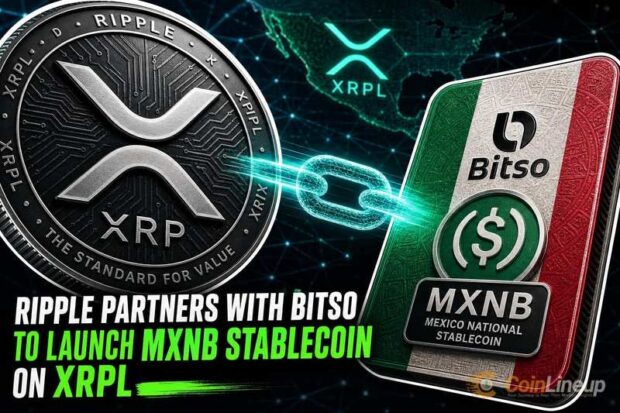
Ripple Partners With Bitso to Launch MXNB Stablecoin on XRPL
Ripple has partnered with Bitso to launch the MXNB stablecoin on the XRP Ledger, framing the peso-linked token around payments and blockchain settlement use.
BitMine Nears 5% ETH Target as Tom Lee Signals Slower Buying Pace
BitMine is approaching its 5% ETH accumulation target while Tom Lee signals a slower buying pace. Here is what the shift could mean for Ethereum and market watchers.

Delaware and New Jersey Advance Crypto ATM Ban Bills
Delaware and New Jersey are moving forward with crypto ATM ban bills, signaling tougher state scrutiny of kiosk operators, fraud risks, and compliance standards.

Kalshi Adds Solana Perpetual Futures as DOGE, SHIB Await Approval
Kalshi launches Solana perpetual futures while DOGE and SHIB contracts await approval, signaling broader interest in crypto derivatives.
Related

SEC Proposal to Scrap NMS Rules 611 and 610(e) Could Reshape Tokenized U.S. Stock Trading in DeFi
Analyze how a proposed SEC rollback of NMS Rules 611 and 610(e) could influence tokenized U.S. stock trading in DeFi, market structure, and crypto platform strategy.
Ripple and Bitso Bring MXNB Stablecoin to XRP Ledger
Ripple and Bitso are expanding their partnership to bring the MXNB stablecoin to the XRP Ledger. Here is what the move could mean for XRPL users.
Seized Alameda Funds Move to Coinbase Prime: What It Signals
Seized Alameda funds have moved to Coinbase Prime. This outline focuses on what moved, why the transfer matters, and what crypto market watchers should monitor next.

U.S. Treasury Expands Iran Crypto Sanctions to Procurement Networks
The U.S. Treasury has widened Iran-related crypto sanctions to cover procurement networks, raising fresh compliance and enforcement questions for digital asset platforms and market participants.

Coinbase launches Coinbase for Agents for AI trading
Coinbase has launched Coinbase for Agents, a new push into AI trading and portfolio management. Here is what the product does, why it matters, and what to watch next.
Ripple Partners With Bitso to Launch MXNB Stablecoin on XRPL
Ripple has partnered with Bitso to launch the MXNB stablecoin on the XRP Ledger, framing the peso-linked token around payments and blockchain settlement use.