


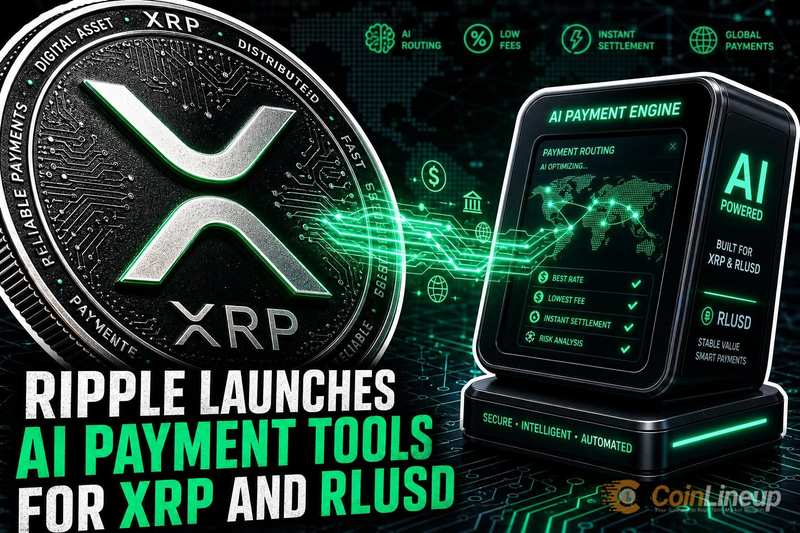
Ripple is rolling out AI payment tools designed to work with XRP and its RLUSD stablecoin, positioning the company at the intersection of agentic commerce and blockchain-based settlement.
The move appears to center on enabling AI agents to initiate and settle payments autonomously using XRP Ledger infrastructure. Ripple has published an XRPL AI Starter Kit that provides developers with tools to build AI-driven payment applications on the ledger.
Separately, XRPL documentation now includes references to agentic transactions, a framework for software agents to execute payments without direct human intervention at each step. The distinction matters: this is not simply an AI chatbot layer but a toolkit for machine-to-machine payment flows.
It is worth noting that the full product scope and rollout timeline remain partially verified. The details below reflect what can be confirmed from published Ripple and XRPL materials, not leaked or speculative feature lists.
Why both XRP and RLUSD appear in the same product framing
The pairing of XRP with RLUSD suggests complementary roles rather than redundancy. XRP has historically served as a bridge asset for cross-border settlement, while RLUSD is Ripple’s dollar-pegged stablecoin designed for value stability during transactions.
In an AI-driven payment flow, this two-asset structure could allow agents to hold value in RLUSD for predictability while using XRP for fast settlement or liquidity bridging. The combination addresses a practical problem: autonomous agents need both a stable unit of account and an efficient settlement rail.
This approach differs from single-token payment systems. Unlike tokens that have experienced sharp volatility from concentrated whale activity, a dual-asset design separates the settlement function from the value-storage function. Ripple’s architecture implies the company is building for use cases where price stability and settlement speed are both critical, such as automated invoice payments or machine-initiated supply chain settlements.
AI payments as a broader industry trend
Ripple is not operating in isolation. Mastercard launched Agent Pay in June 2026, a product explicitly designed for machine-initiated transactions. The parallel timing suggests that AI-driven payments are moving from concept to product across both traditional finance and crypto infrastructure.
For Ripple, the strategic value is clear. The company has spent years building cross-border payment rails. Adding an AI agent layer positions XRP Ledger as infrastructure not just for human-initiated transfers but for the emerging category of autonomous commerce, where software agents negotiate, authorize, and settle payments independently.
The crypto industry has seen multiple projects attempt to merge AI and blockchain, with varying results. As regulatory frameworks tighten globally, tools that emphasize compliance-ready payment flows may carry more weight than experimental AI token projects. Developments like institutional custody upgrades also signal that infrastructure maturity is becoming a competitive differentiator.
Readers should watch for concrete adoption signals: developer uptake of the XRPL AI Starter Kit, live integrations with payment processors, and whether RLUSD sees measurable volume growth tied to agentic use cases. Until those metrics materialize, the announcement represents a strategic positioning play rather than a proven product shift.
Disclaimer: This article is for informational purposes only and does not constitute financial or investment advice. Cryptocurrency and digital asset markets carry significant risk. Always do your own research before making decisions.

About the author

Ripple launches AI payment tools for XRP and RLUSD
Ripple is launching AI payment tools tied to XRP and RLUSD. Here is what the move appears to involve, how the assets may fit together, and why it matters.

Grayscale Updates NEAR ETF Filing With BitGo Custody Details
Grayscale has updated its NEAR ETF filing to include BitGo custody details. Here is what changed, why the amendment matters, and what it could signal for NEAR investors.

Best Crypto to Buy Now: BlockDAG, Near Protocol, Render, and Worldcoin Build Serious Momentum
Evaluating top assets? Discover how Near, Render, and Worldcoin perform alongside BlockDAG, which offers uncapped liquidity to stand out as the best crypto to buy now.

ZachXBT Traces $120.2M USDT Flows as Tether Freezes $72M
ZachXBT traced $120.2M in USDT flows tied to an XMR surge, while Tether froze $72M in USDT. Here is the key timeline, on-chain focus, and market context.

BlackRock Files SEC Registration for Bitcoin Income ETF
BlackRock has filed SEC registration paperwork for a Bitcoin income ETF. Here is what the filing says, how the product may work, and why it matters.

U.S. Treasury Expands Iran Crypto Sanctions to Procurement Networks
The U.S. Treasury has widened Iran-related crypto sanctions to cover procurement networks, raising fresh compliance and enforcement questions for digital asset platforms and market participants.
Related

Zimbabwe Brings Crypto Firms Under RBZ Oversight in New AML Rules
Zimbabwe is bringing crypto firms under RBZ oversight through new AML rules, signaling tighter compliance requirements for the country’s digital asset sector.
Grayscale Updates NEAR ETF Filing With BitGo Custody Details
Grayscale has updated its NEAR ETF filing to include BitGo custody details. Here is what changed, why the amendment matters, and what it could signal for NEAR investors.

Blockworks Acquires Messari: What the Deal Means for Crypto Media and Research
Blockworks acquires Messari in a deal that could reshape crypto media, research, and market intelligence. Here’s what the acquisition may mean.

Tennessee Man Charged in Alleged $1.9M Crypto Ponzi Scheme
A Tennessee man is facing federal charges tied to an alleged $1.9 million crypto Ponzi scheme. Here is what the case alleges, what investors need to know, and why it matters.
Seychelles Court Orders KuCoin Entities to Pay Swiss Investor Over $2M
A Seychelles court has ordered KuCoin entities to pay a Swiss investor more than $2 million, putting fresh legal pressure on the crypto exchange.

Poland President Vetoes Crypto Market Regulation Bill for Third Time
Poland's president has vetoed a crypto market regulation bill for the third time, raising fresh questions about oversight, compliance, and the country's digital asset policy path.