



- AI investment heavily relies on self-financing, challenging expectations.
- Hyperscalers maintain debt-to-cash ratios below zero.
- Focus remains on traditional tech sectors over cryptocurrencies.
AI-related spending primarily stems from companies’ cash flow rather than excessive debt. Despite surging capital expenditures, many AI firms maintain low debt-to-cash-flow ratios, underscoring continued reliance on internal funds.
AI spending shows a primary reliance on internal cash flow, rather than debt as hypothesized by some economists. Current trends defy speculation on rising debt levels, affecting financial markets significantly.
Economic analyses reveal variations in AI financing strategies, emphasizing effects on broader markets and investment behaviors. Analysts highlight AI firms’ substantial internal funding over debt-fueled growth, countering past debt-laden cycles like the dot-com boom.
Financing AI’s Capex Needs
Hyperscalers’ cash flows predominantly finance their capex needs, with debt remaining minuscule compared to the 1990s dot-com era. Companies uphold strong cash reserves, dampening concerns over potential financial bubbles.
“Capex outpaces cash flows; private credit to AI firms could hit $300–600bn by 2030.” – BIS Report
The Role of Traditional Tech and Cryptocurrencies
Current trends indicate negligible changes in cryptocurrency markets, reflecting primarily on traditional tech investments. AI-driven financial models continue evolving, navigated by internal resources more than external debt.
Stability and Fiscal Policy Implications
AI financing underscores market resilience, with potential implications for fiscal policy and innovation. Analysts foresee moderate stability risks due to AI firms’ mixed reliance on cash flow, bonds, and securitization, challenging preconceived market behaviors.


About the author


AI Key to Web3 Competitiveness, Says Gate CEO
Gate.io's CEO Dr. Han states AI will drive Web3's future, enhancing usability and integration.

Binance Initiates First Alpha Box Airdrop Event
Binance launches Alpha Box airdrop, starting at 18:00 UTC, requiring 242 points minimum.

Hong Kong SFC Introduces New Virtual Asset Regulations
Hong Kong's Securities and Futures Commission, led by CEO Julia Leung Fung-yee, announced new virtual asset regulations at Consensus 2026, introducing margin financing and perpetual contracts for select investors.

European Parliament Endorses Digital Euro With Dual Functionality
Pasquale Tridico and 48 EU lawmakers led the February 10, 2026 move in the European Parliament to endorse a digital euro proposal with online and offline capabilities.

Galaxy Digital CEO Predicts Decline in Cryptocurrency Speculation
Galaxy Digital's Mike Novogratz anticipates a shift from speculative to institutional investments in cryptocurrency.

Crypto.com CEO Acquires AI.com for $70 Million in Crypto
Crypto.com CEO Kris Marszalek acquired AI.com for $70 million in cryptocurrency. Unverified claims of a subsequent $500 million offer arise.
Related

CME Group launches 24/7 crypto futures trading
CME Group is moving crypto futures to 24/7 trading, ending its weekend closure and reshaping how traders react to nonstop digital asset markets.

UK Lords Warn Bank of England Caps Could Stifle Pound Stablecoins
UK lawmakers are warning that Bank of England limits on stablecoin holdings could weaken the case for pound-backed tokens and slow Britain’s digital asset ambitions.

Grayscale’s Hyperliquid Staking ETF to Begin Trading: What It Means
Grayscale's Hyperliquid Staking ETF is set to begin trading. Here is what the launch means, what to watch in the product structure, and why the market is paying attention.

Ripple Expands Washington, D.C., Office to Deepen U.S. Policy Ties
Ripple is expanding its Washington, D.C., office as it steps up engagement with U.S. policymakers and regulators amid evolving crypto oversight.

U.S. Treasury Sanctions Iranian Crypto Exchanges Nobitex, Bitpin, Ramzinex, and Wallex
The U.S. Treasury has sanctioned Nobitex, Bitpin, Ramzinex, and Wallex. Here is what the move means, why it matters, and what readers should watch next.
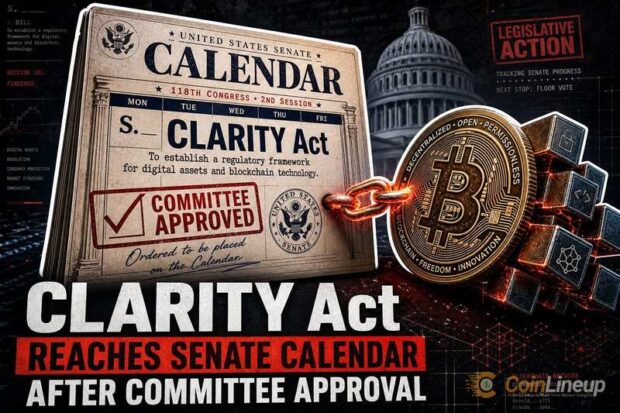
CLARITY Act Reaches Senate Calendar After Committee Approval
The CLARITY Act has advanced to the Senate Calendar following committee approval, marking a key procedural step for U.S. crypto legislation and setting up the next phase to watch.