



Bitcoin’s market capitalization now exceeds Switzerland’s annual GDP by more than $358 billion, a comparison that has been circulating across crypto media as a measure of just how large the network has become.
The claim is striking but requires context. Bitcoin’s market cap, the total value of all circulating BTC at the current spot price, sat at roughly $1.295 trillion in the latest data snapshot. Switzerland’s most recent annual GDP, as reported by the World Bank for 2024, came in at approximately $936.6 billion.
Why Bitcoin Is Being Compared With Switzerland’s GDP
Market capitalization measures the implied total value of an asset at its current price. GDP measures a country’s total economic output over a full year. The two metrics are fundamentally different: one is a stock (a snapshot of value at a moment in time), the other is a flow (cumulative production across twelve months).
That distinction matters. Saying “Bitcoin’s market cap is larger than Switzerland’s GDP” is not the same as saying Bitcoin produces more economic value than Switzerland does. The comparison works as a scale benchmark, a way to convey how large Bitcoin has become in terms familiar to mainstream audiences.
At its recent price of $64,611, BTC commanded a market cap roughly 38% larger than the Swiss economy’s annual output. The gap of more than $358 billion is wide enough that even moderate price swings would not close it quickly.
What the Milestone Says About Bitcoin’s Size in Global Markets
Bitcoin now sits in a weight class that invites comparison with national economies, sovereign wealth funds, and the largest publicly traded companies. That shift in framing, from niche digital token to macro-scale asset, has practical consequences for how institutions allocate capital.
Size-based comparisons influence investor perception. When an asset’s total value exceeds a well-known benchmark like Switzerland’s GDP, it reinforces the narrative that Bitcoin is a permanent fixture of global capital markets rather than a speculative experiment. Companies like SpaceX, which recently joined the ranks of major corporate Bitcoin holders, reflect that shift.
Bitcoin dominance across the broader crypto market stood at 56.6% at the time of the snapshot, underscoring its position as the flagship digital asset. When Bitcoin hits a symbolic milestone, the attention tends to spill across the entire sector.
None of this removes volatility risk. The Fear & Greed Index registered a score of 18, classified as Extreme Fear, even as BTC traded above $64,000. Scale and sentiment do not always move together.
Why This Matters for Traders, Media Narratives, and Crypto Sentiment
High-visibility comparisons like the Switzerland GDP benchmark tend to amplify bullish narratives. They provide media outlets, social accounts, and analysts with a ready-made hook that frames Bitcoin as an increasingly legitimate store of value.
That framing matters beyond headlines. Macro-style positioning can shape how policymakers and mainstream audiences view digital assets, potentially influencing regulatory posture and institutional adoption timelines. The way neobanks are beginning to integrate DeFi infrastructure is one example of how legitimacy narratives translate into product decisions.
For traders, symbolic milestones often coincide with shifts in volume and positioning. Bitcoin’s 24-hour trading volume was approximately $17.7 billion at the time of the data pull, with the price up 1.57% over the prior day. U.S. spot ETF inflows, which remained active through mid-June, provide a structural demand layer that did not exist during previous milestone moments.
The takeaway is practical: Bitcoin’s market cap exceeding a G20-adjacent economy’s GDP is not proof of stability, but it is evidence of scale that is increasingly difficult for institutional allocators and policymakers to dismiss.
Disclaimer: This article is for informational purposes only and does not constitute financial or investment advice. Cryptocurrency and digital asset markets carry significant risk. Always do your own research before making decisions.

About the author


Bitcoin’s Market Value Tops Switzerland’s GDP: Why the Comparison Matters
Bitcoin’s market value now rivals and exceeds Switzerland’s GDP in headline terms. Here’s what the comparison means for BTC, investors, and crypto markets.

Top Crypto News for June 13: Bitcoin Mining Difficulty Drop Leads 24H Update
A focused June 13 crypto news outline centered on Bitcoin's major mining difficulty drop, why it matters, and what traders should watch across the next 24 hours.

Ripple launches AI payment tools for XRP and RLUSD
Ripple is launching AI payment tools tied to XRP and RLUSD. Here is what the move appears to involve, how the assets may fit together, and why it matters.

Grayscale Updates NEAR ETF Filing With BitGo Custody Details
Grayscale has updated its NEAR ETF filing to include BitGo custody details. Here is what changed, why the amendment matters, and what it could signal for NEAR investors.

Best Crypto to Buy Now: BlockDAG, Near Protocol, Render, and Worldcoin Build Serious Momentum
Evaluating top assets? Discover how Near, Render, and Worldcoin perform alongside BlockDAG, which offers uncapped liquidity to stand out as the best crypto to buy now.
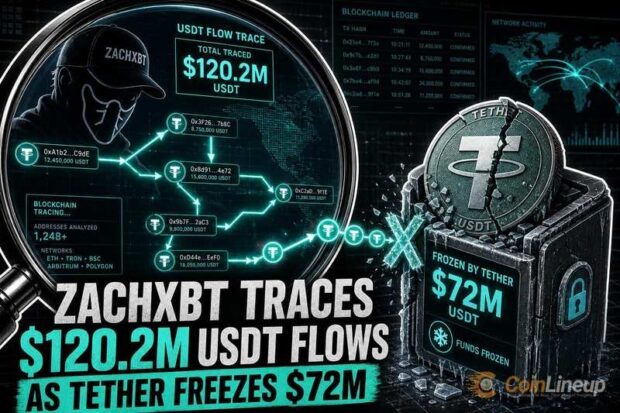
ZachXBT Traces $120.2M USDT Flows as Tether Freezes $72M
ZachXBT traced $120.2M in USDT flows tied to an XMR surge, while Tether froze $72M in USDT. Here is the key timeline, on-chain focus, and market context.
Related

SpaceX Becomes 8th Largest Bitcoin-Holding Company
SpaceX has climbed to the 8th-largest spot among Bitcoin-holding companies, adding a fresh corporate angle to the BTC market story.

BlackRock Files SEC Registration for Bitcoin Income ETF
BlackRock has filed SEC registration paperwork for a Bitcoin income ETF. Here is what the filing says, how the product may work, and why it matters.

BlackRock Updates Bitcoin Premium Income ETF Filing With Covered Calls
BlackRock has updated its filing for a Bitcoin Premium Income ETF with a covered-call strategy. Here is what changed and what it could mean.

Bernstein Says Bitcoin’s Quiet Cycle May Be Healthier Than It Looks
Bernstein argues Bitcoin's subdued cycle may signal resilience, not weakness. Here's the key thesis, the pressure points, and what investors should watch.

Saif Faiq Pleads Guilty in Bitcoin Kidnapping Plot, Faces Up to 20 Years
Saif Faiq pleads guilty in a Bitcoin kidnapping plot case and could face up to 20 years in prison. Here is what the plea means and what comes next.

Strategy Buys 1,550 Bitcoin as Cash Reserve Tops $1B
Strategy purchased 1,550 Bitcoin for $101.3 million, marking another treasury move as its cash reserve reaches the $1 billion milestone.