



Bitcoin’s latest bounce is running straight into a Federal Reserve ceiling, with policymakers holding rates at 3.50% to 3.75% and markets pricing almost no chance of cheaper money in the near term. The Bitcoin recovery Fed ceiling dynamic leaves BTC rebounding without the liquidity tailwind that has powered past rallies.
Why Bitcoin’s rebound is running into a Fed ceiling
On March 18, the FOMC kept the federal funds target range at 3-1/2 to 3-3/4 percent, citing elevated uncertainty over the economic outlook and additional risk from Middle East developments. The statement tied any further adjustments to incoming data, a signal that easing is conditional rather than imminent.
The “Fed ceiling” for Bitcoin is simple: when policy rates stay restrictive and real yields on cash and Treasuries remain elevated, the marginal dollar into risk assets shrinks. Bitcoin, as a long-duration, liquidity-sensitive asset, tends to advance fastest when the cost of money is falling, not when it is stuck.
That backdrop is visible in spot prices. Bitcoin traded at roughly $74,218 with a 24-hour change near 0.05%, a market cap of about $1.48 trillion, and daily volume around $44.8 billion, a recovery tape rather than a breakout.
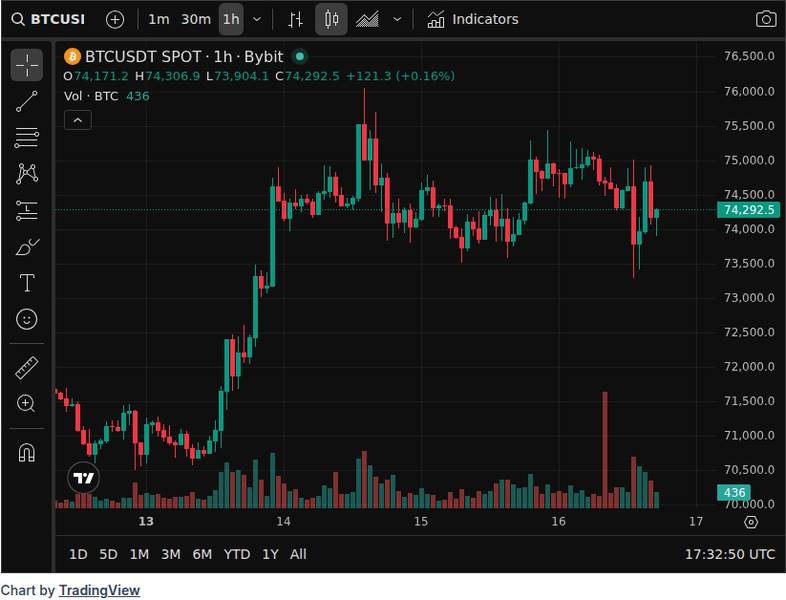
That price level sits inside the zone 21Shares strategist Matt Mena flagged as a key target, telling Cointelegraph that “the $73,000–$75,000 zone is our next major target.” The headline’s “no cheaper money” framing captures why BTC is capping out there rather than extending.
How fading rate-cut hopes are changing Bitcoin sentiment
The Fed’s March Summary of Economic Projections pinned the median 2026 federal funds rate at 3.4%, implying only limited easing from the current range midpoint. Policymakers still flag one additional cut this year, but Chair Jerome Powell signaled inflation concerns could keep policy on hold for an extended period.
Minutes from the March 17-18 meeting reinforced the shift, noting that the market-implied path of the federal funds rate had moved higher with expected easing pushed toward year-end. That is the opposite of the early-2026 setup traders were positioning for.
The near-term calendar confirms the repricing. CME FedWatch shows a 0% probability of an April cut and a 98.4% probability of no move, a reading that strips the rally of any imminent policy catalyst and pressures speculative demand that typically amplifies Bitcoin recoveries.
Sentiment data matches that positioning. The Fear and Greed Index printed 23, classified as Extreme Fear, even with BTC near its recent highs, a split that is consistent with a technical rebound rather than a liquidity-backed rally. Traders are participating, but not chasing, a pattern also visible as liquidation clusters build around $70,700 and $78,000 as leverage creeps back in.
What could lift Bitcoin beyond the current macro ceiling
For BTC to break the ceiling, traders need a credible shift in the rate path. The next triggers are softer inflation prints, clearly weaker labor data, or a change in Fed communication that pulls expected cuts forward from the end of the year, the same window the minutes flagged.
A policy pivot would matter because it would compress real yields and widen the liquidity channel Bitcoin historically rides. Until then, the asset has to lean on independent demand drivers, including on-chain cost-basis support near the true market mean and structural flows tied to regulatory clarity such as the recent SEC relief for certain self-custody crypto apps.
The takeaway for the current tape is narrow. With the target range at 3.50%-3.75%, a 3.4% median 2026 projection, and a 98.4% no-cut probability for April, Bitcoin is recovering under still-restrictive monetary conditions, and the next leg depends on when that changes, not whether price can grind.
Disclaimer: This article is for informational purposes only and does not constitute financial or investment advice. Cryptocurrency and digital asset markets carry significant risk. Always do your own research before making decisions.


About the author


Kalshi Reportedly Filed to Certify XRP, Solana and Dogecoin Perpetual Futures After Bitcoin Approval
Kalshi reportedly moved to certify XRP, Solana and Dogecoin perpetual futures after its Bitcoin-related approval. Here is what the filing could signal for crypto traders and prediction-style markets.

Mystery Whale Pays $30M to Exit BlackRock Bitcoin ETF — What It Means
A mystery whale paid $30 million to exit BlackRock's Bitcoin ETF (IBIT). Here's what the on-chain data reveals and what it signals for institutional Bitcoin flows.
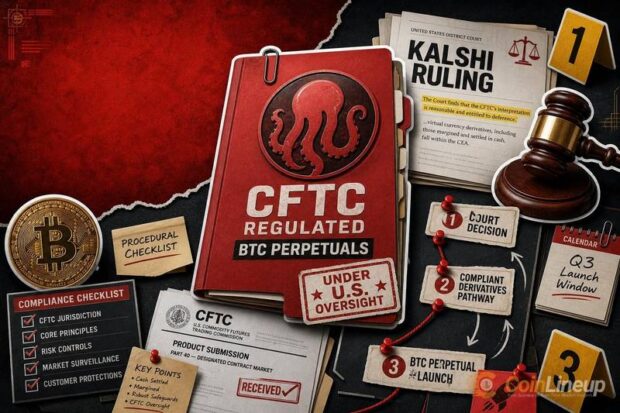
Kraken Eyes CFTC-Regulated Bitcoin Perpetuals After Kalshi Ruling
Kraken is preparing CFTC-regulated Bitcoin perpetuals after the CFTC cleared a Kalshi contract, signaling a potential shift for US crypto derivatives.

UK Applies Sanctioned-Bank Treatment to Crypto Network Over $90B Claim
The UK has moved to treat a crypto network like a sanctioned bank after allegations it processed $90 billion tied to Russia-linked activity. Here is the core SEO outline.

Bitcoin Perps Get US Green Light, but One Catch Could Decide What Happens Next
Bitcoin perpetual futures have a US green light, but one unresolved catch could shape trader access, liquidity, and the market response.

Coinbase Opens Regulated Deribit Options for U.S. Institutions
Coinbase has opened access to regulated Deribit options for U.S. institutions, expanding institutional crypto derivatives access and market reach.
Related
Mystery Whale Pays $30M to Exit BlackRock Bitcoin ETF — What It Means
A mystery whale paid $30 million to exit BlackRock's Bitcoin ETF (IBIT). Here's what the on-chain data reveals and what it signals for institutional Bitcoin flows.
Kraken Eyes CFTC-Regulated Bitcoin Perpetuals After Kalshi Ruling
Kraken is preparing CFTC-regulated Bitcoin perpetuals after the CFTC cleared a Kalshi contract, signaling a potential shift for US crypto derivatives.

How Bitcoin Could Price Trump’s Hormuz Reopening Claim This Weekend
A focused SEO outline on how Bitcoin may react if Hormuz reopens this weekend, including risk-on/risk-off signals, liquidity dynamics, and key market levels to watch.
Bitcoin Perps Get US Green Light, but One Catch Could Decide What Happens Next
Bitcoin perpetual futures have a US green light, but one unresolved catch could shape trader access, liquidity, and the market response.

CFTC Approves First U.S. Bitcoin Perpetual Futures
The CFTC has approved the first Bitcoin perpetual futures on a regulated U.S. exchange. Here is what the launch means for traders, market structure, and U.S. crypto access.

Satoshi Nakamoto Bitcoin Lawsuit Says BTC Is Lost Property
A new lawsuit argues Satoshi Nakamoto's bitcoin should be treated as lost property. Here's what the claim means and why it matters for Bitcoin.