Circle launched CPN Managed Payments on April 8, 2026, a full-stack settlement product that lets payment companies, banks, and enterprises settle cross-border transactions through USDC without directly handling digital assets. The move positions USDC not as a trading token but as infrastructure, quietly embedding it into the plumbing that moves money between institutions.
What CPN Managed Payments Actually Does
CPN Managed Payments is built on the Circle Payments Network, which Circle originally introduced in April 2025 as a real-time cross-border settlement layer using USDC, EURC, and other regulated stablecoins. The new managed product goes further: Circle handles USDC minting and burning, payment orchestration, compliance controls, and blockchain infrastructure on behalf of clients.
The platform connects to payouts across more than 20 blockchains and domestic payment rails. Institutions can access stablecoin-based settlement without building crypto custody or compliance operations internally.
Nikhil Chandhok, a Circle executive, said the company is “simplifying how institutions adopt and scale stablecoin payments.” That framing matters. This is not a consumer product launch; it is a back-end integration play aimed at PSPs, fintechs, and global enterprises that already move money at scale.
“Joining CPN Managed Payments is the natural next step.”
— Chloé Mayenobe, Thunes, via Newswire
Thunes, a cross-border payments company, confirmed on the same day that it joined CPN Managed Payments. Its customers can now access stablecoin-powered settlement while continuing to operate inside fiat-based workflows, a critical detail for institutions that need dollar endpoints, not crypto wallets.
Why Settlement Rails Matter More Than Token Price
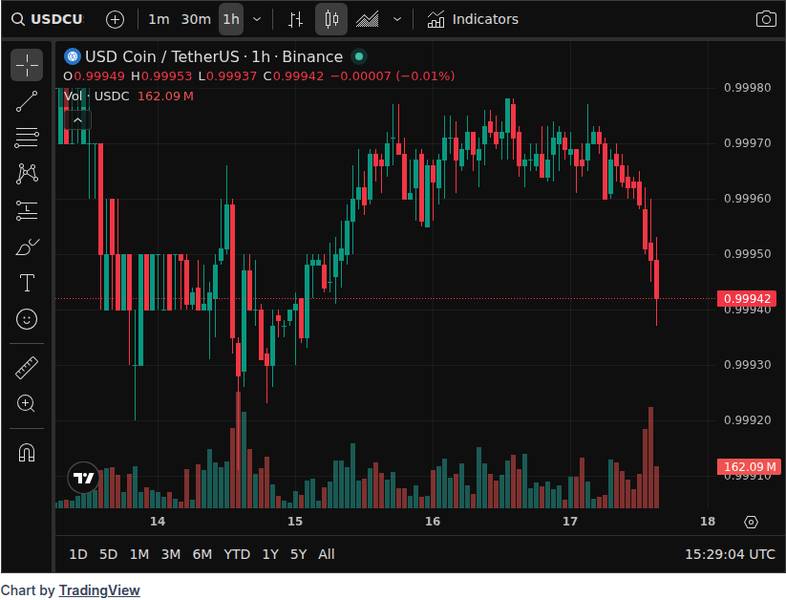
USDC trades at $0.999949 with a market cap near $78.7 billion. Its 24-hour trading volume exceeds $20.5 billion. But the real story is not the peg; it is how that stable value gets used as a settlement intermediary.
Circle says USDC has facilitated over $70 trillion in cumulative on-chain settlement, with $12 trillion in Q4 2025 alone. Those numbers explain why Circle is building managed infrastructure rather than chasing retail adoption. The volume already exists; the question is who controls the rails.
The total stablecoin market now sits at $315.8 billion, according to DefiLlama data. Within that market, settlement infrastructure determines which stablecoins get embedded into payment corridors for remittances, payroll, and treasury operations, the use cases that crypto-native coverage has highlighted as CPN’s target.
This matters in the current environment. The broader market faces macro headwinds, with the Fear & Greed Index at 21, deep in Extreme Fear territory. Infrastructure plays like CPN Managed Payments are not about short-term sentiment. They are about whether USDC becomes a default settlement layer regardless of where Bitcoin trades.
Circle’s Strategic Position as Competition Builds
Circle is a licensed money transmitter and holds a New York Department of Financial Services virtual currency business license. CPN participants must meet licensing, AML/CFT, financial risk management, and cybersecurity standards. That regulatory scaffolding is part of the product, not an afterthought.
The company also notes that USDC fits the SEC staff’s April 2025 “Covered Stablecoin” framework, a classification that could matter as regulatory clarity around crypto custody and self-custody evolves. Circle is betting that compliance infrastructure is a competitive moat, not just a cost center.
The sequence tells the story: network announced April 2025, managed settlement product launched April 2026, partner evidence from Thunes on day one. Circle is not waiting for institutions to figure out crypto. It is abstracting the crypto away entirely, leaving only the settlement speed and cost advantages.
Whether CPN Managed Payments becomes the dominant settlement rail depends on corridor-level throughput data that Circle has not yet disclosed. But the architecture is now live, the first major payments partner is integrated, and the broader crypto market’s leverage dynamics make a case for infrastructure that works independently of spot price volatility.
Disclaimer: This article is for informational purposes only and does not constitute financial or investment advice. Cryptocurrency and digital asset markets carry significant risk. Always do your own research before making decisions.


