

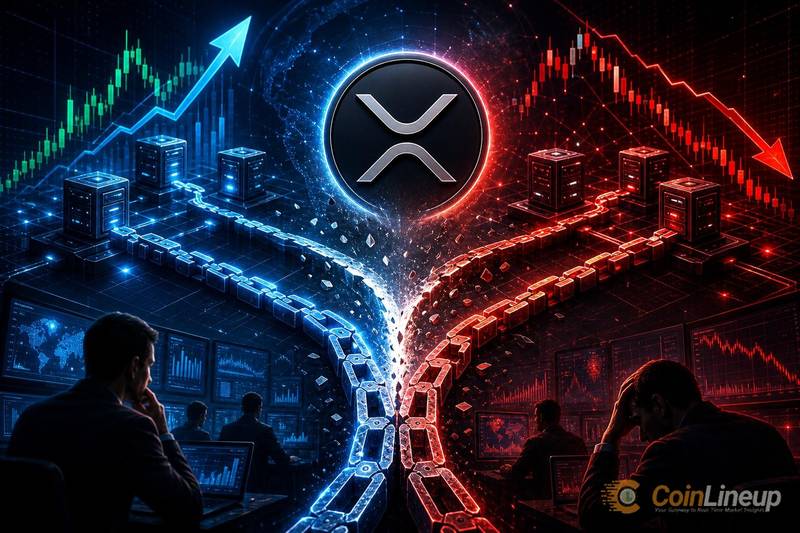
The XRP Ledger is scheduled for a network upgrade on May 27, and attention has turned to how validators, exchanges and market participants will navigate the process if nodes fail to reach consensus on the new software version, potentially resulting in a temporary blockchain split.
Why the May 27 upgrade raises chain split questions
A blockchain split on the XRPL occurs when a portion of validators upgrades to a new version of the rippled software while others remain on the older release. If the new version introduces amendment-gated features that require supermajority support, nodes running different versions can temporarily diverge on which transactions they consider valid.
Unlike proof-of-work chains where hash power determines the canonical fork, XRPL relies on a consensus protocol where validators must agree on each ledger close. An upgrade that changes transaction processing rules creates a coordination window where operators need to align on the same software version before the amendment activates.
May 27 represents the decision point. Validators that have not upgraded by then risk falling out of consensus with the majority, and any delay in reaching the required threshold extends the period of uncertainty for everyone building on the network.
How validators and infrastructure operators may respond
Each validator operator faces a straightforward but consequential choice: upgrade before the activation window or remain on the prior version. The XRPL development team typically publishes upgrade guidance and amendment tracking ahead of scheduled changes, giving operators a clear timeline.
Exchanges and wallet providers have their own set of operational concerns. During a disputed chain state, platforms often pause XRP deposits and withdrawals until one chain achieves definitive validator support. Confirmation requirements may increase, and some services may temporarily disable trading pairs to avoid crediting tokens on a chain that ultimately loses consensus.
Node operators running infrastructure for data providers and block explorers must also choose which chain to index. If the split is brief and cleanly resolved, the disruption stays minimal. A prolonged disagreement between validator groups, while unlikely given XRPL’s governance structure, would create more serious usability problems, similar to the operational disruptions seen in other blockchain incidents.
Custody providers and institutional service layers add another dimension. Firms focused on digital asset custody and infrastructure reliability will be watching whether the validator set converges quickly or fragments, as that outcome directly affects the security guarantees they offer clients.
What a split could mean for XRP market behavior
Upgrade-related chain splits tend to affect short-term liquidity rather than long-term fundamentals. When exchanges pause deposits and withdrawals, available supply on order books can thin out, amplifying price moves in either direction.
Trader confidence during these windows often hinges on how quickly infrastructure support converges. A rapid supermajority of validators adopting the new version typically resolves uncertainty within hours. Markets tend to treat these events as operational pauses rather than structural threats, particularly when the upgrade has been communicated well in advance.
The distinction matters for market participants watching XRP alongside broader digital asset trends. An operational disruption tied to a planned upgrade is fundamentally different from a contentious fork driven by community disagreement, and the two scenarios carry different risk profiles. Companies navigating volatile crypto treasury and revenue conditions understand that infrastructure events can ripple beyond the token directly involved.
For XRP holders, the practical takeaway is to monitor validator adoption metrics in the days leading up to May 27 and to confirm that any exchange or wallet they use has published its own upgrade readiness plan.
Disclaimer: This article is for informational purposes only and does not constitute financial or investment advice. Cryptocurrency and digital asset markets carry significant risk. Always do your own research before making decisions.

About the author

XRPL’s May 27 Upgrade Puts Focus on Validators, Markets and a Blockchain Split
XRPL's May 27 upgrade has shifted attention to validator coordination, exchange responses and market behavior if the network splits into competing chains.
MoonPay Launches MoonPay Trade: What the New Offering Signals
MoonPay has launched MoonPay Trade. Explore what the announcement suggests, why it matters for crypto users, and what details to watch next.
Blockchain.com Confidentially Files for U.S. IPO
Blockchain.com has confidentially filed for a U.S. IPO. This outline focuses on what the filing means, why it matters for crypto markets, and what readers should watch next.
Missouri Sues CoinFlip Over Alleged Crypto ATM Scams
Missouri has sued CoinFlip over alleged crypto ATM scams. This outline focuses on the case, the accusations, consumer risks, and the wider regulatory signal.
Morgan Stanley Refiles Solana ETF With Staking: What It Means
Morgan Stanley refiles a Solana ETF with staking. Here’s what changed, why the staking feature matters, and what it could mean for SOL.

Ark Invest Buys $4.4 Million in Bullish Shares After Selloff
Ark Invest bought $4.4 million in Bullish shares after a selloff, signaling renewed institutional interest and raising questions about market sentiment.
Related
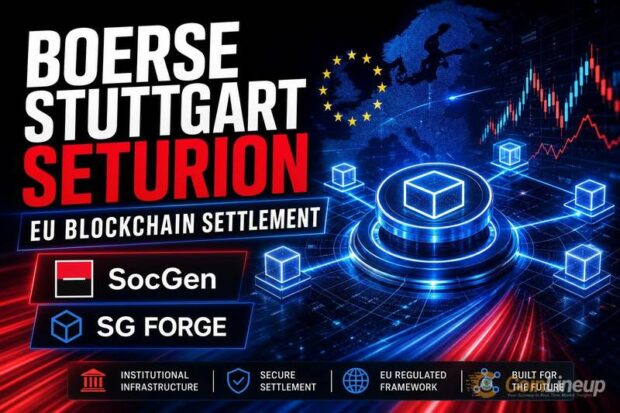
Boerse Stuttgart’s Seturion Adds SocGen and SG-FORGE for EU Blockchain Settlement
Boerse Stuttgart's Seturion has added SocGen and SG-FORGE to support EU blockchain settlement. Here's what the move signals for tokenized finance in Europe.
BNB Chain Says Post-Quantum Signature Test Cut BSC TPS 40%
BNB Chain says a post-quantum signature test reduced BSC throughput by 40%. Here is what the test result suggests for blockchain performance and security.
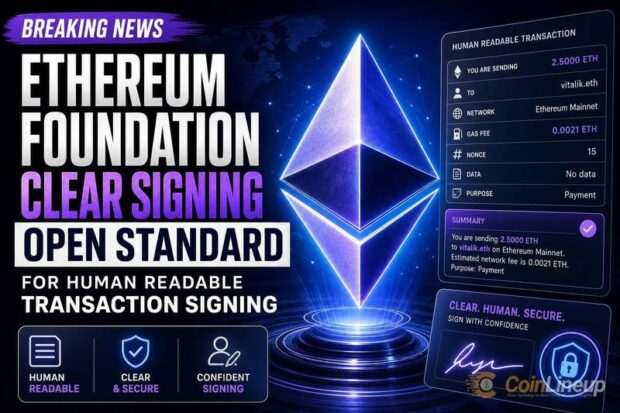
Ethereum Foundation Rolls Out Clear Signing Open Standard for Human-Readable Transaction Signing
Ethereum Foundation introduces Clear Signing, an open standard aimed at making crypto transactions human-readable and reducing signing-related risks.
KB Financial Group Partners With Pantera Capital on Blockchain Strategy
KB Financial Group has partnered with Pantera Capital to expand its blockchain strategy, highlighting rising institutional interest in digital asset infrastructure.

Solana Introduces Falcon Post-Quantum Signature Scheme
Solana has introduced the Falcon post-quantum digital signature scheme after Anza research, signaling a stronger focus on future-ready blockchain security.

Paris Blockchain Week 2026 Live: Cointelegraph on Ground
Paris Blockchain Week 2026 is underway at the Louvre in Paris, with Cointelegraph on the ground as crypto leaders and builders gather for two days of talks.