

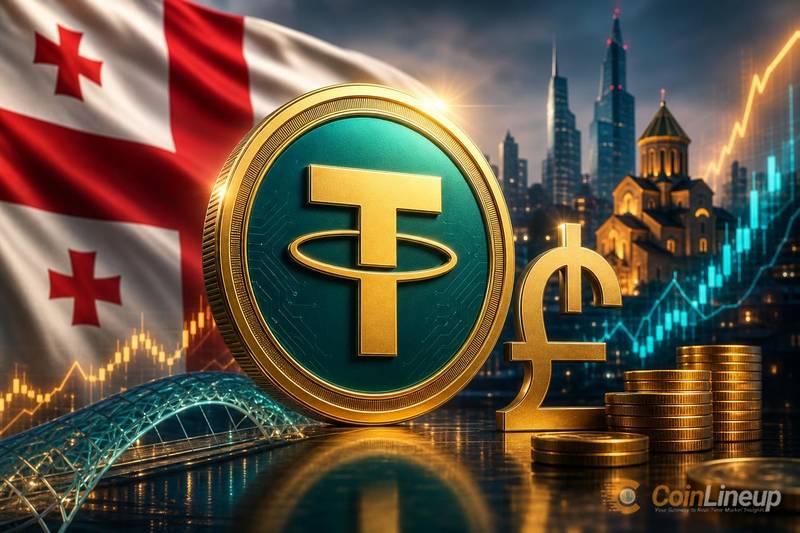

Tether and the Government of Georgia announced plans on May 25, 2026 to launch GEL₮, a stablecoin pegged to the Georgian lari. The token is still a proposal, not a live product, and key details including the legal issuer, reserve custodian, and launch timeline have not been disclosed.
What Tether and Georgia Have Announced About GEL₮
GEL₮ would be a digital token designed to maintain a 1:1 peg with the Georgian lari, Georgia’s national currency. Tether, the company behind USDT, is partnering with the Georgian government on the initiative, which the company said is intended to enable lower transaction costs, near-instant settlement, programmable payments, and more efficient cross-border commerce.
The announcement frames GEL₮ as a plan rather than a finished product. No whitepaper, no named legal issuer, and no confirmed blockchain or settlement rails have been made public. Further details on structure, rollout, and regulatory implementation are expected later.
Tether CEO Paolo Ardoino said that stablecoins “are no longer a niche financial instrument,” signaling the company views local-currency stablecoins as a growth area.
“Stablecoins are no longer a niche financial instrument.”
— Paolo Ardoino, Tether CEO (source)
The partnership is not new. Tether and Georgia signed a memorandum of understanding in June 2023 focused on blockchain infrastructure, education, and startup support, laying groundwork for the current proposal.
Tether’s flagship USDT stablecoin carries an approximately $189.4 billion market cap, making it the largest stablecoin by circulation. That scale gives context for the resources Tether could bring to a smaller, local-currency project like GEL₮.
Why a Lari-Backed Stablecoin Matters for Georgia and Tether
Most stablecoin activity globally is denominated in U.S. dollars. A lari-backed token would give Georgian businesses and consumers on-chain access to their own national currency, potentially reducing reliance on dollar-pegged intermediaries for local transactions.
For domestic payments and remittances, a lari stablecoin could lower friction compared to traditional bank transfers, particularly for cross-border commerce where Georgia’s smaller currency faces conversion costs. This parallels broader industry interest in local-currency stablecoins, similar to how on-chain financial infrastructure is expanding across multiple use cases.
For Tether, the project represents geographic and currency diversification. The company has built its dominance on USDT, but entering fiat-linked markets beyond the dollar could open new revenue streams and deepen government relationships.
Georgia has positioned itself as relatively open to digital assets. The country’s regulatory approach to crypto-adjacent financial products has drawn attention, and a government-backed stablecoin plan adds to that positioning.
What Could Shape the Next Steps for GEL₮
Georgia’s National Bank formalized a stablecoin regulatory framework in March 2026. Under that framework, any stable virtual asset in circulation must be fully backed by reserve assets equal to 100% of circulating value. Reserve assets must also be segregated from the issuer’s own funds.
The rules also require prior written consent from the National Bank before any stablecoin initial coin offering in Georgia. Firms that are not already registered as virtual asset service providers must complete VASP registration first.
These requirements mean GEL₮ cannot simply launch; it must clear a formal regulatory process. The legal amendments underlying this framework were passed in December 2025, expanding the National Bank’s supervisory authority over VASPs.
Key unknowns remain. The announcement did not specify who the legal issuer would be, where reserves would be held, whether holders would have direct redemption rights, or which blockchain would host the token. These details will determine whether GEL₮ gains meaningful adoption or remains a concept.
Adoption will also depend on local demand. Georgia’s economy is relatively small, and a lari stablecoin would need to offer clear advantages over existing payment rails to attract users. Institutional support from Georgian banks and payment processors, along with the broader direction of blockchain infrastructure upgrades, could influence how quickly any rollout gains traction.
For now, GEL₮ is a stated intention backed by an existing government relationship and a newly built regulatory framework. The distance between announcement and functioning stablecoin will be measured by the execution details that Tether and Georgia have yet to disclose.
Disclaimer: This article is for informational purposes only and does not constitute financial or investment advice. Cryptocurrency and digital asset markets carry significant risk. Always do your own research before making decisions.
About the author


Tether and Georgia Plan GEL₮, a Lari-Backed Stablecoin
Tether and Georgia are planning GEL₮, a Georgian lari-backed stablecoin. Here’s what the proposal could mean for local payments, regulation, and regional crypto adoption.

XRPL’s May 27 Upgrade Puts Focus on Validators, Markets and a Blockchain Split
XRPL's May 27 upgrade has shifted attention to validator coordination, exchange responses and market behavior if the network splits into competing chains.

MoonPay Launches MoonPay Trade: What the New Offering Signals
MoonPay has launched MoonPay Trade. Explore what the announcement suggests, why it matters for crypto users, and what details to watch next.

Blockchain.com Confidentially Files for U.S. IPO
Blockchain.com has confidentially filed for a U.S. IPO. This outline focuses on what the filing means, why it matters for crypto markets, and what readers should watch next.

Missouri Sues CoinFlip Over Alleged Crypto ATM Scams
Missouri has sued CoinFlip over alleged crypto ATM scams. This outline focuses on the case, the accusations, consumer risks, and the wider regulatory signal.

Morgan Stanley Refiles Solana ETF With Staking: What It Means
Morgan Stanley refiles a Solana ETF with staking. Here’s what changed, why the staking feature matters, and what it could mean for SOL.
Related

Canaan Q1 Revenue Drops as Bitcoin and Ether Treasury Nears $148M
Canaan reported a Q1 revenue decline while its Bitcoin and Ether treasury approached $148 million, highlighting how the miner is balancing operating pressure with crypto asset accumulation.
Blockchain.com Confidentially Files for U.S. IPO
Blockchain.com has confidentially filed for a U.S. IPO. This outline focuses on what the filing means, why it matters for crypto markets, and what readers should watch next.

Ripple Ranked No. 16 on CNBC’s 2026 Disruptor 50 List
Ripple ranked No. 16 on CNBC's 2026 Disruptor 50 list, a notable milestone for the crypto and blockchain company. Here's what the ranking means.
Morgan Stanley Refiles Solana ETF With Staking: What It Means
Morgan Stanley refiles a Solana ETF with staking. Here’s what changed, why the staking feature matters, and what it could mean for SOL.

Fed Survey: 10% of U.S. Adults Used or Held Crypto in 2025
A Federal Reserve survey found 10% of U.S. adults used or held crypto in 2025. Here’s what the data suggests for adoption, payments, and investing.

Patrick Witt Says Clarity Act Could Aid Crypto Industry
White House crypto advisor Patrick Witt says passing the Clarity Act could help the crypto industry. Here is the key context, market relevance, and what to watch next.