


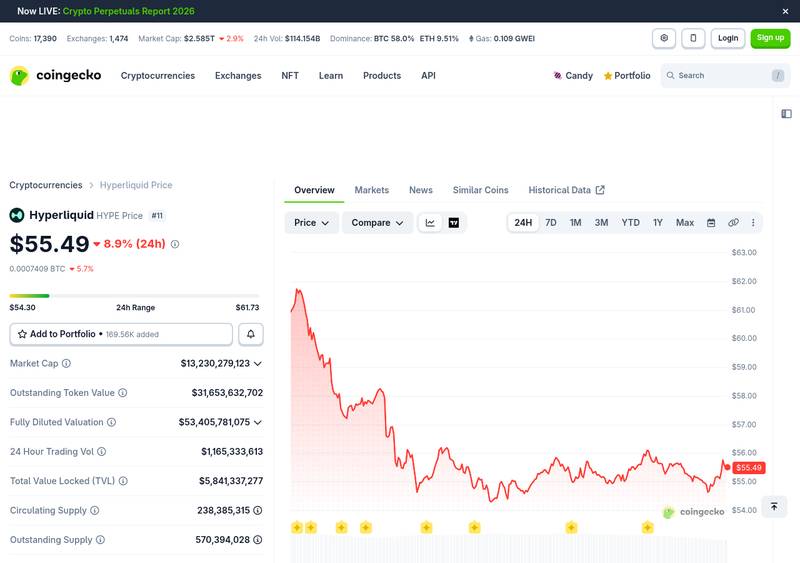
HYPE token hit an all-time high of $62.18 on May 21, 2026, and a growing number of analysts argue the path to $100 runs through Hyperliquid’s transformation from a perpetual futures DEX into a full-stack on-chain financial platform.
The token has since pulled back to around $55.59, a 9.23% decline over 24 hours. Even after the dip, HYPE is up roughly 35% over the past seven days and has gained more than 1,360% from its November 2024 low of $3.81.
Why Analysts Think HYPE Can Reach $100
At the current circulating supply of roughly 238.4 million tokens, a $100 price would put HYPE’s market cap near $23.8 billion. That would require approximately an 80% move from current levels.
The bull case, outlined by CryptoSlate, rests on Hyperliquid evolving beyond a niche DeFi trading venue into what the analysis calls “crypto’s on-chain Wall Street.” The thesis is that Hyperliquid is collapsing traditional finance silos, offering perpetual futures, spot trading, and token launches on a single vertically integrated chain.
Institutional demand is already materializing. Spot HYPE ETFs from Bitwise (ticker: BHYP) and 21Shares launched in May, pulling in roughly $54 million in cumulative inflows during the first seven trading days. Bitwise’s BHYP alone reached $30.5 million in assets under management within five days of launch. That kind of early institutional flow echoes the pattern seen when options trading was approved for the Nasdaq Bitcoin Index, where regulatory product launches became price catalysts.
According to unconfirmed reports, Bitwise plans to use 10% of BHYP management fees to acquire and stake HYPE tokens for its own balance sheet, which would create a structural demand loop tied to fund growth.
What Makes Hyperliquid Different From Other Perp DEXs
The “on-chain Wall Street” framing is not just marketing. Hyperliquid runs a fully on-chain central limit order book, not an AMM model. That architecture gives it execution characteristics closer to centralized exchanges like Binance than to AMM-based competitors like GMX or dYdX.
The dominance metrics back this up. Hyperliquid commands 58.5% of all on-chain perpetual DEX open interest and 31.7% of 30-day perpetual DEX volume, with roughly $176.4 billion in perpetual trading volume over the past month. Open interest stands near $10 billion, a six-month high.
The platform has generated over $1.29 billion in all-time fees, with $57.17 million in the last 30 days alone. Total value locked sits at $5.47 billion across Arbitrum and the Hyperliquid L1.
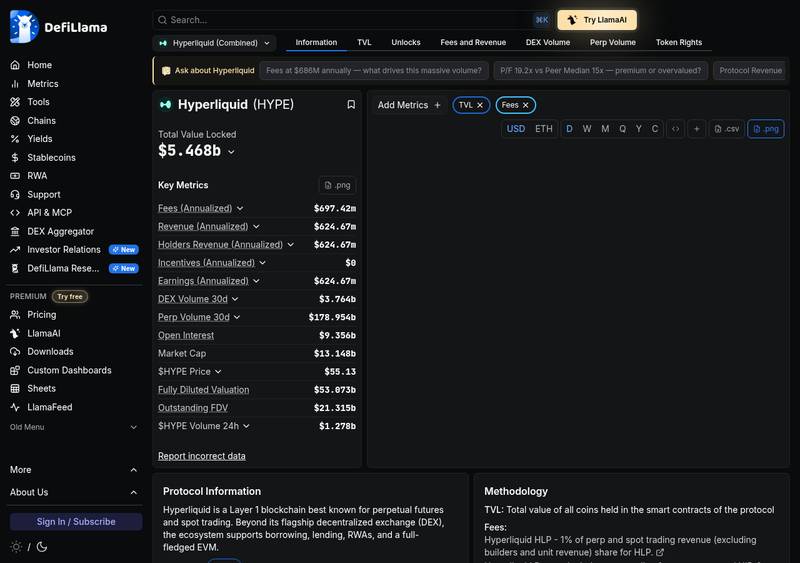
What matters for HYPE token holders is the fee-to-buyback loop. According to CryptoSlate’s analysis, Hyperliquid captures approximately 43% of all chain fees, roughly $11 million per week, and nearly all of that revenue is used to buy back HYPE on the open market. This creates a direct link between platform usage and token value accrual that most DeFi governance tokens lack.
The platform is also expanding into non-crypto assets. According to a single unconfirmed report, a Hyperliquid WTI crude oil perpetual contract generated over $1.2 billion in 24-hour volume during a traditional-market oil spike. If verified, that figure signals Hyperliquid is pulling trading activity away from traditional commodity venues, not just competing with other DEXs.
Key Risks and What to Watch Before HYPE Hits $100
The broader market environment is cautious. The Crypto Fear & Greed Index sits at 28, firmly in “Fear” territory. HYPE’s 9% single-day pullback from its ATH shows the token is not immune to macro sentiment, and a broader risk-off move could stall momentum regardless of fundamentals.
Regulatory risk around on-chain derivatives remains underexplored. While the ETF approvals suggest regulators are comfortable with HYPE as an asset class, Hyperliquid’s core product, permissionless perpetual futures with high leverage, has not faced direct scrutiny. Any enforcement action against on-chain derivatives platforms could reshape the competitive landscape quickly, much as evolving stablecoin custody requirements have forced infrastructure changes across the industry.
Competition is also intensifying. Centralized exchanges are building on-chain trading products, and rival L1s are targeting the same “unified financial platform” thesis. Network upgrades on chains like XRPL are expanding on-chain capabilities that could eventually support similar derivatives infrastructure. Hyperliquid’s 58.5% open interest share gives it a moat, but market share in crypto is notoriously fragile.
The near-term catalyst to watch is continued ETF inflow momentum. If BHYP and 21Shares’ HYPE funds sustain inflows beyond the launch window, that would confirm institutional demand is structural, not speculative. Traders should also monitor whether Hyperliquid’s weekly fee revenue, currently around $14 million, holds steady or accelerates as the platform adds new asset classes.
HYPE’s current market cap of $13.2 billion and its fully diluted valuation ratio of 0.25 suggest that only about a quarter of the total supply is circulating. Future token unlocks could create selling pressure that complicates the path to $100, even if platform fundamentals keep improving. Price targets are speculative, not guarantees.
Disclaimer: This article is for informational purposes only and does not constitute financial or investment advice. Cryptocurrency and digital asset markets carry significant risk. Always do your own research before making decisions.

About the author

HYPE Price Path to $100: How Hyperliquid Is Becoming Crypto’s On-Chain Wall Street
HYPE token eyes a $100 price target as Hyperliquid builds out a full-stack on-chain financial platform. Here's what's driving the bullish thesis and what to watch.

CADD Stablecoin Taps Anchorage Digital for Custody
CADD Stablecoin has selected Anchorage Digital for custody, signaling a security-focused move that could strengthen trust, compliance positioning, and market credibility.

Verus Bridge Attacker Returns $8.5M in ETH, Keeps Bounty
The Verus bridge attacker returned $8.5 million in ETH and kept a bounty, marking a major twist in the exploit story and raising fresh DeFi security questions.

Coinbase Plans Perpetual-Style Equity Index Futures Launch in U.S. on June 8
Coinbase plans to launch perpetual-style equity index futures in the U.S. on June 8. Here is the key setup, why it matters, and what traders should watch.

Solana Treasury Firm Solmate Raises $11.4 Million in Stock Offering
Solana treasury firm Solmate has raised $11.4 million through a stock offering. Here’s what the deal means, how the funds may be used, and why it matters for crypto markets.

Boerse Stuttgart’s Seturion Adds SocGen and SG-FORGE for EU Blockchain Settlement
Boerse Stuttgart's Seturion has added SocGen and SG-FORGE to support EU blockchain settlement. Here's what the move signals for tokenized finance in Europe.
Related

Over $526M Liquidated From Crypto Market in 1 Hour as Longs Lead Losses
More than $526 million was liquidated from the crypto market in the past hour. See why long positions absorbed most of the losses and what traders should watch next.

Whale Opens 25x ETH Long After $32M Loss: Market Impact
A crypto whale, down $32M, has opened a 25x ETH long worth $2.7M. Here’s what the trade means for Ethereum sentiment, risk, and market focus.

USDC Circulating Supply Fell by $1B in 7 Days
USDC circulating supply shrank by roughly $1 billion over the past seven days. Here is what the move signals for stablecoin flows and crypto markets.

Altcoin Momentum Builds as Volume Tops Yearly Baseline
A reported volume shift suggests altcoin momentum may be improving. Here is what the yearly-baseline signal means, what it does not prove, and what to watch next.

Stablecoin Market Cap Doubled in 2 Years | Markets News
The stablecoin market cap has doubled over the past two years. Explore what drove the surge, which trends matter now, and why markets are paying attention.
South Korean Crypto Holdings Fall 50% to $41B Amid Stock Shift
South Korean crypto holdings reportedly fell 50% to $41 billion as investors shifted to stocks. Here’s what drove the move and what it could mean next.