


Optimism has launched a stake-based gas priority experiment on OP Mainnet, replacing the standard Priority Gas Auction ordering with a system that gives stakers preferential transaction sequencing. The four-week test, running from May 27 through June 23, 2026, marks the first time OP Mainnet’s sequencer has deviated from pure fee-based ordering.
What Optimism Is Testing: Stake-Based Gas Priority Explained
Approved as Upgrade 19 under Optimism’s Joint House governance process (Voting Cycle #52), the experiment passed with fewer than 0.38% of eligible votes against through Optimistic Approval.
Under the current system, OP Mainnet uses a Priority Gas Auction where users bid higher gas fees for faster transaction inclusion. The new experiment replaces this with a staking mechanism: participants deposit OP tokens into a dedicated PolicyEngineStaking smart contract to receive priority ordering over non-stakers.
The minimum threshold to participate is 100,000 OP tokens, roughly $12,780 at current prices. That barrier effectively limits the experiment to institutional market makers and arbitrage firms rather than retail users.
OP Token Price
Market Cap: $274.8M | 24h Change: −0.90%
Source: CoinGecko
The experiment runs in two phases. Phase 1 (up to one week) uses simple FIFO ordering among eligible stakers. Phase 2 (up to three weeks) switches to stake-weighted ordering with diminishing returns, a design intended to resist flash loan manipulation.
Participation is voluntary and opt-in. Non-participants continue under standard PGA ordering, and stakers can withdraw 100% of their stake at any time with no lockup period. A staker may link their stake to one beneficiary address, though the staker’s own address does not simultaneously receive the benefit if linked to another.
Why It Matters: Implications for OP Stakers and Everyday Users
The experiment is designed to generate data on how market makers and arbitrage bots behave under stake-based ordering. For stakers, the benefit is concrete: faster, more predictable transaction inclusion without needing to outbid competitors in gas auctions.
For non-stakers, the picture is less clear. During congestion, users who haven’t staked may face slower transaction inclusion as stakers receive sequencing priority. This creates a two-tier system where network access quality correlates with capital commitment rather than willingness to pay per-transaction fees.
The mechanism also introduces new utility for the OP token itself. If staking yields a tangible ordering advantage, demand for OP could increase beyond governance and speculative use cases. That dynamic is worth watching as institutional treasury strategies increasingly incorporate token utility into their calculations.
Optimism’s chain currently holds approximately $649.4 million in total value locked, supporting a substantial DeFi ecosystem that would be directly affected by changes to transaction ordering. The experiment could reduce MEV extraction for staked participants while concentrating ordering power among well-capitalized actors.
What Comes Next: Timeline, Risks, and What to Watch
OP Mainnet will revert to standard Priority Gas Auction ordering after the experiment ends on June 23, 2026. The test ran on Sepolia testnet for two to four weeks before the mainnet launch.
The central risk is stake concentration. If a small number of large OP holders dominate the priority queue, the experiment could demonstrate that stake-based ordering favors incumbents over smaller participants. This mirrors concerns seen in other staking-for-access models, similar to how Ethereum-based treasury approaches have drawn scrutiny over concentration dynamics.
The broader strategic context is Optimism’s Superchain roadmap. OP Stack powers multiple L2 chains including Base, Unichain, Ink, and World Chain. If stake-based priority ordering proves successful on OP Mainnet, the mechanism could be adopted across the entire Superchain ecosystem, amplifying both its benefits and risks. The agricultural tech sector has seen parallel experimentation with proprietary solutions that carry similar adoption-or-abandon dynamics.
The Crypto Fear & Greed Index sits at 34 (Fear), suggesting the broader market is cautious. OP token trades at $0.128 with a market cap of $274.6 million and 24-hour trading volume of $56.6 million, well below its all-time high of $4.84 set in March 2024.
According to unconfirmed reports, OP price briefly jumped 6% to $0.132 around the announcement, though CoinGecko data showed a 0.93% decline over 24 hours at the time of research, suggesting any intraday spike was not sustained.
Key signals to monitor over the next four weeks: how many unique addresses stake above the 100,000 OP threshold, whether non-staker transaction inclusion times measurably degrade, and whether Optimism governance moves to make any version of stake-based ordering permanent after the experiment concludes.
Disclaimer: This article is for informational purposes only and does not constitute financial or investment advice. Cryptocurrency and digital asset markets carry significant risk. Always do your own research before making decisions.
About the author

Optimism Tests Stake-Based Gas Priority on OP Mainnet
Optimism is piloting a stake-based gas priority mechanism on OP mainnet that lets stakers secure preferential transaction ordering — here's what it means for users and the network.
OKX X Layer Launches Exchange OS to Let Builders Deploy Custom Crypto Markets
OKX's X Layer has launched Exchange OS, a platform letting builders deploy their own specialized crypto trading markets. Here's what it does and why it matters.

Tether and Georgia Plan GEL₮, a Lari-Backed Stablecoin
Tether and Georgia are planning GEL₮, a Georgian lari-backed stablecoin. Here’s what the proposal could mean for local payments, regulation, and regional crypto adoption.
XRPL’s May 27 Upgrade Puts Focus on Validators, Markets and a Blockchain Split
XRPL's May 27 upgrade has shifted attention to validator coordination, exchange responses and market behavior if the network splits into competing chains.
MoonPay Launches MoonPay Trade: What the New Offering Signals
MoonPay has launched MoonPay Trade. Explore what the announcement suggests, why it matters for crypto users, and what details to watch next.

Blockchain.com Confidentially Files for U.S. IPO
Blockchain.com has confidentially filed for a U.S. IPO. This outline focuses on what the filing means, why it matters for crypto markets, and what readers should watch next.
Related
XRPL’s May 27 Upgrade Puts Focus on Validators, Markets and a Blockchain Split
XRPL's May 27 upgrade has shifted attention to validator coordination, exchange responses and market behavior if the network splits into competing chains.

Boerse Stuttgart’s Seturion Adds SocGen and SG-FORGE for EU Blockchain Settlement
Boerse Stuttgart's Seturion has added SocGen and SG-FORGE to support EU blockchain settlement. Here's what the move signals for tokenized finance in Europe.

BNB Chain Says Post-Quantum Signature Test Cut BSC TPS 40%
BNB Chain says a post-quantum signature test reduced BSC throughput by 40%. Here is what the test result suggests for blockchain performance and security.
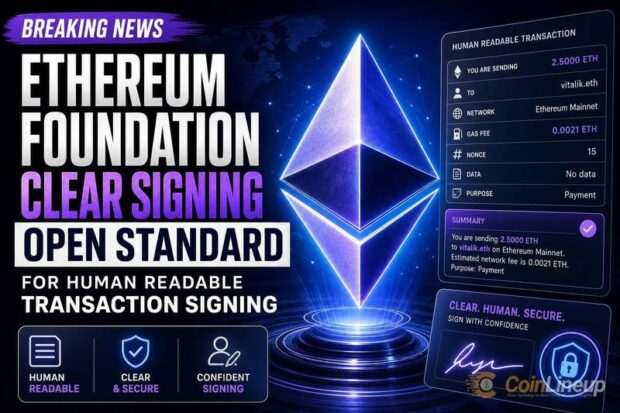
Ethereum Foundation Rolls Out Clear Signing Open Standard for Human-Readable Transaction Signing
Ethereum Foundation introduces Clear Signing, an open standard aimed at making crypto transactions human-readable and reducing signing-related risks.
KB Financial Group Partners With Pantera Capital on Blockchain Strategy
KB Financial Group has partnered with Pantera Capital to expand its blockchain strategy, highlighting rising institutional interest in digital asset infrastructure.

Solana Introduces Falcon Post-Quantum Signature Scheme
Solana has introduced the Falcon post-quantum digital signature scheme after Anza research, signaling a stronger focus on future-ready blockchain security.