


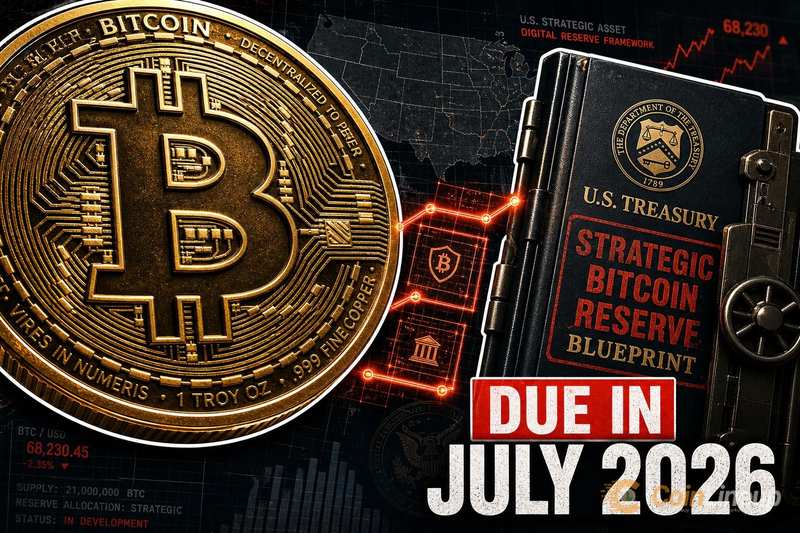
The U.S. government’s blueprint for a strategic Bitcoin reserve is due in July 2026, setting a concrete policy checkpoint that could shape how Washington treats Bitcoin as a national asset for years to come.
Why the July 2026 Deadline Matters
In March 2025, President Trump signed an executive order titled Establishment of the Strategic Bitcoin Reserve and United States Digital Asset Stockpile. The order directed federal agencies to evaluate and report on how the U.S. could hold Bitcoin as a strategic reserve asset.
That directive set a timeline culminating in a formal blueprint due in July 2026. The deadline creates a fixed policy milestone, one that forces agencies to commit findings to paper rather than defer indefinitely.
In May 2026, a White House adviser indicated that a reserve update would arrive within weeks, reinforcing that the administration intends to meet the schedule. A blueprint is not a final policy rollout; it is a planning document that outlines objectives, constraints, and recommended next steps.
What a Strategic Bitcoin Reserve Blueprint Could Cover
A reserve blueprint of this nature would typically address structure, objectives, oversight mechanisms, and implementation considerations. For Bitcoin specifically, that raises questions about custody arrangements, acquisition strategy, and public reporting standards.
Governance is a central concern. The blueprint would need to define which agencies oversee the reserve, how decisions about buying or selling are made, and what transparency obligations apply. These questions parallel debates already emerging in Congress, where legislative proposals have begun addressing digital asset policy frameworks.
Custody is another likely topic. The U.S. government already holds Bitcoin seized through law enforcement actions. The blueprint may clarify whether those holdings would be folded into a formal reserve or kept separate, and whether the government would acquire additional Bitcoin on the open market.
Readers should distinguish between what a blueprint outlines and what it authorizes. The July document will frame possibilities, not execute them. Actual reserve operations, if approved, would require further policy steps and potentially congressional action.
Potential Market and Political Implications
Government reserve discussions can influence Bitcoin sentiment well before any policy takes effect. The mere existence of a deadline has already prompted speculation about how large a U.S. reserve might be and what acquisition pace Washington could set. Bitcoin has experienced sharp price swings on policy signals before, and the blueprint’s release could trigger similar volatility.
Policy milestones shape expectations. If the blueprint signals serious intent, institutional investors may adjust positioning ahead of implementation. If it reads as noncommittal, the market reaction could be muted. Similar dynamics have played out around other regulatory developments, including the launch of CME Group’s expanded crypto futures trading, which reflected growing institutional infrastructure.
The political significance is distinct from the market impact. Treating Bitcoin as a strategic asset topic at the executive level represents a shift in how Washington categorizes digital assets. That framing could influence parallel regulatory efforts, including stablecoin policy debates unfolding internationally.
The July 2026 deadline is now less than two months away. Whatever the blueprint contains, its release will mark the first time the U.S. government formally commits a Bitcoin reserve strategy to an official planning document.
Disclaimer: This article is for informational purposes only and does not constitute financial or investment advice. Cryptocurrency and digital asset markets carry significant risk. Always do your own research before making decisions.

About the author

U.S. Strategic Bitcoin Reserve Blueprint Due in July 2026
The U.S. strategic Bitcoin reserve blueprint is due in July 2026. This outline frames the deadline, policy stakes, and likely Bitcoin market impact.

Bitcoin Falls Below $66,000: What the Move Means for the Market
Bitcoin has dropped below $66,000. This outline focuses on the price break, what may be driving the move, and what traders will watch next.
Ripple Expands Washington, D.C., Office to Deepen U.S. Policy Ties
Ripple is expanding its Washington, D.C., office as it steps up engagement with U.S. policymakers and regulators amid evolving crypto oversight.

Strive Adds 2,500 BTC, Increasing Holdings to 19,000 BTC
Strive added 2,500 BTC, lifting its total Bitcoin holdings to 19,000 BTC. Here is the key context, scale of the increase, and why it matters.

Kalshi Reportedly Filed to Certify XRP, Solana and Dogecoin Perpetual Futures After Bitcoin Approval
Kalshi reportedly moved to certify XRP, Solana and Dogecoin perpetual futures after its Bitcoin-related approval. Here is what the filing could signal for crypto traders and prediction-style markets.

Mystery Whale Pays $30M to Exit BlackRock Bitcoin ETF — What It Means
A mystery whale paid $30 million to exit BlackRock's Bitcoin ETF (IBIT). Here's what the on-chain data reveals and what it signals for institutional Bitcoin flows.
Related
Bitcoin Falls Below $66,000: What the Move Means for the Market
Bitcoin has dropped below $66,000. This outline focuses on the price break, what may be driving the move, and what traders will watch next.
Mystery Whale Pays $30M to Exit BlackRock Bitcoin ETF — What It Means
A mystery whale paid $30 million to exit BlackRock's Bitcoin ETF (IBIT). Here's what the on-chain data reveals and what it signals for institutional Bitcoin flows.
Kraken Eyes CFTC-Regulated Bitcoin Perpetuals After Kalshi Ruling
Kraken is preparing CFTC-regulated Bitcoin perpetuals after the CFTC cleared a Kalshi contract, signaling a potential shift for US crypto derivatives.

How Bitcoin Could Price Trump’s Hormuz Reopening Claim This Weekend
A focused SEO outline on how Bitcoin may react if Hormuz reopens this weekend, including risk-on/risk-off signals, liquidity dynamics, and key market levels to watch.

Bitcoin Perps Get US Green Light, but One Catch Could Decide What Happens Next
Bitcoin perpetual futures have a US green light, but one unresolved catch could shape trader access, liquidity, and the market response.

CFTC Approves First U.S. Bitcoin Perpetual Futures
The CFTC has approved the first Bitcoin perpetual futures on a regulated U.S. exchange. Here is what the launch means for traders, market structure, and U.S. crypto access.