


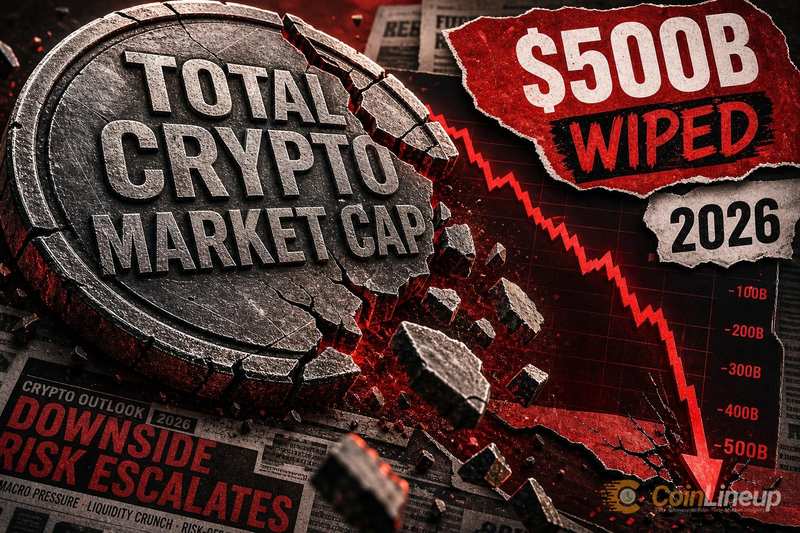
The total crypto market has shed more than $500 billion in value since the start of 2026, punishing leveraged traders and dragging sentiment to levels not seen since the depths of previous bear cycles.
CoinGecko’s Q1 2026 industry report, published on April 16, confirmed the damage: total crypto market capitalization fell 20.4% in Q1 alone, a loss of $622 billion, with the quarter ending at $2.4 trillion.
The drawdown was not spread evenly across the quarter. CoinGecko noted that the bulk of the decline occurred from mid-January to early February, compressing months of pain into roughly two weeks.
How the Total Crypto Market Lost $500 Billion in 2026
This was a broad market-capitalization collapse, not a single-asset story. While Bitcoin held up better than most altcoins, rising to 57.3% dominance, the total market shed value across every major sector.
The scale matters because $500 billion erased in a few months rivals some of the sharpest drawdowns in crypto history. For context, the entire XRP Ledger saw activity rise 35% even as its token price slumped, illustrating how network usage and market value can diverge during broad selloffs.
At the time of writing, total crypto market capitalization sits at roughly $2.58 trillion, having recovered modestly from the Q1 low but remaining well below the $3 trillion-plus levels seen in late 2025.
What Is Driving the 2026 Crypto Market Selloff
The catalyst that CoinGecko tied to the initial leg down was the January 30 nomination of Kevin Warsh as the next Federal Reserve chair. Markets interpreted the pick as a hawkish signal on rates and balance-sheet policy.
The macro pressure was not isolated to crypto. Reuters reported that the selloff hit equities, precious metals, and risk assets broadly, with Trump’s China tariff announcement adding fuel. Crypto, being the most leveraged corner of the risk-asset universe, absorbed outsized damage.
The liquidation cascade was historic. Reuters reported on February 2 that bitcoin investors alone liquidated $2.56 billion in recent days. CoinDesk later put the 24-hour figure at more than $2.6 billion in leveraged futures bets unwound, with bitcoin touching $60,000, its lowest since October 2024.
That kind of forced selling feeds on itself. As positions are liquidated, prices fall further, triggering more margin calls. The episode resembled previous deleveraging events that have reshaped how institutions and even political actors think about crypto market structure.
What Traders and Investors Are Watching Next
The Fear & Greed Index currently reads 28, firmly in “Fear” territory. That level suggests the market has not yet recovered its confidence despite the partial bounce from Q1 lows.
Bitcoin dominance at 57.3% signals that capital continues to rotate toward the largest asset during uncertainty, a pattern consistent with early-stage recoveries but also with continued altcoin weakness.
Traders are watching whether the total crypto market can hold the $2.5 trillion level as a floor, or whether macro headwinds, particularly Fed policy under Warsh’s expected tenure, push it lower. The regulatory environment remains a wildcard, with governments worldwide still adjusting their approach to crypto oversight.
Bitcoin trading near $73,920 with BTC dominance elevated means the broader market remains fragile. A sustained move above $2.8 trillion in total market cap would be the first sign of genuine recovery; until then, the $500 billion wipeout defines the 2026 narrative.
Disclaimer: This article is for informational purposes only and does not constitute financial or investment advice. Cryptocurrency and digital asset markets carry significant risk. Always do your own research before making decisions.

About the author

PAIN: 2026 Has Wiped Out $500B From the Total Crypto Market
The total crypto market has shed $500 billion in 2026. This outline frames the selloff, the major drivers behind it, and what traders are watching next.

Messari: XRP Ledger Activity Rose 35% Despite XRP Price Slump
A Messari report says XRP Ledger activity climbed 35% even as XRP price weakened. Here’s what the data suggests about XRPL usage, network traction, and market sentiment.

Dash Says Crypto Forgot Its Original Killer App: Digital Cash
Dash argues crypto has drifted from its original purpose and says digital cash still matters most for real-world payments and adoption.

Crypto Lobbying Groups Spent 11X More on Republicans Than Democrats
A focused news outline on the claim that crypto lobbying groups spent 11 times more on Republicans than Democrats, covering the spending gap, political meaning, and market relevance.

SEC Alleges Texas Man Spent $6.2M in Investor Funds on Personal Expenses
The SEC says a Texas man raised millions for a fake AI crypto operation and diverted about $6.2 million in investor funds to personal spending. Here’s what was alleged and why it matters.

EU Unified Crypto and Gambling Tax Plan Targets €20B by 2034
The EU is preparing a unified crypto tax and gambling tax framework aimed at raising €20B in revenue between 2028 and 2034. Here is what the plan could mean for markets and policy.
Related
HYPE Price Path to $100: How Hyperliquid Is Becoming Crypto’s On-Chain Wall Street
HYPE token eyes a $100 price target as Hyperliquid builds out a full-stack on-chain financial platform. Here's what's driving the bullish thesis and what to watch.
Over $526M Liquidated From Crypto Market in 1 Hour as Longs Lead Losses
More than $526 million was liquidated from the crypto market in the past hour. See why long positions absorbed most of the losses and what traders should watch next.

Whale Opens 25x ETH Long After $32M Loss: Market Impact
A crypto whale, down $32M, has opened a 25x ETH long worth $2.7M. Here’s what the trade means for Ethereum sentiment, risk, and market focus.

USDC Circulating Supply Fell by $1B in 7 Days
USDC circulating supply shrank by roughly $1 billion over the past seven days. Here is what the move signals for stablecoin flows and crypto markets.

Altcoin Momentum Builds as Volume Tops Yearly Baseline
A reported volume shift suggests altcoin momentum may be improving. Here is what the yearly-baseline signal means, what it does not prove, and what to watch next.

Stablecoin Market Cap Doubled in 2 Years | Markets News
The stablecoin market cap has doubled over the past two years. Explore what drove the surge, which trends matter now, and why markets are paying attention.