Aave has adopted Chainlink’s Cross-Chain Interoperability Protocol (CCIP) as its default standard for cross-chain actions, consolidating the DeFi lending protocol’s multichain infrastructure under a single interoperability framework.
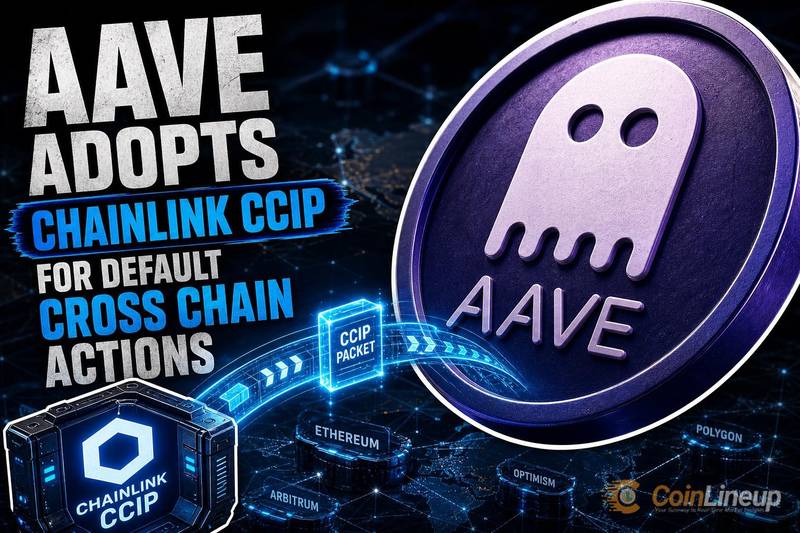
The integration, announced by Aave, positions CCIP as the primary messaging and execution layer for Aave’s cross-chain operations. Cross-chain actions in this context refer to governance votes, token transfers, and protocol messages that need to travel between different blockchain networks where Aave is deployed. For related coverage, see Aave Files Emergency Motion Over Frozen ETH in New York.
For a protocol that operates across multiple chains, standardizing on a single cross-chain framework reduces the complexity of maintaining separate bridge integrations. CCIP provides a unified messaging layer, meaning Aave governance decisions executed on one chain can propagate to deployments on other networks through a consistent pipeline. For related coverage, see Hyundai Completes USDT Treasury Pilot on Avalanche.
Why CCIP over alternatives
Security appears to be the central factor. Cross-chain bridges have historically been among the most exploited components in DeFi, with billions lost to bridge hacks. By defaulting to CCIP, Aave aligns its cross-chain security model with Chainlink’s oracle network infrastructure, which already underpins much of Aave’s price feed architecture. For related coverage, see OKX to Suspend Solana USDC Deposits and Withdrawals: What Users Need to Know.
The decision also connects to Aave’s broader multichain strategy. A governance proposal on Aave’s forum previously explored using CCIP for GHO, Aave’s stablecoin, as part of a cross-chain deployment strategy. The adoption of CCIP as the default for all cross-chain actions extends that approach protocol-wide.
Rather than replacing a single prior solution, the move establishes CCIP as the preferred standard going forward. This reduces fragmentation across Aave’s multichain deployments, where different chains previously may have relied on different messaging solutions.
Impact on Aave users and DeFi interoperability
For Aave users, the immediate effect is on governance and protocol coordination rather than day-to-day lending and borrowing. Governance proposals that affect multiple chains can now execute through a standardized path, reducing the risk of message failures or delays between deployments.
The adoption also signals a broader trend in DeFi toward standardized cross-chain rails. As protocols like Aave commit to specific interoperability frameworks, it creates pressure for other major protocols to align on compatible standards. This is particularly relevant given Aave’s ongoing work across its V3 markets and the operational complexity of managing parameters across chains.
Cross-chain security remains a persistent challenge for DeFi broadly. The Bonzo Lend exploit, where a zeroed oracle signature led to a $9 million loss, illustrates how oracle and messaging infrastructure failures can cascade into protocol-level damage. Aave’s decision to consolidate on a single, established cross-chain provider reflects an industry-wide shift toward reducing the attack surface of multichain deployments.
Specific rollout timelines and the full list of supported networks for the CCIP integration were not detailed in the initial announcement. How quickly the transition completes across all of Aave’s active deployments will determine the practical impact for developers building on top of the protocol.
Disclaimer: This article is for informational purposes only and does not constitute financial or investment advice. Cryptocurrency and digital asset markets carry significant risk. Always do your own research before making decisions.


