Who This Guide Is For
This guide is for people who hold SOL, or plan to, and keep hearing that “staking” can earn them a yield. You do not need to know what a validator is. We explain every term the first time it appears. It is also for readers who already stake and want to know what Marinade actually is in late 2026, because the product has changed a lot. The site that used to be a single “stake SOL, get mSOL” page is now a full app with four tabs, three earning products, a borrowing screen and a validator explorer, and its homepage now talks about a Visa card.
We did not just read the marketing. We opened the live app on a desktop, a tablet and a phone, connected a throwaway wallet, walked through every screen we could reach, and checked the numbers against independent sources. Where we could not test something, we say so.
How We Tested Marinade
| Device | Viewport | What we did |
|---|---|---|
| Desktop | 1440 x 900 | Homepage, docs, full app walkthrough after connecting a wallet |
| Tablet | about 820 to 1024 px wide | Homepage, docs, and the Earn, Native, Portfolio, Borrow and Explore screens |
| Phone | about 390 to 430 px wide | Same screens, including the bottom navigation bar the app uses on phones |
The Wallet We Used
We used a brand new, throwaway MetaMask profile created only for testing. MetaMask can offer a Solana account as well as Ethereum accounts, and Marinade’s wallet picker listed MetaMask as an installed wallet. The account held 0 SOL, 0 mSOL and 0 USDC. We did not deposit anything, we did not sign any transaction, and we did not approve any spending permission. The only approval we gave was the connection request, and MetaMask’s own popup told us that this permission “cannot move funds without your permission.”
What we did not do is just as important, and we list it in full in the FAQ at the end. In short: no staking, no unstaking, no mSOL minting, no USDC deposit, no loan, no MNDE staking and no voting.
Quick Verdict
Marinade is one of the longest-running and most transparent staking projects on Solana. It has a clean audit trail going back to 2021, no entry in the DefiLlama hacks database, a fee table that says “no deposit fee and no performance fee” in plain words, and an Explore page that shows which validators actually pay stakers well and which ones do not. The weak points are commercial rather than technical: the staked amount on the Native product visibly fell during the last month, the MNDE token trades about 99 percent below its all-time high, the homepage’s “up to 11.1% APY” does not match any rate we could find in the app, and the numbers for “how much is staked” differ by hundreds of millions of dollars depending on where you look.
| Item | Detail |
|---|---|
| Project | Marinade Finance |
| Website | marinade.finance (the app and the homepage now share one site) |
| Chain | Solana |
| Products we reached | Marinade Native, Marinade Liquid (mSOL), USDC Vault, Borrow, Explore |
| Token | MNDE (governance) and mSOL (liquid staking token) |
| Our editorial score | 3.9 out of 5 |
| Wallet needed to browse | No. Most pages open without signing in |
| Money at risk in our test | None |

What Is Marinade (Plain English)
Think of the Solana network as a very large bank vault that needs thousands of night guards. Those guards are called validators: computers run by companies and individuals that confirm every transaction. To make sure the guards behave, the network lets ordinary people lend their SOL to a guard. That is staking. In return, the network pays a reward, a bit like interest. The catch is that your SOL is then tied up, and picking a good validator is homework most people do not want to do.
Marinade is a service that does the homework for you. You hand it your SOL, and it spreads the stake across many validators, and it keeps moving the stake to the ones that pay stakers the most. You earn the staking reward and Marinade takes no cut of it (we verify that claim in the fees section).
In plain terms
- You lend SOL to the network and get paid for it. Marinade just picks the validators for you.
- Your SOL is not “sold” to Marinade. In the Native product the stake stays in accounts controlled by your own wallet. That is the main reason the product is called “self-custodial.”
- Because Marinade spreads stake across 50 or more validators, one bad validator cannot take down your whole position.
The Four Roles on Marinade
| Role | Who they are | What they do |
|---|---|---|
| Staker | You | Deposit SOL and receive rewards |
| Validator | A company or individual running a Solana node | Confirms transactions and earns stake by offering stakers a good yield |
| Marinade | The protocol and its team | Runs the auction that decides which validators get stake, and the app you click |
| MNDE holder | Governance voters | Vote on how the protocol and its treasury are run |
Reading that table, notice that Marinade does not run validators itself. It runs an auction. Validators bid to receive your stake, and the winners are the ones that promise stakers the highest yield. The auction is called the Stake Auction Market, or SAM, and we explain it in a later section.
Key Facts
All figures below were read on November 16 and 17, 2026. They are dated snapshots, with the source and date named for each row, because Marinade’s numbers do not agree with each other (see the note after the table).
| Metric | Value | Source and date |
|---|---|---|
| Homepage “Earning with Marinade” | $444M | Marinade homepage, Nov 17, 2026 |
| Homepage “Total rewards distributed” | $320,481,927 | Marinade homepage, Nov 17, 2026 |
| Homepage APY claim | “Up to 11.1%” | Marinade homepage, Nov 17, 2026 |
| Native TVL shown on the Earn card | $282M | Marinade app, Nov 17, 2026 |
| “Total staked” shown in the Earn strategies box | $431M | Marinade app, Nov 17, 2026 |
| Native total staked (chart header) | 3,935,241.62 SOL | Marinade app, Nov 17, 2026 |
| Liquid total staked (chart header) | 2,261,451.74 SOL | Marinade app, Nov 17, 2026 |
| USDC Vault TVL | $1.41M | Marinade app, Nov 17, 2026 |
| Native TVL on DefiLlama | $196.9M | DefiLlama, Nov 17, 2026 |
| Liquid staking TVL on DefiLlama | $161.3M | DefiLlama, Nov 17, 2026 |
| Select TVL on DefiLlama | $71.5M | DefiLlama, Nov 17, 2026 |
| Native APY (14 day average) | 4.86% | Marinade app, Nov 17, 2026 |
| Liquid (mSOL) APY | 5.22% | Marinade app, Nov 17, 2026 |
| USDC Vault APY | 5.70% | Marinade app, Nov 17, 2026 |
| Borrow rates | from 4.94% (SOL) and 5.06% (USDC) | Marinade app, Nov 17, 2026 |
| Founded | 2021, mainnet launch of mSOL in August 2021 | Marinade docs |
Why the numbers differ
- Three products, three DefiLlama pages. DefiLlama splits Marinade into “Marinade Native”, “Marinade Liquid Staking” and “Marinade Select”. Add the first two and you get about $358M. Add all three and you get about $430M, which is close to the $431M the app shows in its Earn strategies box. That is our calculation, and Marinade does not say this is how the box is built.
- The homepage $444M. Our calculation: the app’s Native TVL of $282M plus DefiLlama’s liquid figure of $161.3M equals $443.3M, which is very close to $444M. This is a guess at the method, not something Marinade states.
- App versus DefiLlama on Native. The app shows $282M, DefiLlama shows $196.9M. DefiLlama may price or classify stake accounts differently. We cannot tell which is right, so we cite both.
- The “up to 11.1% APY”. We did not find any product in the app that shows 11.1 percent. The three live rates we saw were 4.86, 5.22 and 5.70 percent. The homepage may be quoting a boosted or promotional rate for the upcoming card product, but the page does not explain it.
A note on a large drop in staked SOL
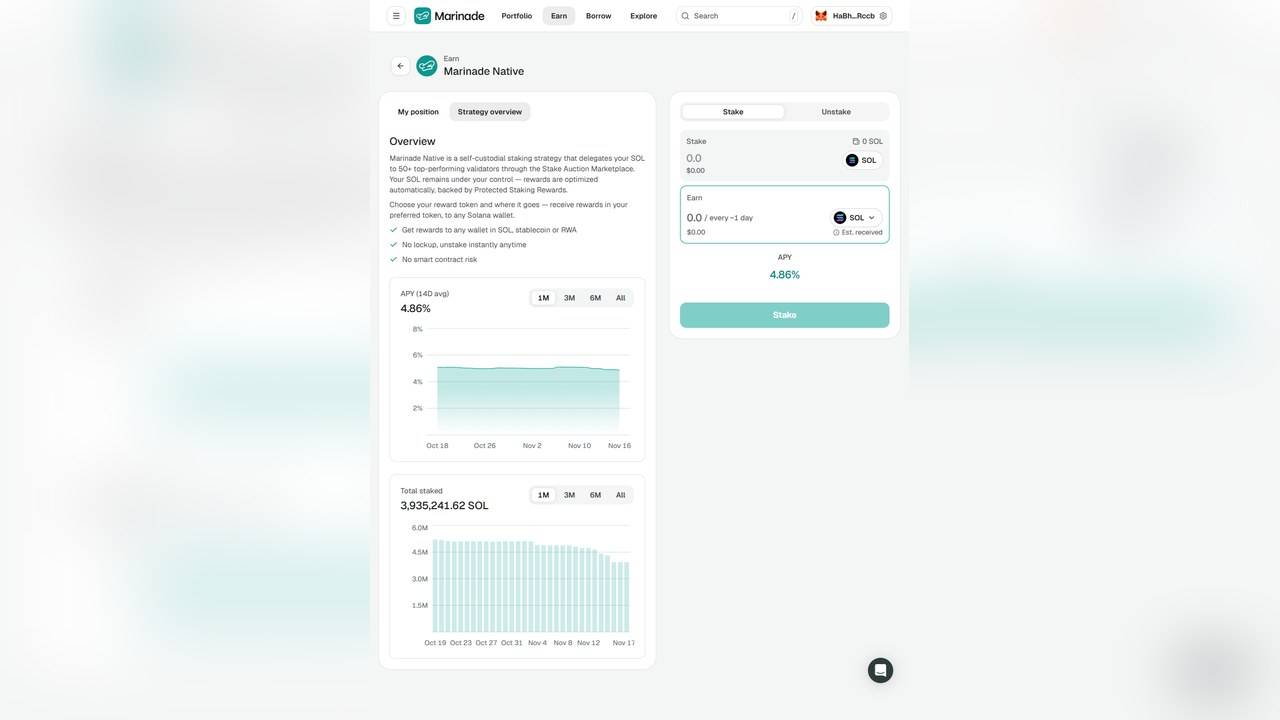
The bar chart on the Native page (“Total staked”, 1 month view) shows a clear downward step. Reading the bars on the tablet screenshot below, the total starts at roughly 5 million SOL around October 19 and ends at 3.94 million SOL on November 17. That is about a fifth less in four weeks. This is our reading of the chart, not a number Marinade publishes. It could come from stakers leaving, from Marinade moving stake between products, or from a price effect on the dollar figures. The chart is in SOL, so price is not the explanation for this particular chart.
Related entries
Marinade is one of several protocols we reviewed in this series. If you are comparing, see our reviews of Rocket Pool (the equivalent for Ethereum staking), Babylon (Bitcoin staking) and Symbiotic (restaking).
How Marinade Looks on Your Device
Desktop
On a desktop the homepage is a dark, photo-led marketing page. The headline reads “Earn on Solana even when you spend,” with an email box for a waitlist and three statistics underneath. The actual app opens at the same domain once you click “Get started” or go straight to a page such as Earn. The app is clean and light-colored, with a top bar (Portfolio, Earn, Borrow, Explore), a search box and a sign-in button.
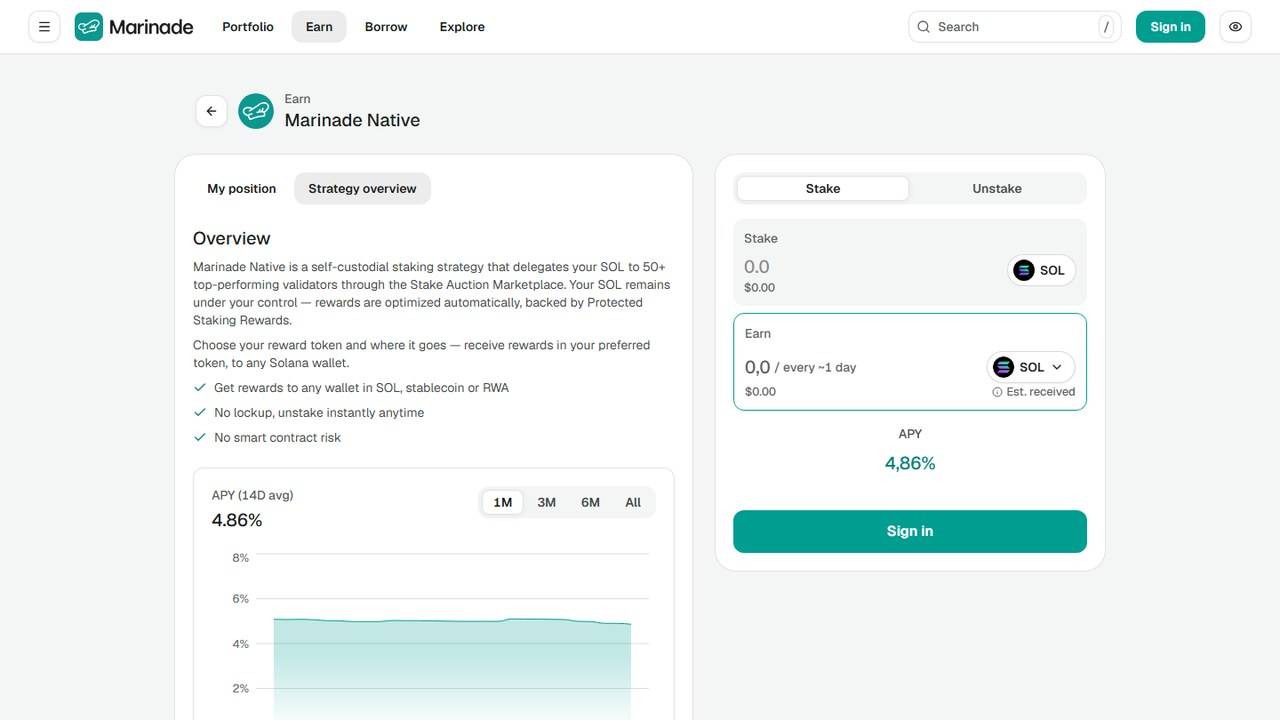
A useful detail: you can read the whole strategy page, the APY chart and the stake calculator without connecting a wallet. The stake box simply shows a “Sign in” button where the “Stake” button would be.
Tablet
On a tablet the homepage keeps the same layout but stacks the statistics under the headline. The app switches to a two-column layout that fits well. We found no clipped text or broken blocks on the tablet screens we checked.

Phone
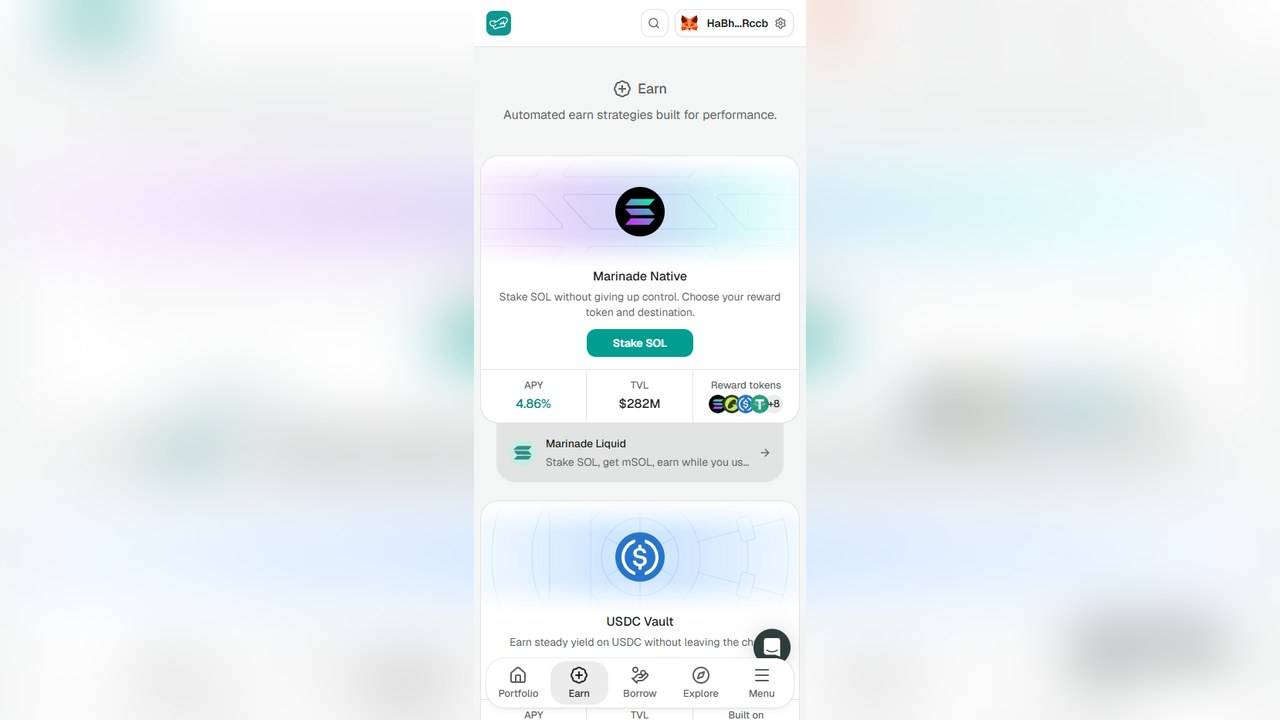
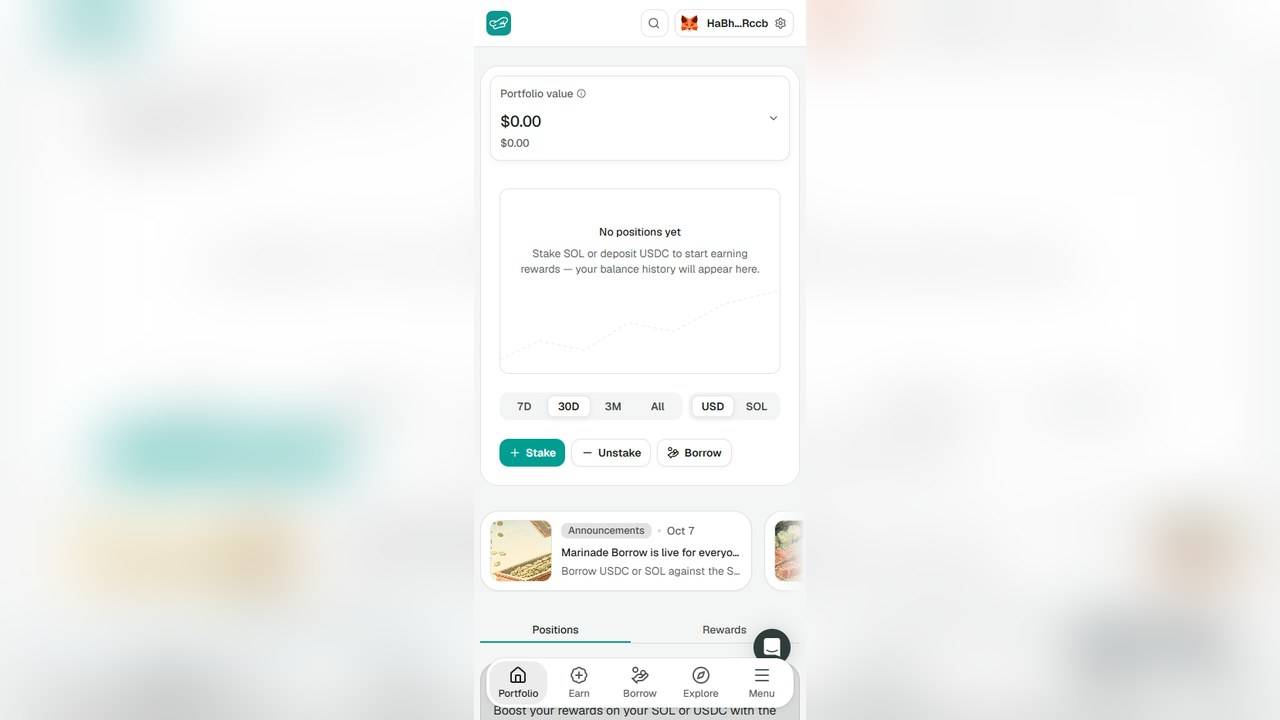
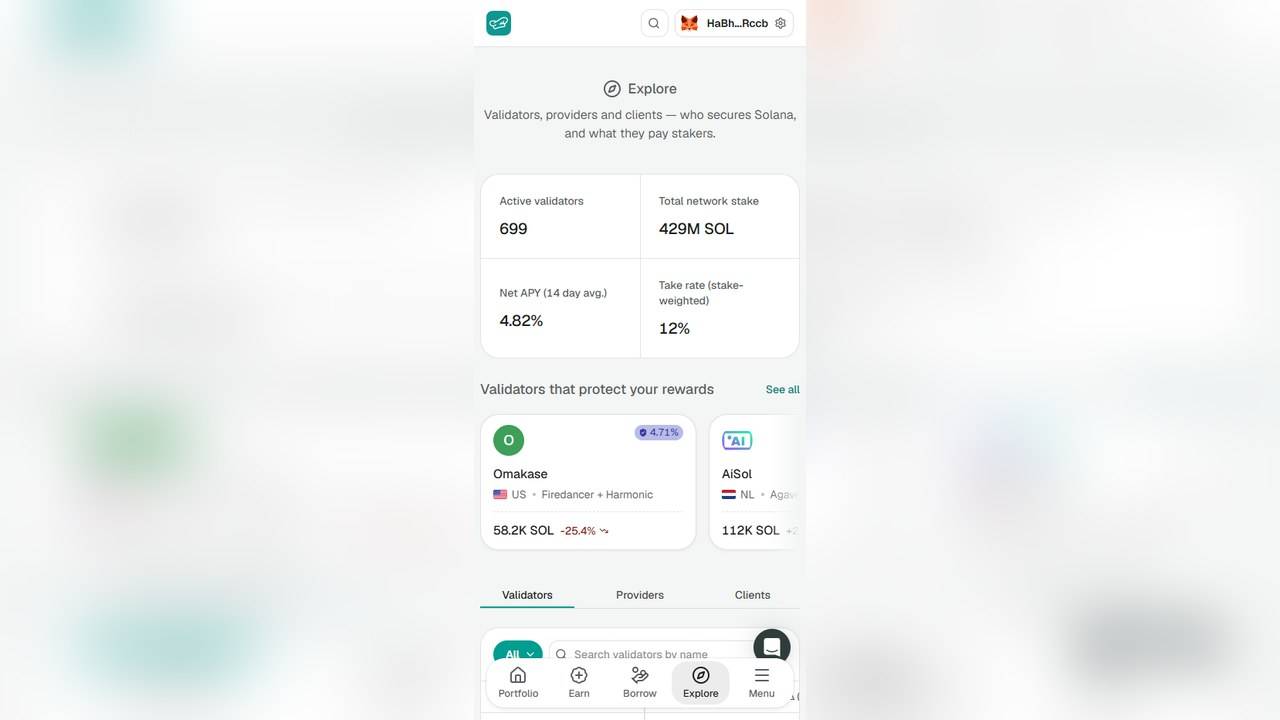
The phone version is the strongest of the three. The top navigation turns into a floating bottom bar with five items: Portfolio, Earn, Borrow, Explore and Menu. On the Native page the stake box moves above the explanation, so you can act first and read later. That is a sensible choice for a phone, though a beginner may prefer to read first.

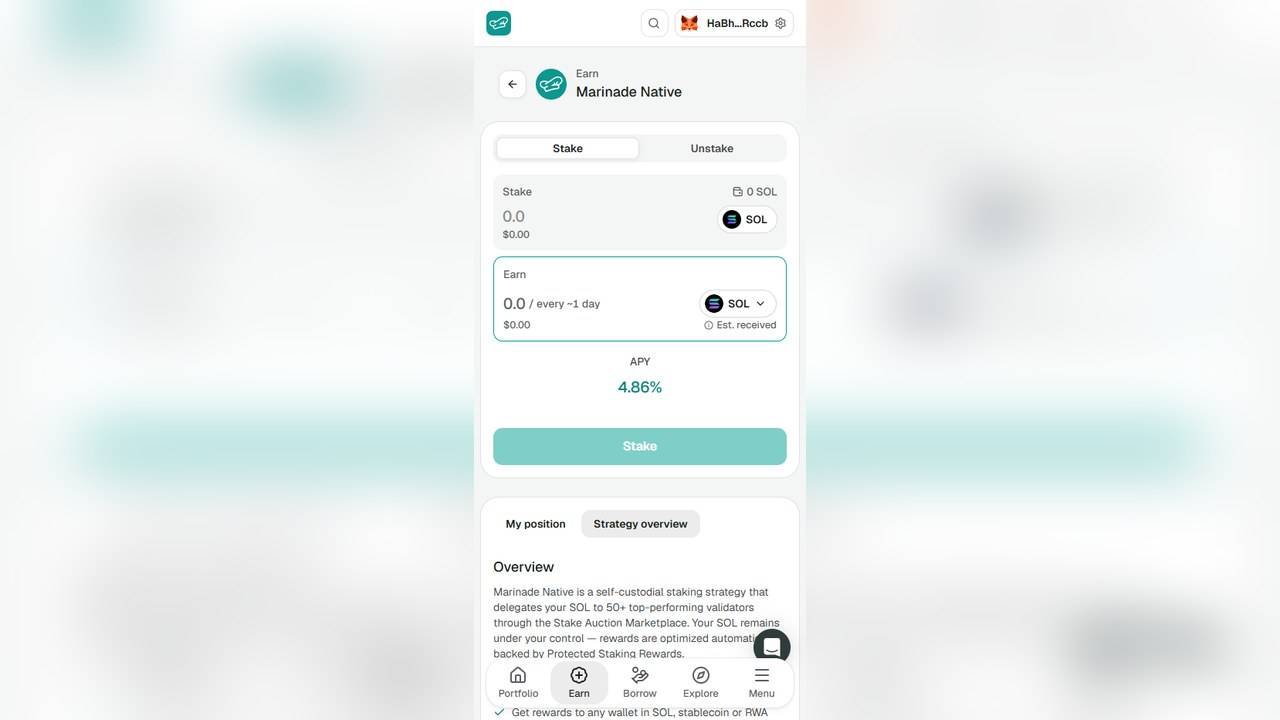
One small usability note: on the phone, the round chat button in the lower right corner sits over the bottom navigation bar on some screens and covers part of a card. It is minor, but it overlaps content in several of our screenshots.
The Marinade Select Page Returned a 404
During our test, the marketing URL marinade.finance/select returned a “404, This page isn’t on the menu” page. The documentation explains why this is probably expected: the Select page says the product is a premium validator set that no longer takes new stake, and tells new users to use Marinade Native instead. Existing Select positions stay in the user’s own stake accounts. Still, a reader who follows an older link or an older article lands on an error page.
Connecting Your Wallet
- Open the app and click Sign in in the top right corner.
- A “Connect wallet” box appears. It lists MetaMask (marked “Installed”) and a “More wallets” option that covers WalletConnect, Ledger and mobile wallets.
- Pick your wallet. Our wallet popup asked us to “Connect this website with MetaMask,” showed the account name and listed the permissions: see addresses, balances and activity, and send requests for transactions. It also said the site cannot move funds without permission.
- Click Connect. The sign-in button is replaced by a shortened address, and every page now shows your own balances.
We did not save a screenshot of the sign-in box itself, so the steps above are from the page text and the wallet popup we read. The result of step 4 is below.
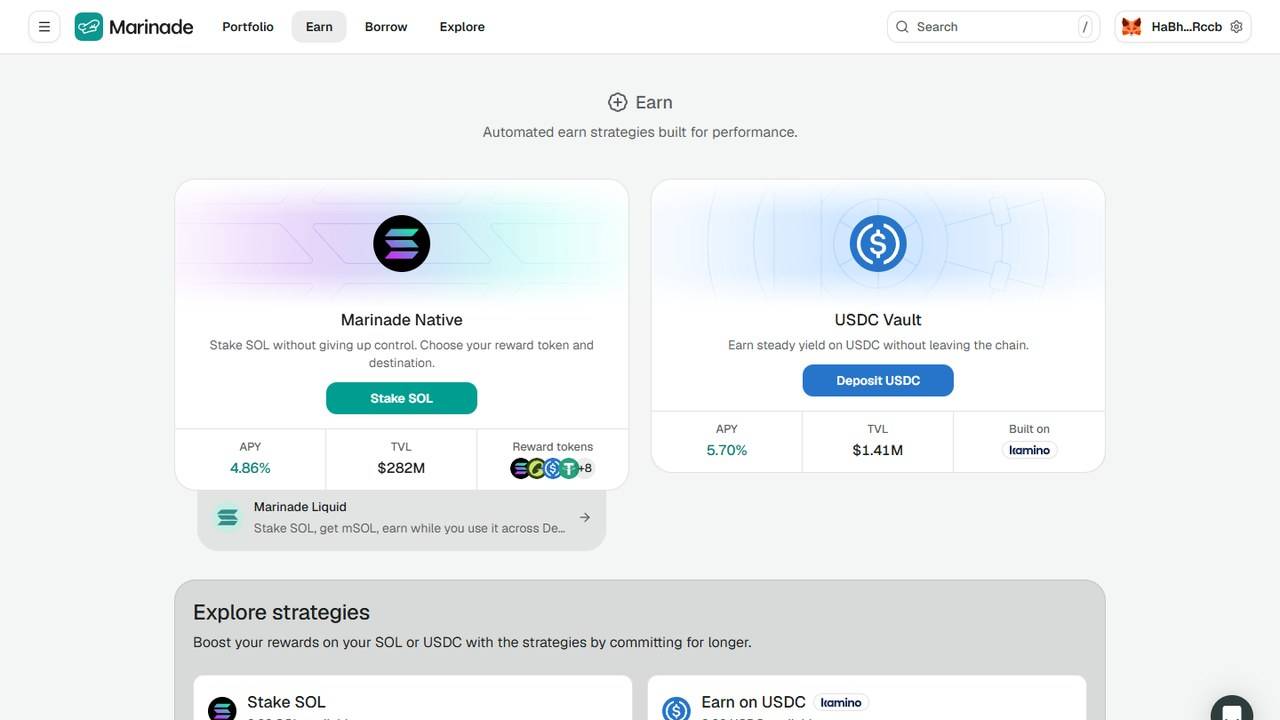
Beginner safety tip: connecting is not the same as paying. Connecting lets the site view the wallet information disclosed in the wallet prompt and request transactions; it cannot move funds unless you approve a transaction in your wallet. Real danger starts at the moment a popup asks you to sign a transaction or approve a spending limit. Read that popup slowly, and never sign something you do not understand. Use a fresh wallet with a tiny amount while you learn.
Core Features at a Glance
| Feature | What it does | Tested by us |
|---|---|---|
| Marinade Native | Stake SOL, receive rewards in SOL or another token, no lockup | Screens and calculator only, no stake |
| Marinade Liquid | Stake SOL, receive mSOL that you can use elsewhere in DeFi | Screens and calculator only, no stake |
| USDC Vault | Lend USDC through Kamino and earn a variable rate | Screens only, no deposit |
| Borrow | Borrow SOL or USDC against staked SOL | Screen only, loan form not reachable with an empty wallet |
| Portfolio | See balances, positions and rewards | Yes, empty wallet |
| Explore | Compare validators, providers and software clients | Yes |
| Reward token choice | Receive Native rewards in SOL, BTC, ETH, stablecoins and more | Opened the picker, no change saved |
| MNDE governance | Stake MNDE, vote, claim buyback rewards | Docs only |
| Visa card (waitlist) | Spend from a portfolio that earns yield | Not tested, no email entered |
Feature 1: Marinade Native
Native is now the main product. The page calls it “a self-custodial staking strategy that delegates your SOL to 50+ top-performing validators through the Stake Auction Marketplace.” Three checkmarks sit underneath: rewards can go to any wallet in SOL, a stablecoin or a tokenized real-world asset, there is no lockup and unstaking is instant, and there is “no smart contract risk.”
That last claim deserves a careful reading. Native stake stays in stake accounts owned by your wallet, so Marinade’s own program does not hold your SOL in a pool. That removes one risk. It does not remove all risk. Your SOL is still staked with validators, the app and the delegation logic are still software, and the rewards depend on how well the validators perform. Treat “no smart contract risk” as “no pooled-contract risk” rather than “no risk.”
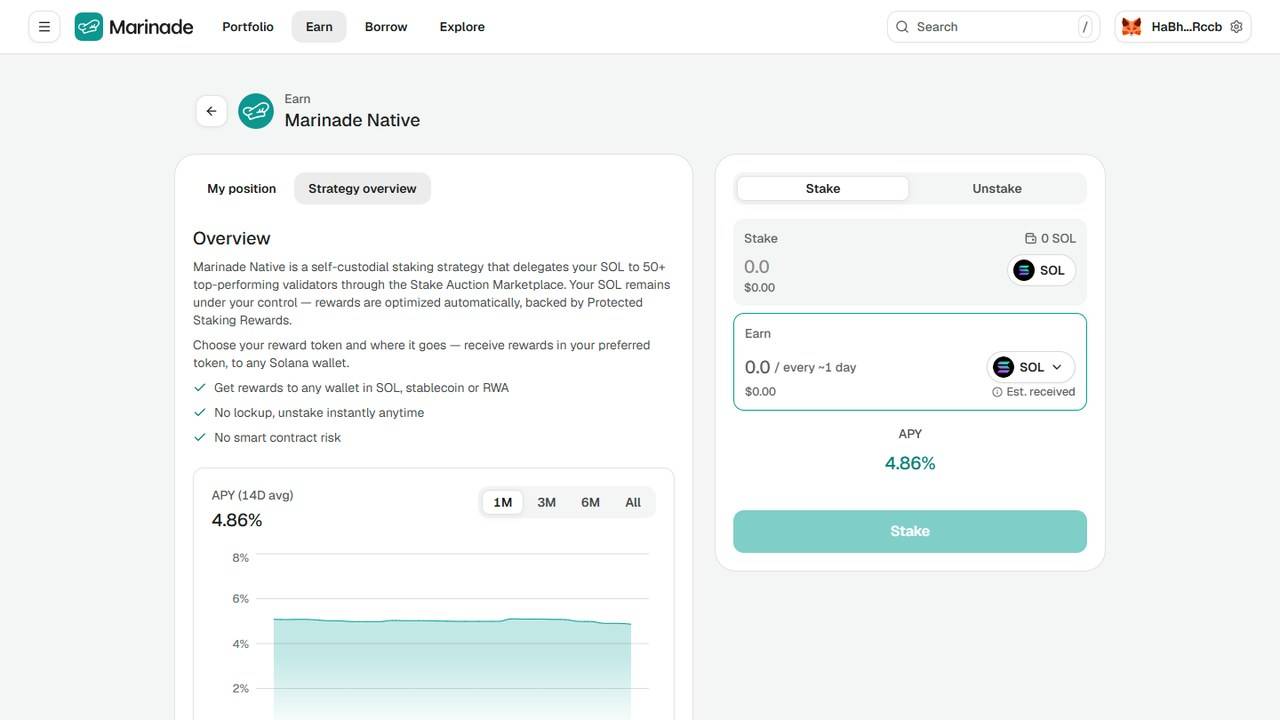
What we saw on the page
- A stake box with an amount field, your SOL balance and an “Earn” box under it that estimates how much you will receive “every ~1 day.”
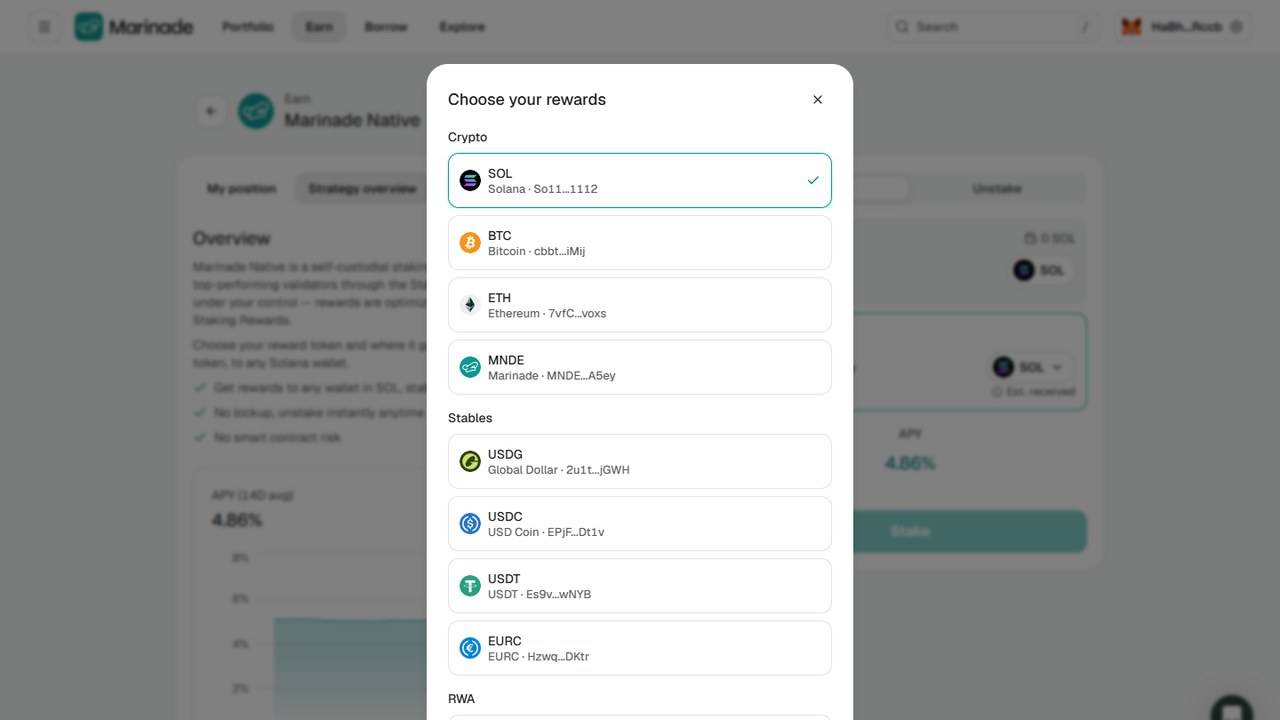
- A reward token selector. Marinade lets you take rewards in a different token. We opened the picker and saw SOL (selected), BTC, ETH and MNDE under “Crypto,” then USDG, USDC, USDT and EURC under “Stables,” and a “RWA” group below. This is unusual and is the most original feature in the app. It lets you stake SOL but be paid in dollars.
- An APY chart with 1M, 3M, 6M and All ranges. The 14 day average was 4.86 percent, and the line was flat over the month.
- A “Total staked” chart that showed the decline we described above.
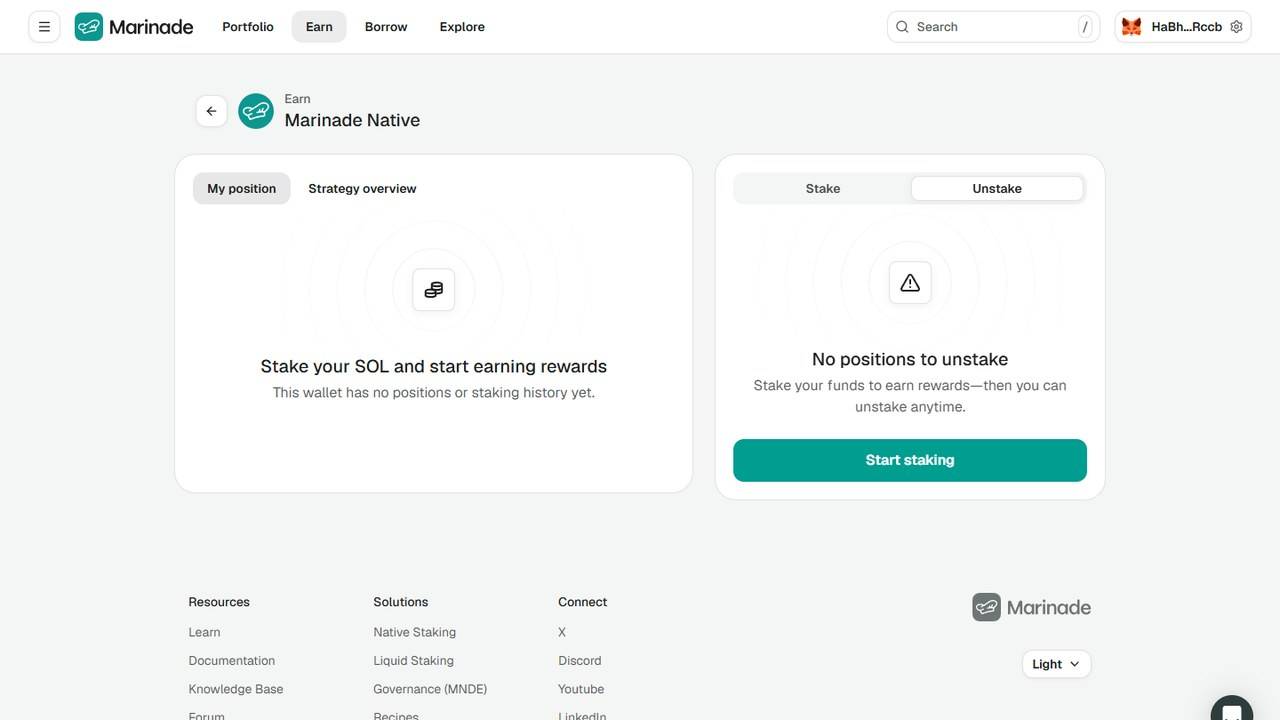
- Two tabs, “My position” and “Strategy overview.” On our empty wallet, “My position” said “This wallet has no positions or staking history yet,” and the Unstake tab said “No positions to unstake” with a “Start staking” button.
What the docs say about leaving
The fee page says Delayed Unstake on Native costs a flat 0.003 SOL and completes after one epoch, “currently about 1 day.” Instant Unstake sells the position for SOL within seconds, with a dynamic cost that the docs put at typically 0.10 to 0.40 percent in total, and needs a stake account of at least 1 SOL. Stake that is still warming up or cooling down cannot be sold instantly. We did not test either exit.
Feature 2: Marinade Liquid (mSOL)
Liquid is the original Marinade product, and it is the one most people know. You deposit SOL and receive mSOL, a token that represents your share of the pool. The page says mSOL “accrues staking value over time,” and you can use it elsewhere on Solana as collateral, in liquidity pools or for lending.
The simplest way to picture mSOL is a gift card whose balance grows. You do not get more tokens each day. Instead, each mSOL becomes worth a little more SOL as rewards pile up. The docs give the formula: the price of mSOL equals total staked SOL divided by mSOL minted.
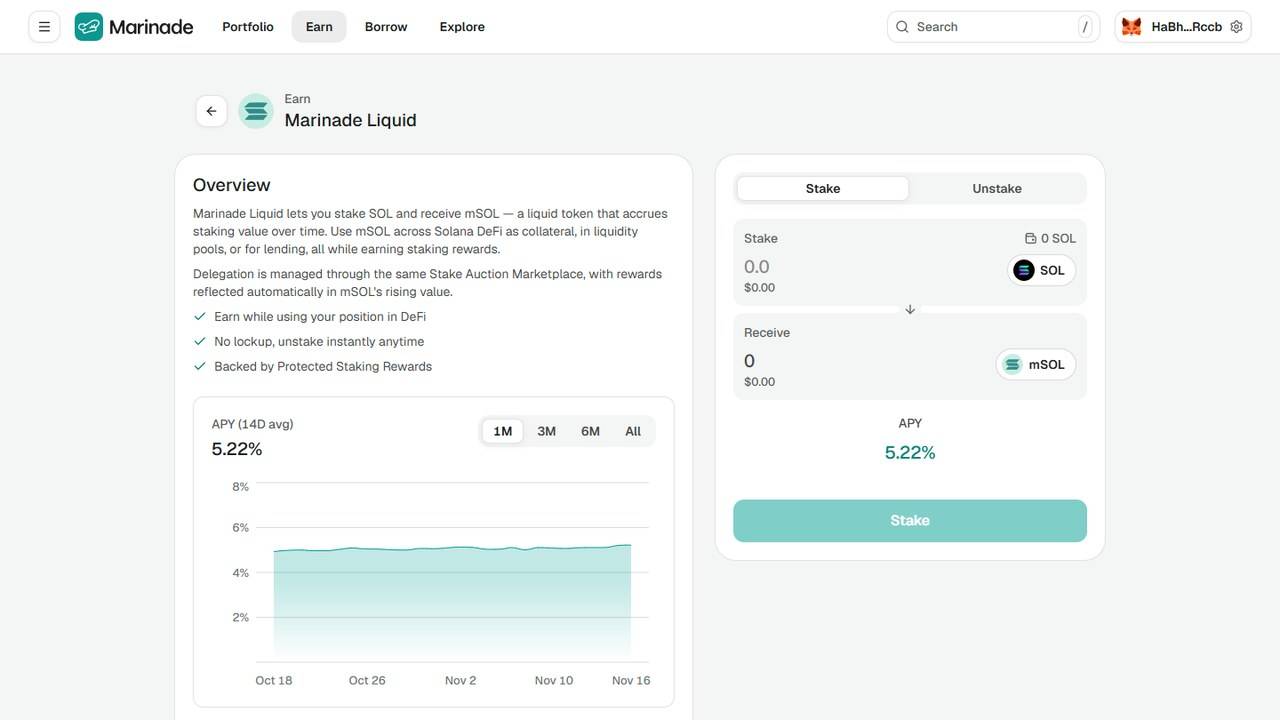
On our visit the Liquid page showed a 5.22 percent APY (14 day average) and a total of 2,261,451.74 SOL staked. The docs say Marinade displays a 30 day simple moving average of the 14 day APY, which smooths out daily noise. mSOL’s market price on CoinGecko was $101.55 on November 17, 2026, with a market cap of $161.9M. Our calculation from those two figures: $161.9M divided by $101.55 is about 1.59 million mSOL in circulation.
Beginners should know one trade-off. Liquid is the only product that has a fee on a normal exit: the docs list a 0.2 percent Delayed Unstake fee for mSOL, deducted before your ticket is credited. A swap on an exchange or a Marinade Instant Unstake route may be cheaper or dearer depending on the pool.
Feature 3: USDC Vault
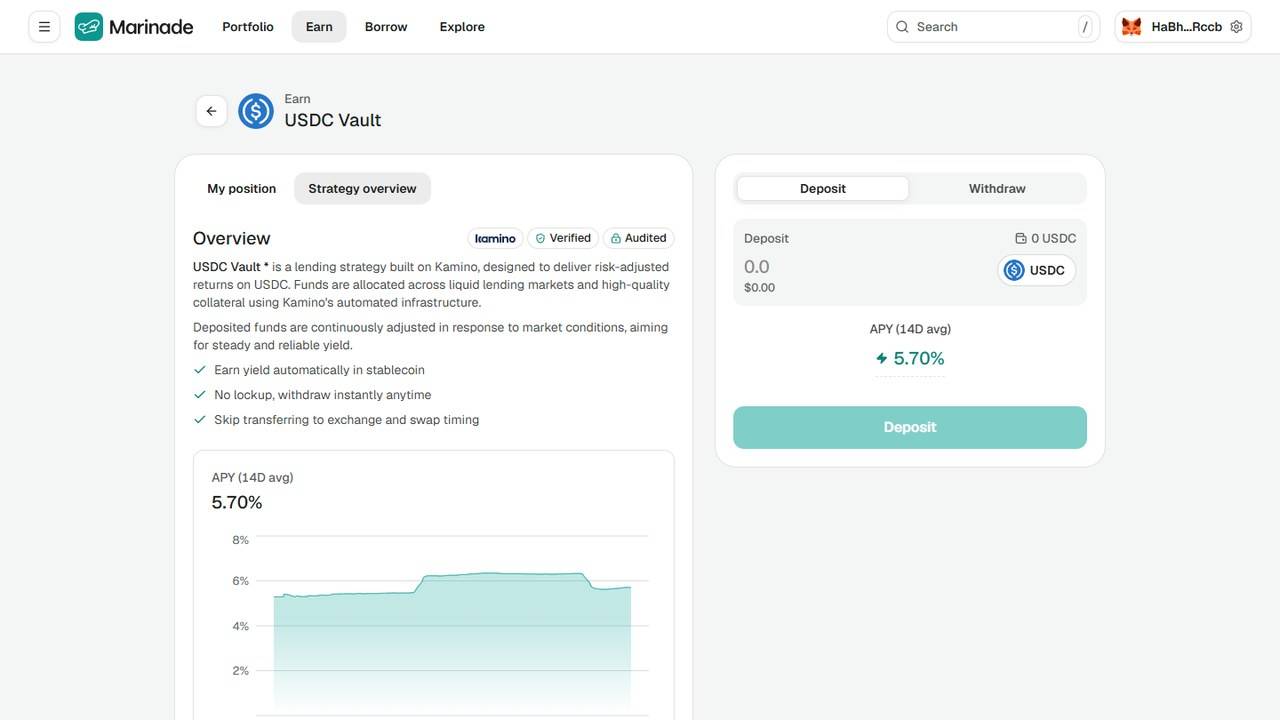
The USDC Vault is a lending product, not a staking one. You deposit USDC, and the funds are lent out through Kamino, another Solana protocol. The page shows “Kamino,” “Verified” and “Audited” badges, and says it aims for “steady and reliable yield.” Our visit showed a 5.70 percent 14 day average and $1.41M of deposits.
Scrolling down reveals the details table: token USDC, vault manager RockawayX, a shortened vault ID, supply APY 5.70 percent and “Lending provided to Kamino.” The page also carries a footnote that we found important: it says Marinade does not manage or have access to users’ deposited funds, does not operate Kamino’s lending markets or smart contracts, and that the vault strategy is managed by RockawayX, not Marinade.
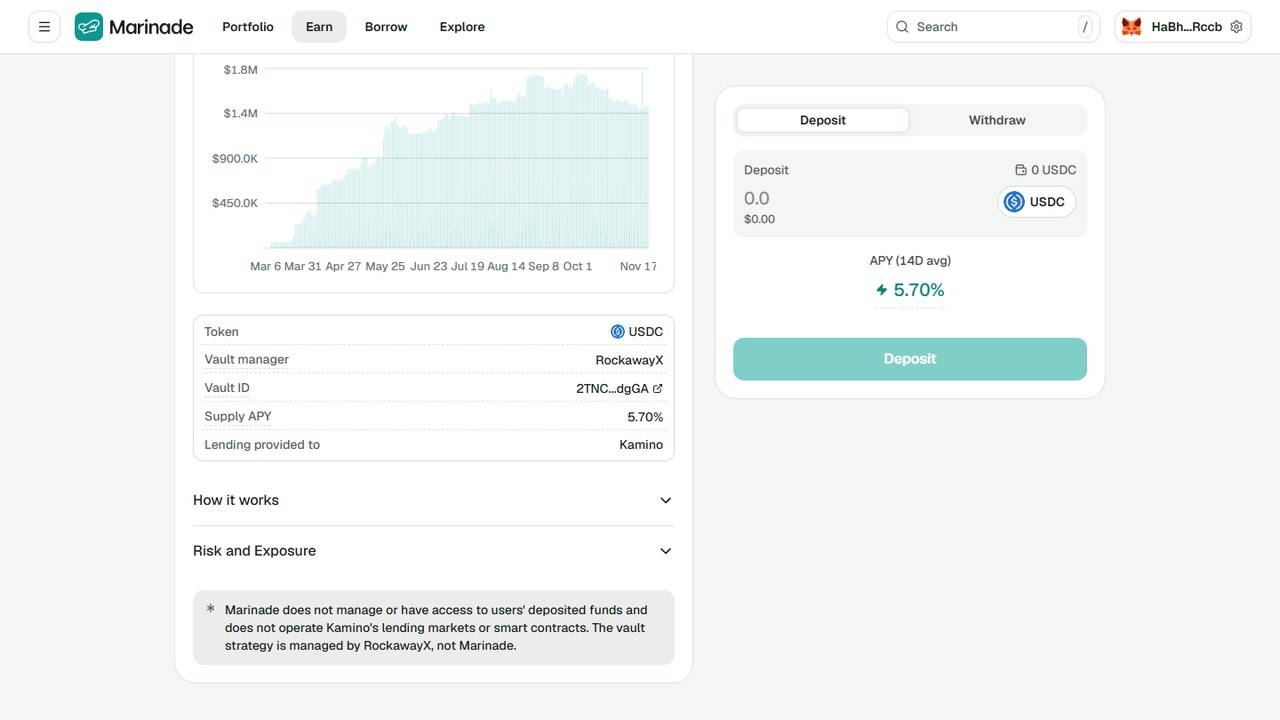
So the USDC Vault is, in effect, a third party’s strategy with a Marinade front door. It is also tiny. At $1.41M it is about half of one percent of the Native figure. The fee page lists a 5 percent performance fee on net interest and no withdrawal fee, but warns that withdrawals depend on lending liquidity and can be limited when utilization is very high. “How it works” and “Risk and Exposure” are collapsed panels under the table. We did not expand them, so we cannot summarize what they say.
Feature 4: Borrow
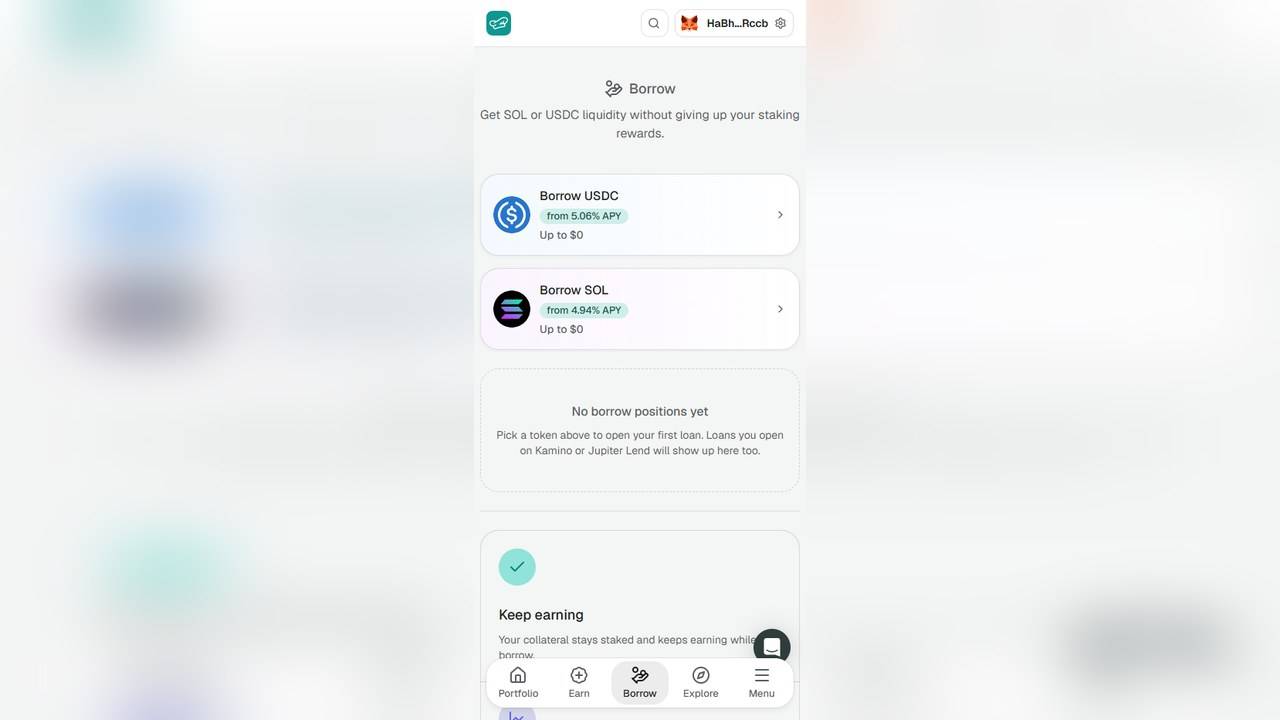
Borrow lets you take out SOL or USDC without selling your staked SOL. The headline says “Get SOL or USDC liquidity without giving up your staking rewards.” Two cards show the entry rates: Borrow USDC from 5.06% APY and Borrow SOL from 4.94% APY. Under them, a dashed box says “No borrow positions yet” and notes that loans opened directly on Kamino or Jupiter Lend will show up here too.
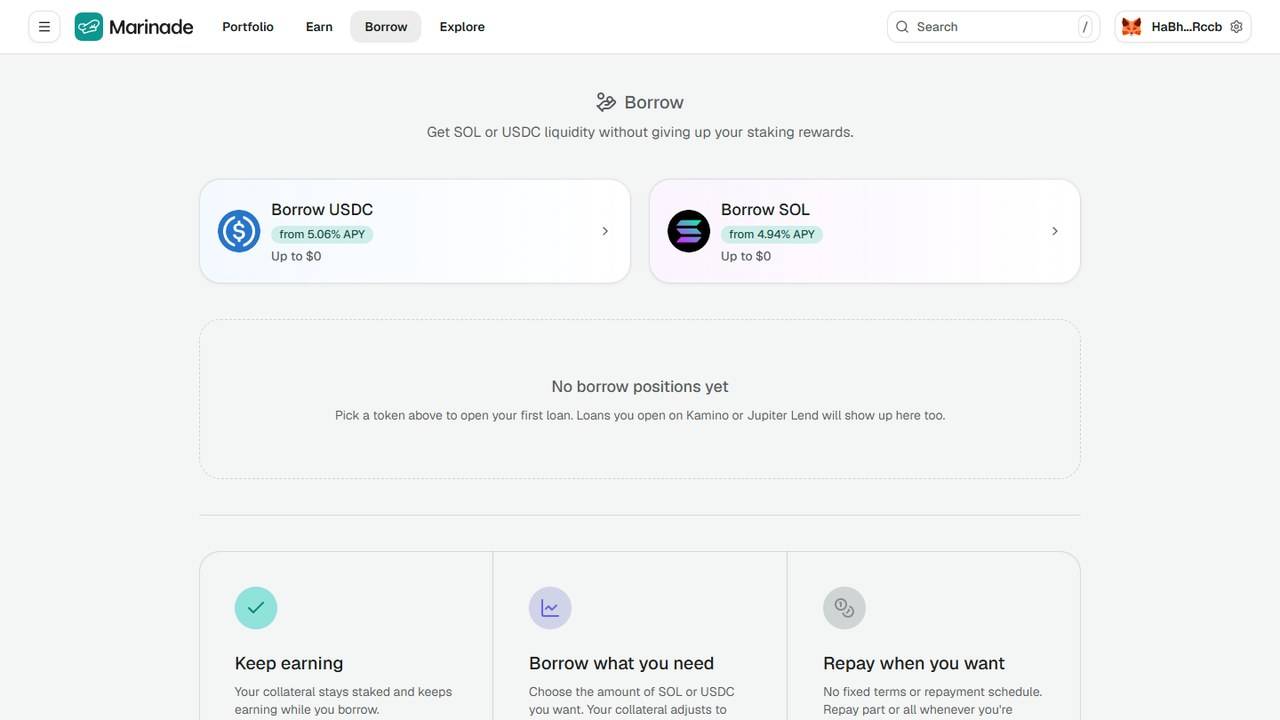
Both cards read “Up to $0” for our wallet, because we held nothing to borrow against. We tried to open each card by clicking it, and the page stayed on the Borrow screen, so we never saw the loan form. We think the cards are inactive when the wallet has no eligible collateral, but we did not confirm that, so treat this as untested.
How Borrow works (docs say)
The documentation describes it in plain terms, and the points below are from the docs, not from our own test:
- Marinade is not a new lending market. A routing engine places the loan on whichever venue has the best rate, currently Kamino or Jupiter Lend.
- You say how much you want to borrow. Marinade then builds the collateral from what you hold, in a set order: stake held outside Marinade, idle mSOL, idle SOL, and finally your existing Marinade stake.
- Whatever is used as collateral is converted to mSOL, but only the minimum needed. The part used as collateral keeps earning staking rewards.
- Opening a loan takes two or three wallet signatures.
- The app keeps 0.04 SOL back for network fees, and blocks every Borrow action when your available SOL is too low. The docs say closing a position takes several transactions.
- The page itself warns that rates are variable and that positions can be liquidated if the loan-to-value ratio crosses the market’s threshold.
A plain-English warning for beginners: borrowing against a volatile asset is the fastest way to lose money in crypto. If SOL falls and your loan is in USDC, the platform can sell your collateral automatically. That is what liquidation means. Do not borrow more than a small fraction of what you hold.
Feature 5: Portfolio
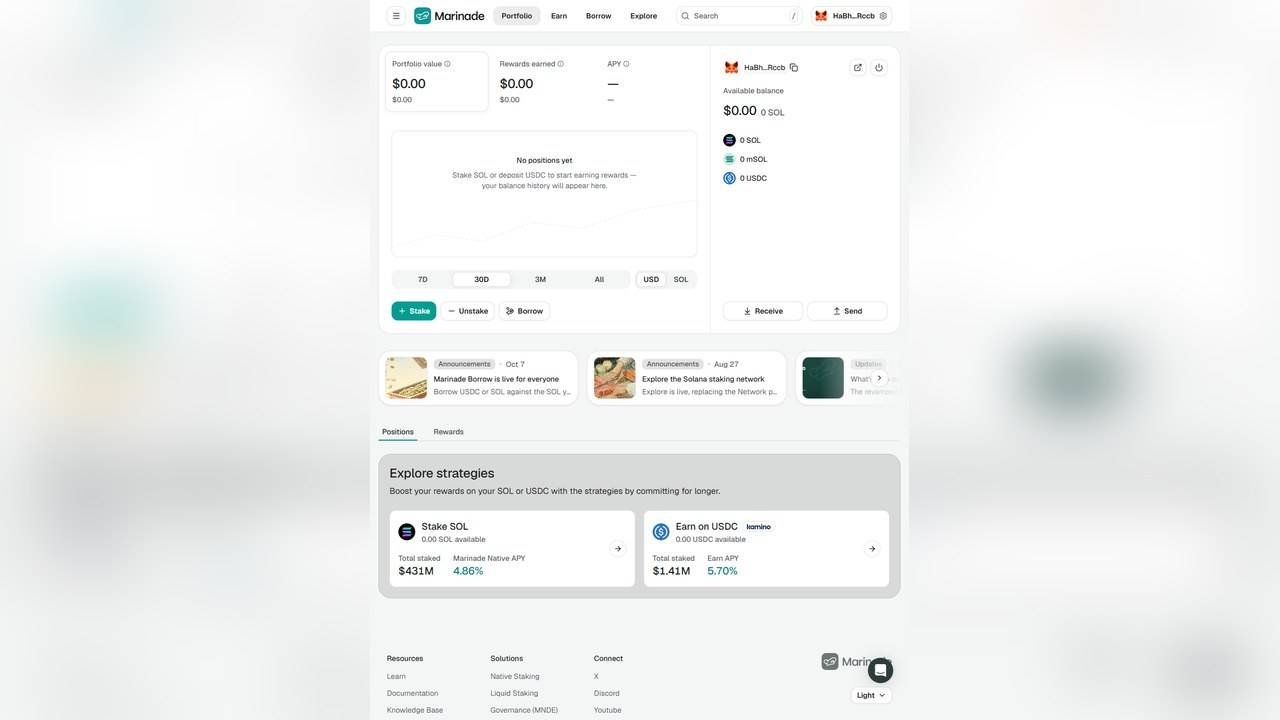
Portfolio is the dashboard. It shows a portfolio value, “Rewards earned,” and a combined APY weighted by how much you hold in each position. Our empty wallet showed $0.00 everywhere and the message “No positions yet.” On the right sits a wallet panel with your shortened address, balances for SOL, mSOL and USDC, and Receive and Send buttons. Below the chart are three shortcut buttons: Stake, Unstake and Borrow. Under those, a row of news cards, and two tabs, Positions and Rewards.
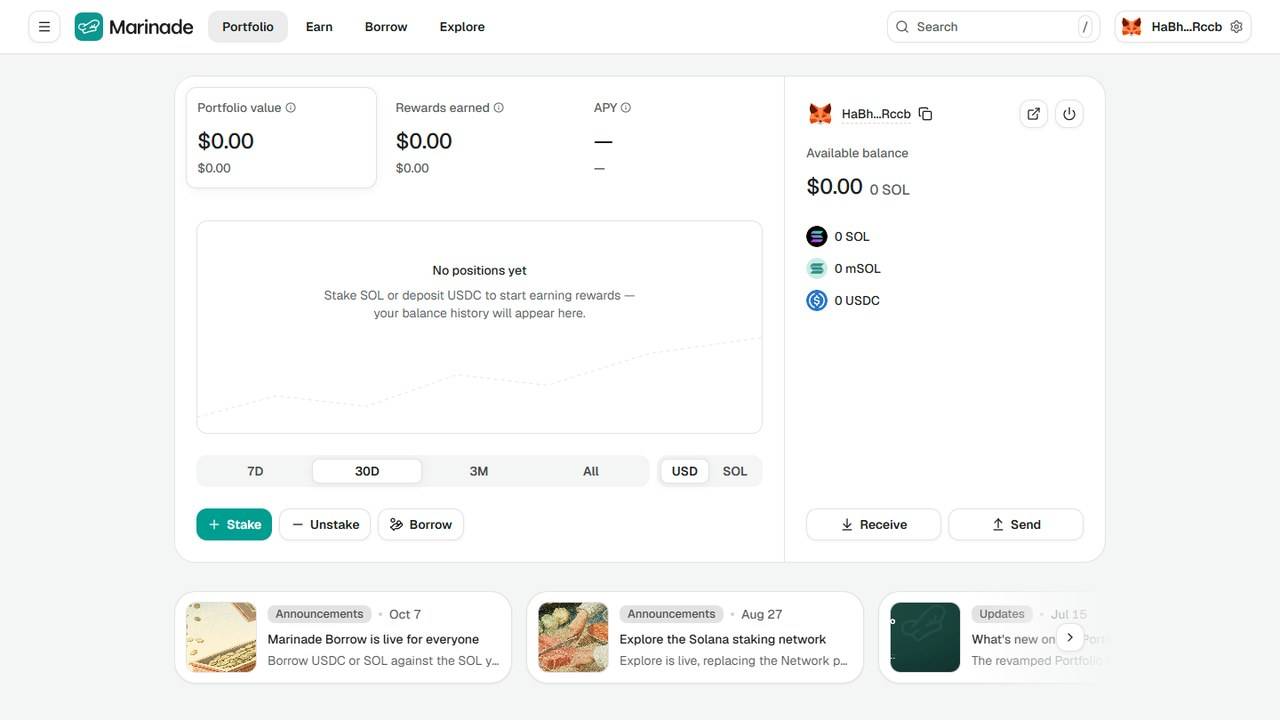
A fine-print line explains what the numbers mean: rewards are “each valued when it was earned,” stake rewards count from when Marinade’s records for your wallet begin, and mSOL gains are not included. That last point matters. If most of your position is mSOL, the “Rewards earned” figure will understate what you really made.
The Receive and Send buttons mean the app can also move tokens around, so treat the wallet panel as live. We did not press either.
Feature 6: Explore
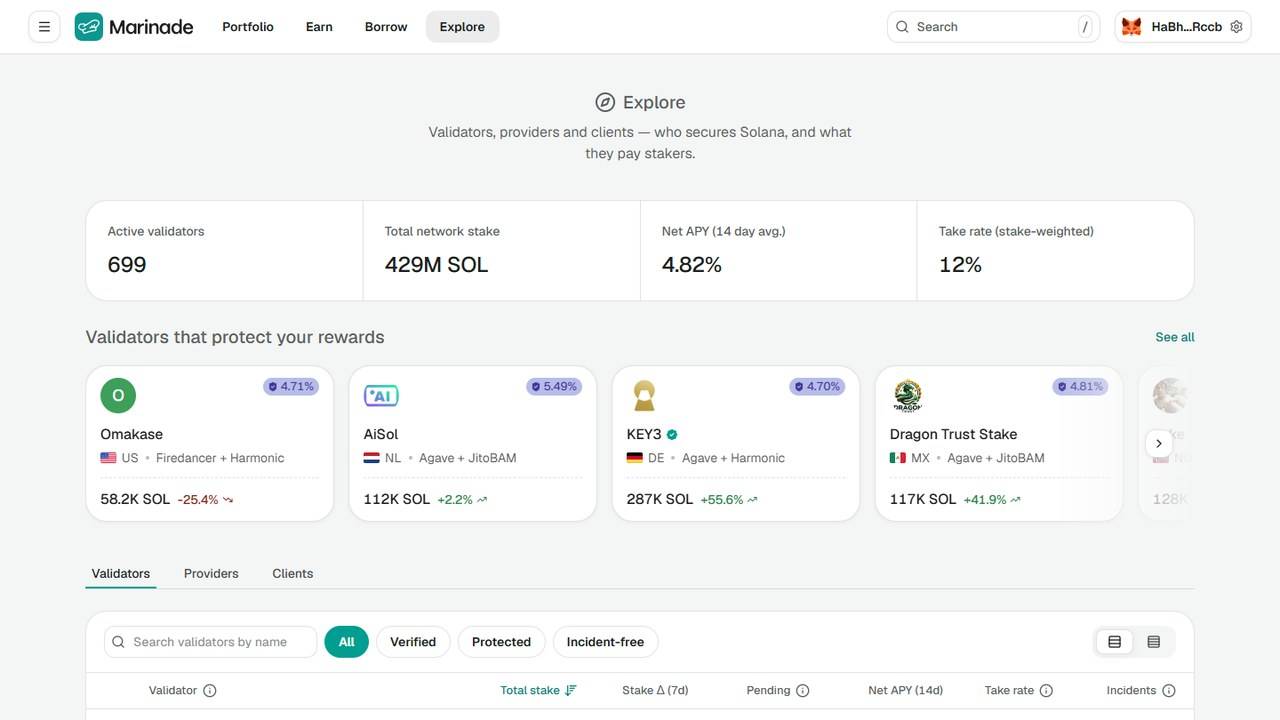
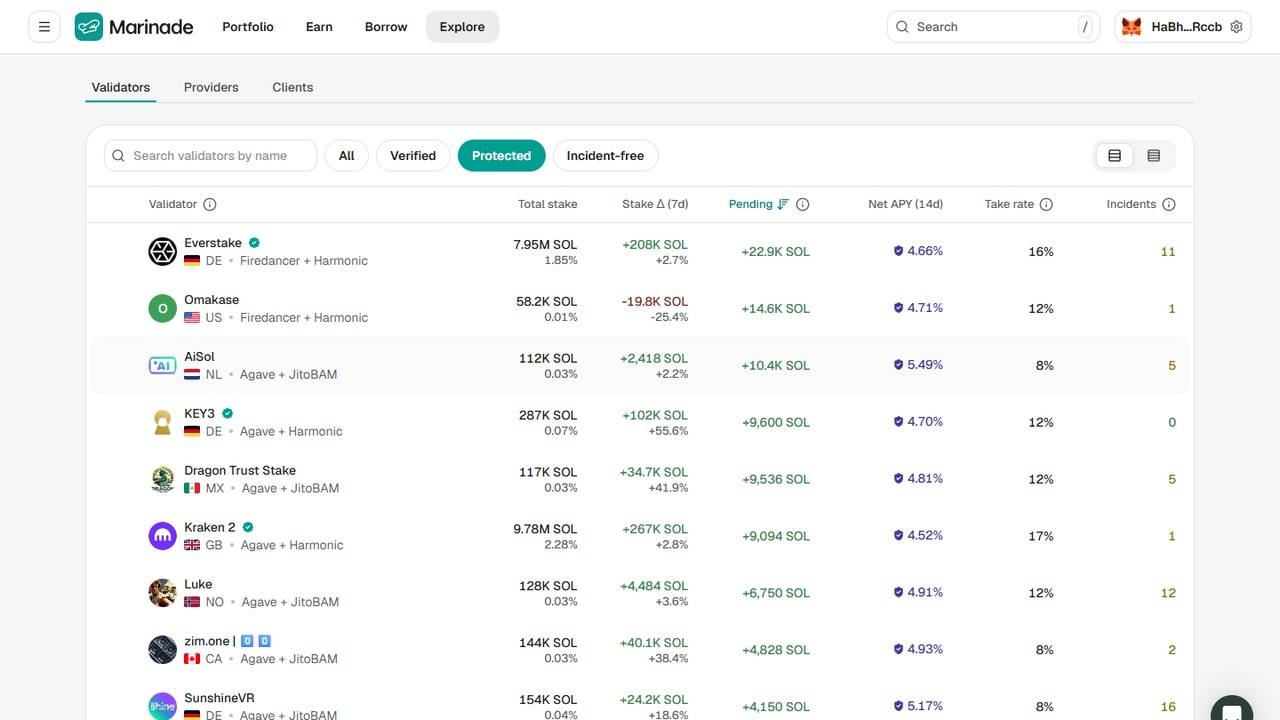
Explore is the most interesting new screen, and it is the one that best shows Marinade’s focus on transparency. The subtitle reads “Validators, providers and clients: who secures Solana, and what they pay stakers.” Four statistics sit at the top: 699 active validators, 429M SOL total network stake, 4.82 percent net APY (14 day average) and a 12 percent stake-weighted take rate.
The “take rate” is the share of rewards a validator keeps for itself before paying stakers. A low take rate is good for you.
The validators table
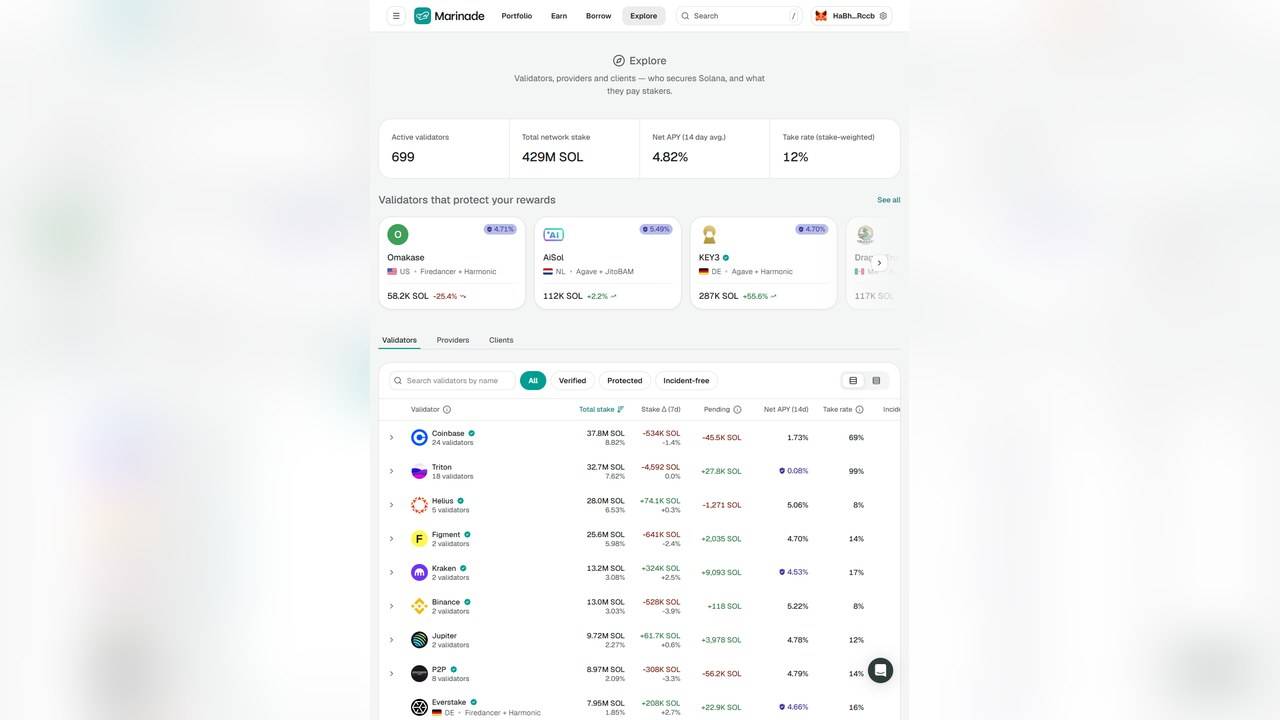
Below a carousel of featured validators, a table lists the validators shown in our app view, ordered by total stake from highest to lowest; no tie occurred among the displayed figures. The numbers we read on November 17, 2026 tell a story the marketing never would:
| Validator | Total stake | Net APY (14d) | Take rate |
|---|---|---|---|
| Coinbase (24 validators) | 37.8M SOL | 1.73% | 69% |
| Triton (18 validators) | 32.7M SOL | 0.08% | 99% |
| Helius (5 validators) | 28.0M SOL | 5.06% | 8% |
| Figment (2 validators) | 25.6M SOL | 4.70% | 14% |
| Kraken (2 validators) | 13.2M SOL | 4.53% | 17% |
| Binance (2 validators) | 13.0M SOL | 5.22% | 8% |
| Everstake | 7.95M SOL | 4.66% | 16% |
The two biggest names on the list keep most of the rewards for themselves. Coinbase’s take rate was 69 percent and Triton’s was 99 percent. If you stake directly with them, you earn a fraction of what the network pays. Part of Marinade’s pitch is that its auction pushes stake toward validators that keep less. These figures are Explore’s own, and we did not check them independently.
Providers and clients
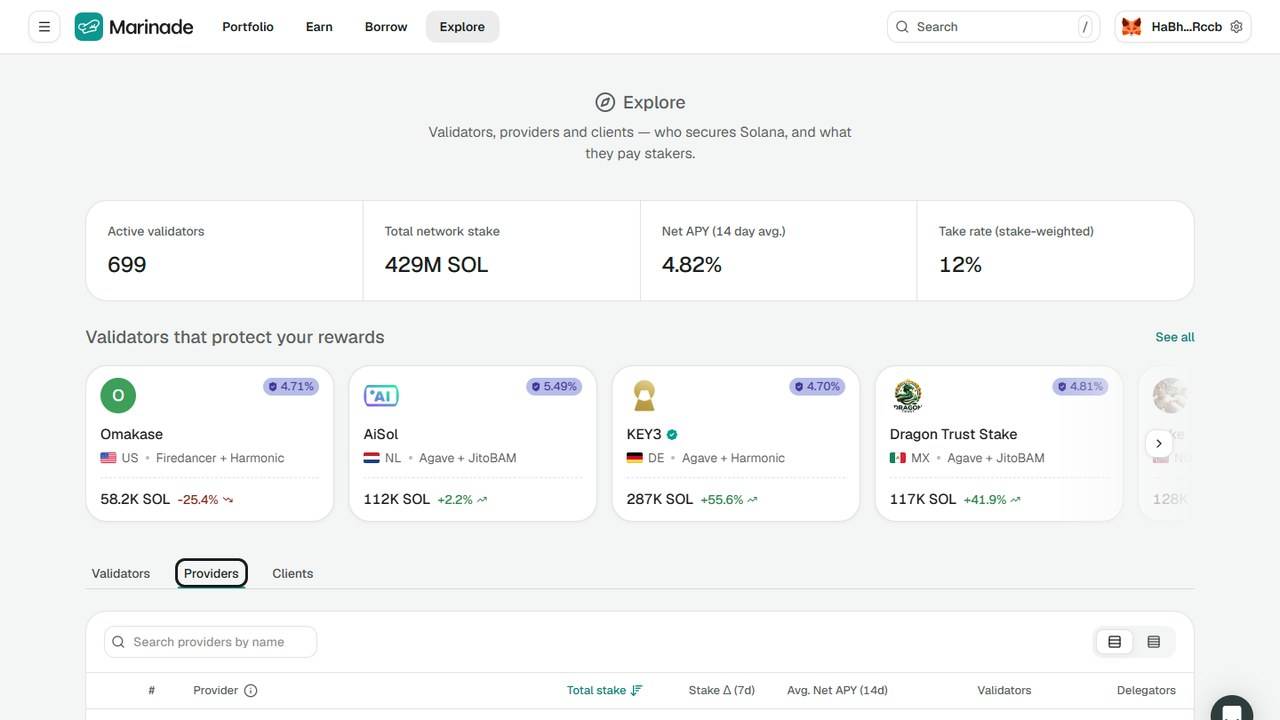
The Providers tab groups validators by hosting company. The largest was TeraSwitch Networks Inc., with 116M SOL (27.18 percent of network stake), followed by UAB Cherry Servers at 61.6M SOL. That concentration is worth knowing: if one hosting company has an outage, a quarter of stake is affected.
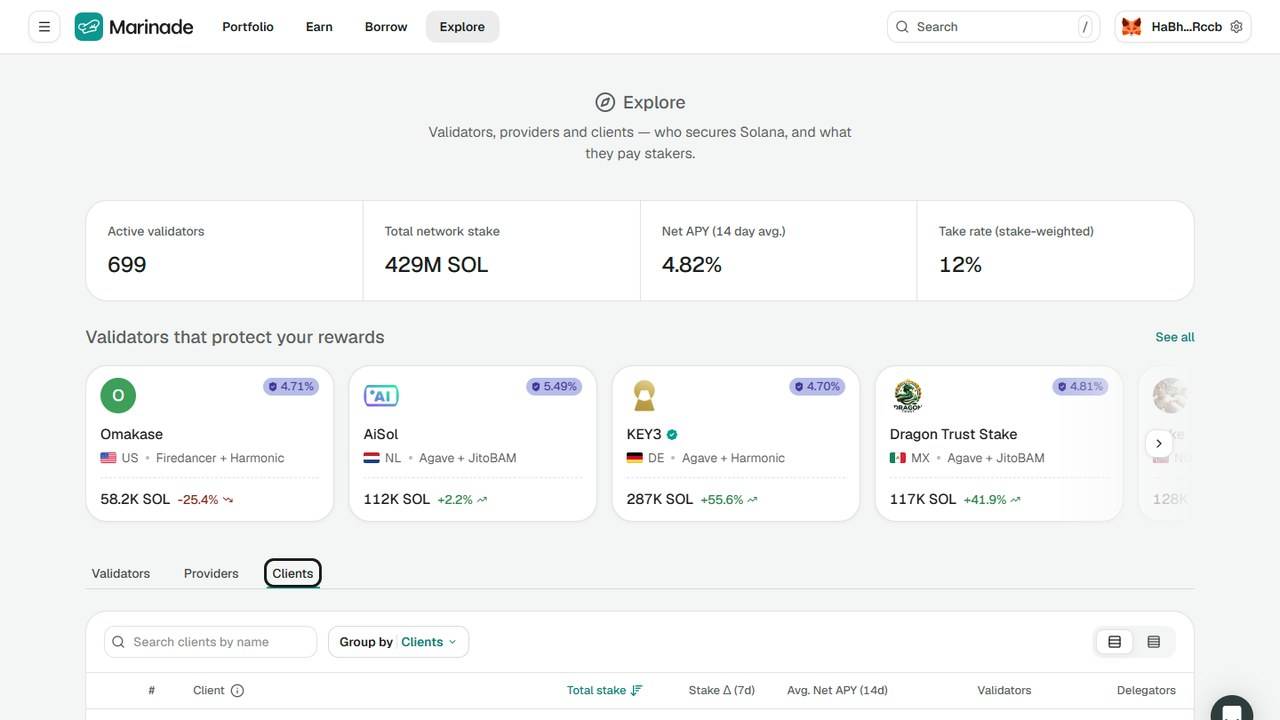
The Clients tab groups validators by software. Agave ran 81.59 percent of stake (350M SOL) and Firedancer 77.6M SOL. A bug in one dominant client can hurt the whole network, which is why the Solana community cares about this split.
The “Protected” filter
The “See all” link opens the table with a Protected filter and sorts it by pending stake. Protected means the validator posts a bond (explained next). The list also shows an Incidents column. Everstake showed 11, Luke 12 and SunshineVR 16, while KEY3 showed 0. The page does not define an “incident” in the view we saw, so use the column as a rough signal only.
Feature 7: The Stake Auction Market and Protected Staking Rewards (docs)
This is the engine under Native and Liquid. We could not test it directly, because it runs in the background, so everything in this section is what the docs say.
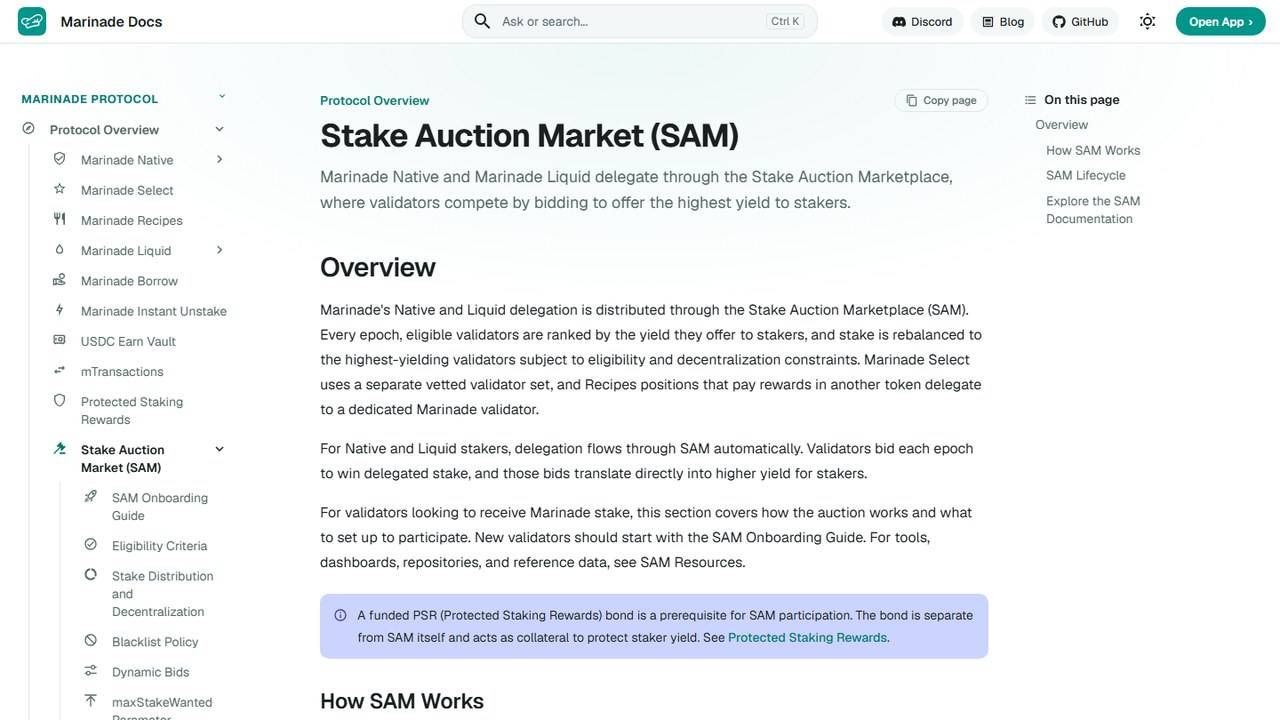
Stake Auction Market (SAM)
Every epoch, Marinade ranks eligible validators by the highest yield they offer stakers, and allocates stake from the top down. The docs call the ranking number max_yield, for example “8% APY on 100k SOL.” It includes the validator’s commission and any extra bid. Validators place bids to get more stake, so a validator that wants your SOL has to promise to share more rewards. The docs say a funded bond is a requirement to take part.
Protected Staking Rewards (PSR)
PSR is Marinade’s safety net for stakers. Each validator in the auction posts a bond, which is SOL set aside as collateral. According to the docs, the bond pays stakers back in three situations: extended downtime that cost them rewards, a validator raising its commission in the middle of an epoch, and a validator that voted but was not admitted to the reward committee. The docs state that MEV and block rewards are not covered, and that PSR only applies to stake delegated through Marinade, not stake you delegated yourself.
The docs also describe a change called MIP-23, effective from epoch 1040, after which validators cover the full downtime charge from their own bonds and the DAO’s reserve no longer absorbs any part of it. In the docs’ words, there is a grace period for the first one percentage point of downtime. We did not read the full formulas.
It is worth being exact about what PSR is. Solana has no slashing today, so PSR is a compensation system funded by bonds, not a punishment system. It protects your yield, not your principal. If SOL’s price falls, nothing here helps you.
Feature 8: Other Products Described in the Docs
The docs menu lists more products than the app shows. We did not test any of these.
| Product | What the docs say | Status for new users |
|---|---|---|
| Marinade Select | Invite-only validator set that excludes superminority validators and blacklisted ones, with a bond of 1 SOL per 2,000 SOL staked | Closed to new stake, use Native |
| Marinade Recipes | Rewards paid in another token, delegated to a dedicated Marinade validator | Appears to be what the reward token picker uses, not confirmed |
| Instant Unstake | Sells a stake position for SOL, usually within seconds | Available on positions of 1 SOL or more |
| mTransactions | Listed in the docs menu | Not tested |
| Visa card | Homepage headline promises a card backed by your portfolio | Waitlist only |
The Visa card is the biggest change of direction. The homepage now sells “Earn on dollars, euros and crypto. Spend anywhere with a Visa card backed by your portfolio.” The only action offered is an email waitlist. We did not enter an email, and we found no card screen inside the app. If you are reading this to decide on a card, there is nothing to test yet.
The MNDE and mSOL Tokens
Marinade has two tokens, and beginners often confuse them. mSOL is the liquid staking receipt that tracks SOL’s value plus rewards. MNDE is the governance token, which lets holders vote on the protocol.
| Metric | MNDE | mSOL |
|---|---|---|
| Price | $0.0197 | $101.55 |
| Market cap | $10.75M | $161.9M |
| Fully diluted valuation | $13.78M | Not applicable |
| 24 hour volume | $19,602 | $736,110 |
| Circulating supply | 546.4M | about 1.59M |
| Total supply | 700.0M | Not applicable |
| Max supply (CoinGecko) | 1,000,000,000 | Not applicable |
| All-time high | $1.64 (down 98.8%) | Not stated |
| 7 day change | down 12.4% | Not stated |
| 30 day change | down 24.6% | Not stated |
| CoinGecko-reported rank | 1,096 | Not stated |
Source: CoinGecko API, November 17, 2026.
Why the numbers differ
- Max supply. CoinGecko lists a max supply of 1 billion MNDE. The Marinade docs say 1 billion was the original supply, that 300 million MNDE were burned under a DAO vote (MIP-14), that the current supply is about 699.99 million, and that minting is disabled because the mint and freeze authorities are set to null on chain. So the real ceiling is about 700 million, and CoinGecko’s “max supply” field looks out of date. We have not read the on-chain mint account ourselves.
- Circulating versus total. About 154 million MNDE are counted as not circulating (700.0M minus 546.4M, our calculation). The docs point to a stats page for the circulating figure, and we did not open it.
How to read this
MNDE trades at a market cap of about $10.75M and about $19.6K of daily volume. That is thin. A holder who wanted to sell a meaningful amount would move the price. For comparison, mSOL has about $0.7M of daily volume, and the app’s Native product alone shows hundreds of millions of dollars staked. The project’s activity and the token’s value are very far apart. Our view is that MNDE is a governance tool first and an investment very far second.
Governance
Marinade runs a DAO. According to the docs:
- Holders stake MNDE on Marinade’s governance page, and voting happens in Realms. Unstaking takes 30 days, but voting power declines steadily to zero during that period, so you can still vote while leaving.
- Under MIP-22, 10 percent of protocol revenue funds open-market MNDE buybacks, distributed each quarter to eligible stakers. To be eligible a wallet must have MNDE staked and must have voted at least once in the trailing 12 months. The Q3 2026 rewards were claimable until April 1, 2027, and the docs warn to claim only through the official app and to treat any other request to connect a wallet as a scam.
- The constitution splits power: MNDE holders control the main program upgrade and treasury, and the core team controls program parameters and fees.
We did not stake MNDE, vote or claim. The docs also say the DAO will not build second-layer DeFi products such as lending or DEXs, which sits oddly with the new Borrow screen. Borrow is routed to Kamino and Jupiter Lend, so Marinade is not building its own lending market, but a reader could reasonably ask how that fits the constitution’s wording.
Fees and Costs
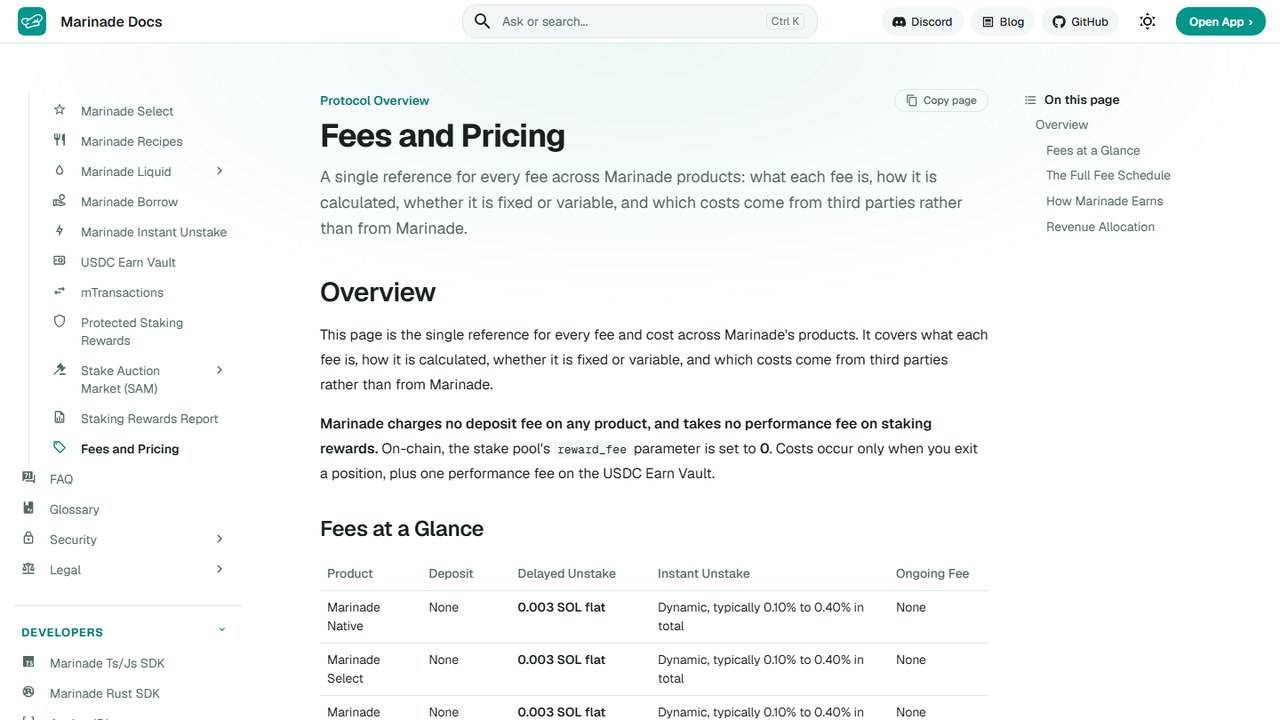
The fee page is one of the clearest we have read in this series. It opens by saying Marinade charges no deposit fee on any product and takes no performance fee on staking rewards, and that the stake pool’s on-chain reward_fee parameter is set to 0. We could not verify the on-chain value ourselves, so this is a docs claim.
| Product | Deposit | Delayed unstake | Instant unstake | Ongoing fee |
|---|---|---|---|---|
| Marinade Native | None | 0.003 SOL flat | Dynamic, typically 0.10% to 0.40% total | None |
| Marinade Select | None | 0.003 SOL flat | Dynamic, typically 0.10% to 0.40% total | None |
| Marinade Recipes | None | 0.003 SOL flat | Dynamic, typically 0.10% to 0.40% total | None |
| Marinade Liquid (mSOL) | None | 0.2% | No Marinade fee on the swap route, 0.03% to 1.5% on the pool route | None |
| USDC Earn Vault | None | No withdrawal fee | Not applicable | 5% of net interest |
Source: Marinade docs, Fees and Pricing, read November 17, 2026.
Three things stand out for a beginner:
- The 0.003 SOL exit fee is flat. It costs the same whether you leave with 1 SOL or 100 SOL. That is almost nothing on a large position and noticeable on a very small one. A standard network fee of 0.000005 SOL applies on top, and the docs say the 0.003 SOL comes out of your wallet’s SOL balance rather than from the amount you unstake.
- Instant Unstake is a cost, not a fee. The docs describe a 0.01 percent protocol fee plus a listing rent of about 0.00097 SOL that is not returned, and the app compares routes. The app shows the total next to the unstake button. We did not reach that button.
- Borrow and the USDC Vault have costs outside Marinade. Borrow interest is set by Kamino or Jupiter Lend, and the vault manager takes the 5 percent performance fee.
Our calculation of what 0.003 SOL means: at the roughly $70 per SOL implied by the app’s own figures ($282M divided by 3.935M SOL is about $71.7), 0.003 SOL is around 21 cents. We use that only as an illustration, not as a live price.
Security
What the docs say
| Area | What we found | Source |
|---|---|---|
| Custody on Native | Stake stays in stake accounts owned by the user’s wallet | Marinade docs and app text |
| Custody on Liquid | SOL is pooled and mSOL is minted against it | Marinade docs |
| mSOL price feeds | Pyth and Switchboard, with a Chainlink partnership announced | Marinade docs |
| Validator protection | Bond-funded Protected Staking Rewards | Marinade docs |
| Governance control | Realms DAO, with a multisig section in the docs menu | Marinade docs |
Audits
The docs audit page lists reports across five years. According to that page:
- 2021: Kudelski Security and Ackee Blockchain audited the original program, and Neodyme published a code review.
- 2023: Neodyme and Sec3 audited the upgraded contract.
- 2024: Neodyme audited the Validator Bonds program and called the design clean with above-standard code quality.
- 2026: Neodyme reviewed new additions to the liquid staking program, including canonical stake accounts and deposit fee functionality, and the docs say it found no issues at any severity level.
DefiLlama’s Marinade Liquid Staking page links Neodyme, Ackee and Kudelski reports and records two audits. These are first-party links, so a reader should open the PDFs rather than rely on the list. We did not read them.
Bug bounty
The docs menu has a Bug Bounty entry under Developers. When we fetched the page by a guessed address it returned a “404 Not found,” so we did not confirm the bounty size or rules. Check the docs menu directly before you assume a reward exists.
Track record
We searched the DefiLlama hacks database on November 17, 2026 for any entry containing the name Marinade and found none. That is a good sign, but it means only “not listed there,” not “never had an incident.”
Risks in plain English
| Risk | What it means | How worried to be |
|---|---|---|
| Validator risk | A validator misbehaves or goes offline and your rewards drop | Moderate. PSR bonds cover some cases but not MEV or block rewards |
| Smart contract risk | A bug in the Liquid pool or bond program | Low to moderate. Many audits, but audits are not guarantees |
| Depeg risk on mSOL | mSOL trades below its true value on an exchange | Low for small trades, higher in stress |
| Borrow liquidation | Collateral is sold when prices move | High if you borrow close to the limit |
| Third-party risk | USDC Vault and Borrow depend on Kamino, Jupiter Lend and RockawayX | Moderate. Marinade says it does not control them |
| Product and brand risk | The homepage pivots to a card that is not live yet | Low for funds, moderate for clarity |
| Token risk | MNDE has low liquidity and a long price decline | High for anyone buying MNDE |
Marinade vs Competitors
DefiLlama splits Marinade across three entries. We list Marinade’s liquid entry beside the other large Solana liquid staking products, using the figures from November 17, 2026. We left out Lido, because DefiLlama counts its multichain total of about $17.7B under Solana too, and that would mislead.
| Protocol | TVL (DefiLlama) | Note |
|---|---|---|
| Sanctum Validator LSTs | $1.336B | Basket of validator-specific tokens |
| Binance Staked SOL | $743.0M | Exchange-issued |
| Jito Liquid Staking | $726.5M | Largest dedicated rival |
| Jupiter Staked SOL | $368.6M | Run by a large Solana app |
| Drift Staked SOL | $199.7M | Run by a Solana trading app |
| Marinade Liquid Staking | $161.3M | mSOL pool |
| Marinade Native | $196.9M | Separate DefiLlama entry |
| Marinade Select | $71.5M | Legacy, closed to new stake |
This is a selected comparison list, not a market-wide ranking. Its eligible universe is the eight DefiLlama entries displayed above: the listed Solana liquid-staking products and Marinade’s three separate entries. Lido is excluded because DefiLlama counts its multichain total under Solana. Marinade Native, Liquid Staking and Select are shown separately rather than aggregated, and entries are sorted by displayed TVL from highest to lowest; if displayed TVL values tie, entries are ordered alphabetically. Adding Native, Liquid Staking and Select puts the Marinade family at about $430M. Whether you should add them together is a judgment call, because Native stake is not pooled the same way.
What sets Marinade apart is not size. It is the combination of the auction, the bonds, the reward-token choice and the Explore page. What holds it back is that rivals such as Jito and Sanctum have grown faster in this snapshot.
For other staking and lending ideas, compare with Rocket Pool for Ethereum staking, Compound and Spark for lending, Maple for institutional credit, Euler for modular lending, and Orca, a Solana exchange.
Pros and Cons
What we liked
- Plain fee page. No deposit fee and no staking performance fee, according to the docs, with a clear table of exit costs.
- Long audit trail. Reports from 2021 to 2026 by several named firms, and no entry in the DefiLlama hacks database.
- Reward token choice. Staking SOL while being paid in a stablecoin or another token is a genuinely useful feature that few rivals match.
- Explore page. It exposes take rates, provider concentration and client concentration, which most staking sites hide.
- Self-custodial Native staking. The stake sits in accounts controlled by your own wallet.
- Good phone layout. A bottom navigation bar and the stake box placed first.
- Free to browse. You can read every strategy page without connecting a wallet.
What we did not like
- Numbers that do not match. $444M, $431M, $282M and $196.9M all describe overlapping things, and none of the pages explains how they relate.
- The “up to 11.1% APY” headline. We found no live product at that rate.
- A visible fall in staked SOL. The Native chart shows about a fifth fewer SOL in a month, with no explanation on the page.
- Many products, one app. Native, Liquid, Select, Recipes, USDC Vault, Borrow and a card in waiting is a lot for a beginner to sort out.
- Third parties behind the new products. The USDC Vault is managed by RockawayX on Kamino, and Borrow routes to Kamino or Jupiter Lend.
- A weak governance token. MNDE is down about 99 percent from its high and trades on thin volume.
- Dead links. The Select page and the guessed bug bounty page returned 404 errors.
Who Should Use Marinade
| Reader | Fit |
|---|---|
| A beginner holding SOL who wants to earn without picking validators | Good fit. Start with Native and a small amount |
| Someone who wants a liquid token for use in DeFi | Reasonable. Compare mSOL’s fees and liquidity with rivals first |
| A user who wants to be paid in USDC while staking SOL | Good fit. The reward token picker is the reason to come here |
| A borrower looking for leverage | Careful. Liquidation risk is yours |
| Someone who wants to speculate on MNDE | Poor fit on the evidence we saw |
| Someone waiting for the Visa card | Nothing to use yet |
Verdict
Marinade earns 3.9 out of 5 from us. It is a mature, well-audited and unusually open staking service, and its newest screens (reward token choice and Explore) are better than what most competitors show. We hold back points for the inconsistent headline numbers, the unexplained 11.1 percent claim, the shrinking Native stake in the chart, and the thin value of the MNDE token. None of those are signs of a broken product. They are signs of a project in the middle of changing what it is.
Our practical advice: if you stake SOL anyway, Marinade is a reasonable place to do it, as long as you start small, use Native rather than the older Select, and read the signing popup every time.
FAQ
Is Marinade safe to use?
We found no hack listed on DefiLlama and a long list of audits, but no staking product is risk-free. Validators can fail, software can have bugs, and prices can fall. Test with a small amount first.
Do I need a wallet to look around?
No. The strategy pages, charts and Explore screens open without signing in. You need a wallet only to stake, deposit or borrow.
What is the difference between Native and Liquid?
Native keeps your stake in accounts your wallet controls and does not give you a token. Liquid gives you mSOL, which you can use elsewhere. Liquid is the only one with a percentage fee on a normal exit (0.2 percent, per the docs).
Does Marinade charge a fee on rewards?
The docs say no deposit fee and no performance fee on staking rewards. The USDC Vault is the exception, with a 5 percent performance fee on net interest.
Can I lose my SOL by staking?
Solana has no slashing today, and the docs say so. You can still lose money if the price of SOL falls, and loans can be liquidated.
Is the 11.1 percent APY real?
We could not find it. The live rates we saw were 4.86, 5.22 and 5.70 percent. Ask Marinade what the homepage number refers to before relying on it.
Why is Marinade’s TVL different on different sites?
Marinade appears as three DefiLlama entries and the app uses its own totals. See the table in the Key Facts section for the figures we found.
What did you not test?
We did not stake, unstake, use Instant Unstake, mint mSOL, deposit into the USDC Vault, open or repay a loan, stake or claim MNDE, vote, test the Visa card waitlist, or open the collapsed “How it works” and “Risk and Exposure” panels. We did not read the audit PDFs, the on-chain accounts or the bug bounty rules. We also did not save a screenshot of the sign-in box. Everything about those items comes from the docs or from the page text.
Quick Links
- Marinade app and homepage
- Marinade documentation
- Marinade fee page
- Marinade audits
- Marinade Liquid Staking on DefiLlama
- Marinade Native on DefiLlama
- MNDE on CoinGecko
Disclaimer
This article is an independent editorial review for information only. It is not financial, legal or tax advice. Crypto assets are volatile and you can lose some or all of your money. We tested with a wallet that held no funds, and we did not sign any transaction. Figures are from the sources and dates named in each table and may have changed since. Do your own research before you stake, deposit or borrow.
Editorial credits
Checked by CoinLineup QC Team before publishing on November 19, 2026 for headline accuracy, original value, factual consistency, metadata, commercial disclosure, authorship claims, review evidence and risk disclosure: our AI review system checks every article before it goes live, and our duty editor monitors it after publication. Report an error.
CoinLineup uses AI for research, drafting and review. Our editorial team is responsible for every article and corrects or withdraws articles when needed. How we review.