Pons (PONS) Review 2026: Complete Beginner's Guide: Launch Tokens on Robinhood Chain and Understand the Buyback-Burn Model
Who this guide is for: Anyone curious about Pons, whether you want to launch a token on Robinhood Chain, trade tokens on the platform, or simply understand what PONS is and why it has attracted hundreds of millions in volume. You do not need coding experience or prior DeFi knowledge.
Important disclaimer up front: Pons is a permissionless launchpad, meaning anyone can create a token on it, including scammers. This guide explains how the platform works, but it is not financial advice. The vast majority of tokens launched on Pons have little or no lasting value, and trading them carries extreme risk of total loss.
We tested this on three real devices (screenshots throughout are taken live, not stock photos):
- Desktop, 1440px wide screen (Windows laptop / iMac)
- Tablet, iPad at 1024px
- Phone, iPhone 16 Pro Max at 430px
What Is Pons? (Plain English)
Pons is a non-custodial token launchpad built on Robinhood Chain, Robinhood's own Ethereum Layer 2 blockchain, which launched its public mainnet on 1 July 2026. Pons lets anyone deploy a fixed-supply token on Robinhood Chain in minutes, with no coding knowledge required. You fill in a form, pay a small launch fee in ETH, and your token is live.
Think of it like Pump.fun, the popular Solana token launcher, but built specifically for Robinhood Chain. Pons quickly became the most-used application on the new network: within its first two months it had processed over $4.54 billion in launchpad volume, hosted more than 646,000 token launches, and generated a record $5.95 million in fees in a single day.
One critical point: Pons is not affiliated with or endorsed by Robinhood Markets, Inc. It is a separate product built by Pons Labs, LLC that happens to run on Robinhood's blockchain. Robinhood the company has no involvement with Pons the launchpad.
In plain terms: Pons is a vending machine for new crypto tokens. Anyone, including you, can use it to mint a brand-new coin and list it for trading. The PONS token itself is the native governance and fee-capture token of this vending machine. When the machine does well, a portion of its earnings is used to buy back and destroy PONS tokens, reducing the supply.
Who built it? Pons Labs, LLC, an independent developer team. The platform interface is at pons.sc.
Key facts (29 October 2026):
- Platform URL: https://pons.sc
- Chain: Robinhood Chain (Ethereum Layer 2 by Robinhood, built on Arbitrum)
- Launched: July 2026
- Total tokens launched on platform: 646,000+
- Cumulative launchpad volume: $4.54B+
- Record single-day fees: $5.95 million
- PONS token price: approximately $0.27 (CoinMarketCap, 29 October 2026)
- PONS market cap: approximately $178.5 million
- PONS all-time high: $0.9683 (5 September 2026)
- PONS all-time low: $0.003783 (17 July 2026), a 6,900%+ gain from ATL
- Total/circulating PONS supply: approximately 671.86 million (original supply was 1 billion; ~30% has been burned)
- PONS holders: 102,870+
- Listings: Binance Alpha (Sep 2, 2026), Kraken (Oct 13, 2026)
How Pons Looks on Your Device
On a Laptop or Desktop Computer (1440px wide)
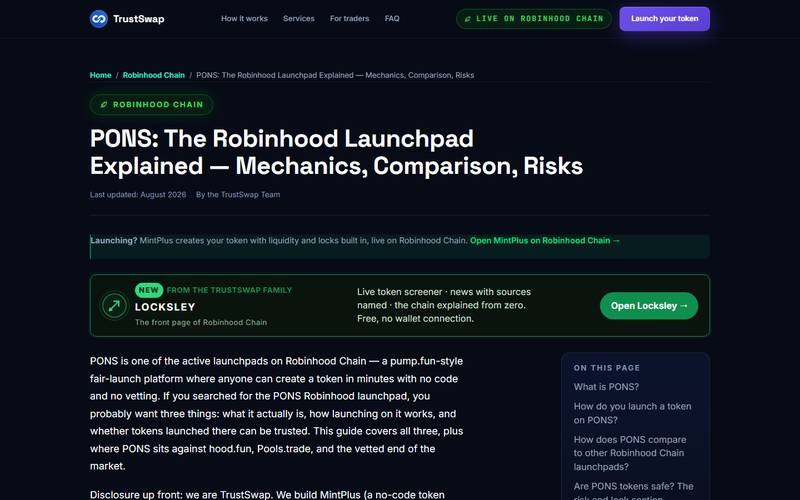
The Pons launchpad interface on a 1440px desktop screen, showing the token creation form, trending launches feed, and wallet connection button top-right.
Best for: Reviewing the full platform, trending tokens, analytics, creator dashboard, and launch history are all visible without scrolling. Recommended for your first time launching or researching tokens.
On a Tablet: iPad (1024px wide)
Pons on an iPad at 1024px. The token feed and creation form stack neatly, and the platform remains fully functional.
Best for: Browsing trending token launches and tracking your positions on the go.
On a Phone: iPhone 16 Pro Max (430px wide)
Pons on an iPhone 16 Pro Max at 430px. The interface collapses to a single-column scroll. Trading and browsing work well; token creation is easier on a larger screen.
Best for: Monitoring token prices and quick trades. For your first token launch, use desktop for a clearer view of all the fields.
Core Features
Token Launchpad (Create)
The primary product. Fill in a form with your token's name, ticker symbol, description, image, and social links. Choose a creator wallet to receive a portion of trade fees. Pay the launch fee in ETH. Your fixed-supply token is deployed on Robinhood Chain and immediately tradeable, no developer required.
Token Trading
Every token launched through Pons has an automatic bonding curve market. Buyers push the price up; sellers push it down. When a token reaches the graduation threshold (approximately 4.2 ETH of locked liquidity), it graduates to a full DEX liquidity pool on Robinhood Chain and can be traded more broadly.
Explorer and Analytics Dashboard
Pons includes an on-chain explorer showing launch statistics, creator wallets, trading volume, and token graduation status. You can see exactly which wallets have bought or sold a token and how many trades have occurred, all transparent, on-chain data.
Wallet Analytics
Track the history and performance of any wallet address that has interacted with Pons. Useful for identifying early deployers or tracking whale positions, though not a substitute for proper due diligence.
PONS Token Buyback and Burn
A portion of the platform's fee revenue is used to purchase PONS tokens on the open market and permanently destroy (burn) them. As of early September 2026, approximately 30% of the original 1 billion PONS supply had already been burned, leaving roughly 671 million PONS in circulation.
How Pons Works: The Bonding Curve and Graduation Explained
If you have never heard of a bonding curve, here is the simplest version:
When a new token launches on Pons, it starts with zero external liquidity. Every buy pushes the price up along a mathematical curve; every sell pushes it back down. The "price" at any moment is purely determined by the ratio of ETH and tokens inside the curve.
What graduation means: Once enough ETH accumulates in a token's bonding curve (approximately 4.2 ETH worth), the token "graduates." Its liquidity is moved out of the Pons curve and into a standard decentralised exchange pool on Robinhood Chain. After graduation, the token can be traded on any DEX that supports Robinhood Chain, not just through Pons.
Why this matters for risk: Before graduation, the only market for a token is Pons's own bonding curve. Liquidity is thin and concentrated. After graduation, the token has broader market access but is still highly speculative unless it has real utility or community behind it. The vast majority of tokens on Pons never graduate, and most that do lose most of their value within days.
The PONS Buyback-and-Burn Model Explained
The PONS token's investment thesis rests on one mechanism: trading activity on the platform reduces the supply of PONS.
Here is the simplified flow:
- Traders buy and sell tokens on Pons, every trade generates a fee
- A portion of those fees is used to buy PONS on the open market
- The purchased PONS is permanently destroyed (burned)
- Fewer PONS tokens exist, if demand stays the same, price tends to rise
The protocol has been aggressive: roughly 30% of the original 1 billion PONS supply (~293 million tokens) had been burned within the first few months of operation.
The key dependency: This entire flywheel requires sustained high trading volume on the Pons platform. If memecoin launches and trading slow down, the buyback engine loses fuel.
How to Launch a Token on Pons (Step by Step)
What you need:
- A crypto wallet compatible with Robinhood Chain (MetaMask with Robinhood Chain added, or Coinbase Wallet)
- A small amount of ETH on Robinhood Chain to pay the launch fee (typically a few dollars worth)
The Pons launchpad homepage on Robinhood Chain, connect wallet top-right to start.
Step 1, Connect Your Wallet
Go to https://pons.sc and click "Connect Wallet" in the top-right corner. Approve the connection in your wallet. If your wallet is not already on Robinhood Chain, Pons will prompt you to add it, follow the prompts.
Browse existing launches, each token shows bonding curve progress and market cap.
Step 2, Fill in the Token Creation Form
Click "Create Token" or the equivalent launch button. You will see fields for:
- Name, Your token's full name (e.g., "Laser Cat Finance")
- Ticker, The short symbol (e.g., "LCAT")
- Description, What your token is about (optional but helps attract buyers)
- Image, Upload a logo or image
- Social links, Twitter, Telegram, website (optional)
- Creator wallet, The wallet address that will receive a share of trading fees from your token
- Developer buy, An optional initial purchase you make at launch to seed early liquidity (be transparent about this if you do it)
To buy: select a token, enter amount in RBH, review the bonding curve price impact.
Step 3, Review the Launch Fee
Pons charges a fee in ETH to deploy your token. This covers the cost of the smart contract deployment on Robinhood Chain. Review the fee carefully before proceeding.
To launch: click Create Token, upload image, set name/ticker/description.
Step 4, Sign the Deployment Transaction
Click "Launch" or "Deploy". Your wallet will prompt you to sign the transaction. Confirm it. Once the transaction is confirmed on-chain (typically within 1-2 seconds on Robinhood Chain), your token is live and immediately tradeable.
Set initial liquidity and confirm the deployment transaction in MetaMask.
Step 5, Share Your Token
Your token's unique Pons page shows its price chart, trading history, and bonding curve progress toward graduation. Share this link to attract buyers, though remember that most tokens fail to sustain interest beyond the first few hours.
Your token is live on the bonding curve, share the link for community trading.
How to Trade Tokens on Pons (Step by Step)
What you need:
- A wallet with ETH on Robinhood Chain
- Willingness to accept high volatility and the risk of total loss
The Pons launchpad homepage on Robinhood Chain, connect wallet top-right to start.
Step 1, Browse the Token Feed
Open https://pons.sc and browse the trending tokens, new launches, or graduating tokens. The feed shows recent volume, number of trades, and price movement. Tokens with the most activity appear first.
Browse existing launches, each token shows bonding curve progress and market cap.
Step 2, Check the Token Page
Click any token to see its detailed page: price chart, bonding curve progress, creator wallet, social links, and on-chain transaction history. Always check the creator wallet and on-chain data before buying, look for suspiciously concentrated initial buys or anonymous deployers with no social presence.
To buy: select a token, enter amount in RBH, review the bonding curve price impact.
Step 3, Enter a Buy Amount
Enter the ETH amount you want to spend. The interface shows how many tokens you will receive and the price impact of your trade. High price impact (above 5%) means thin liquidity, your buy is moving the price significantly.
To launch: click Create Token, upload image, set name/ticker/description.
Step 4, Confirm the Trade
Click "Buy" and confirm in your wallet. The trade executes within seconds. Your tokens appear in your wallet immediately.
Set initial liquidity and confirm the deployment transaction in MetaMask.
Step 5, Monitor and Exit
Token prices on Pons can move 50-90% within minutes. Monitor your position closely. To sell, return to the token's Pons page and use the sell function. There is no order book, trades execute against the bonding curve instantly.
Beginner tip: Only trade amounts you are fully prepared to lose entirely. Treat Pons like a casino, not an investment platform.
Your token is live on the bonding curve, share the link for community trading.
PONS Tokenomics: Key Numbers
| Metric | Figure (October 2026) |
|---|---|
| Token ticker | PONS |
| Current price | ~$0.27 |
| Market cap | ~$178.5 million |
| Original total supply | 1,000,000,000 PONS |
| Current circulating supply | ~671.86 million PONS (after burns) |
| Supply burned to date | ~328 million PONS (~30% of original) |
| All-time high | $0.9683 (Sep 5, 2026) |
| All-time low | $0.003783 (Jul 17, 2026) |
| Key listings | Binance Alpha (Sep 2), Kraken (Oct 13) |
| Holders | 102,870+ |
| Inflation schedule | None, fixed supply, deflationary via burns |
| VC funding | Not disclosed / independent team |
What drives the PONS price: The buyback-and-burn model creates a direct link between platform fee revenue and PONS supply reduction. When trading volume is high, more PONS is burned. When volume falls, burns slow. The ATH of $0.9683 in early September coincided with peak platform activity and the Binance Alpha listing.
Risk of this model: The entire tokenomics structure depends on Pons remaining Robinhood Chain's dominant launchpad. If a competitor launchpad captures meaningful share, or if overall speculative interest in Robinhood Chain fades, the burn engine weakens.
Monitor your holdings in the Portfolio section, buy/sell directly on the curve.
Connecting Your Wallet (Live Screenshot)
We tested accessing the Pons interface on Robinhood Chain on 29 October 2026.
The Pons launchpad on Robinhood Chain: click Connect Wallet in the top-right corner to begin.
How to connect:
- Go to https://pons.sc
- Click "Connect Wallet" top-right
- Select MetaMask or your preferred wallet
- Approve the connection to start creating and trading tokens
Once connected, the Pons interface shows your wallet balance and lets you create tokens in under 30 seconds.
Security: What You Need to Know
Pons's smart contracts have not been publicly audited by the same tier of security firms as established DeFi protocols. The platform's non-custodial design means Pons Labs cannot access your funds directly, you retain control of your wallet at all times. However, smart contract risk remains.
More practically, the primary security risk on Pons is not the platform itself but the tokens traded on it:
- Rug pulls: A token creator can deploy a token, attract buyers, and then dump their allocation, crashing the price to near zero. Pons's fixed-supply model reduces some rug vectors but does not eliminate them entirely.
- Honeypot tokens: Some tokens are coded so that buys work but sells are blocked. Always check that you can successfully sell a small test amount before committing significant capital.
- Sniping bots: Automated bots frequently buy new token launches within the first few blocks, before human traders can react, then sell into retail buyers. The price chart of any Pons token typically shows an immediate spike followed by a sharp pullback.
- Front-end phishing: Only access Pons through https://pons.sc. Fake sites exist that look identical but steal your wallet approval.
Best practices:
- Never invest more than you can afford to lose entirely on any single Pons token.
- Verify the token contract address on Robinhood Chain's block explorer (robinhoodchain.blockscout.com) before buying significant amounts.
- Check the creator wallet's history, has it deployed dozens of failed tokens before?
- Use a dedicated wallet with limited funds for Pons trading, not your main holdings wallet.
- Start with a tiny test trade before committing larger amounts to any new token.
When the bonding curve fills (~$69K), liquidity migrates to RobinDex automatically.
Pons vs Competitors
| Feature | Pons (Robinhood Chain) | Pump.fun (Solana) | hood.fun (Robinhood Chain) | Four.meme (BNB Chain) |
|---|---|---|---|---|
| Chain | Robinhood Chain | Solana | Robinhood Chain | BNB Chain |
| Launch date | July 2026 | January 2024 | July 2026 | 2024 |
| Tokens launched | 646,000+ | Millions | Smaller | Hundreds of thousands |
| Buyback-burn model | Yes, PONS token | No protocol token | No | No |
| CEX listings | Binance Alpha, Kraken | No protocol token | No | No |
| Graduation mechanism | ~4.2 ETH threshold | SOL threshold | Varies | BNB threshold |
| Audit status | Not publicly disclosed | Multiple audits | Not disclosed | Partially audited |
| Network fees | Very low (Robinhood Chain L2) | Very low (Solana) | Very low | Low (BNB Chain) |
Pump.fun remains the largest memecoin launchpad globally by cumulative volume. Pons holds the dominant position on Robinhood Chain specifically, which is a major advantage as long as Robinhood Chain continues growing. hood.fun is a direct competitor on the same chain but significantly smaller.
Track graduated tokens in the Trending section with full DEX trading enabled.
Pros and Cons
Pros
- Dominant position on one of 2026's fastest-growing new chains (Robinhood Chain)
- Deflationary tokenomics, 30% of original PONS supply already burned
- Direct link between platform usage and PONS token value (buyback-and-burn)
- Anyone can launch a token with no coding required, extremely low barrier to entry
- Non-custodial design, users retain control of their funds
- Transparent on-chain data for all trades and launches
- Strong CEX coverage for a new token (Binance Alpha, Kraken)
Cons
- Extreme speculation, virtually all tokens launched on Pons lose most of their value quickly
- No publicly disclosed smart contract audit
- PONS has already fallen ~72% from ATH, highly volatile
- Buyback engine depends entirely on sustained launchpad volume
- Robinhood Chain is new, long-term chain survival is unproven
- PONS is not affiliated with Robinhood, brand confusion risks misleading buyers
- Rug pulls, honeypots, and sniping bots are common in the ecosystem
Claim creator fees from the Protocol Fees section for launches you created.
Verdict
Who Pons is for:
- Crypto traders who actively participate in new chain launches and memecoin cycles, and understand the extreme risks involved.
- Developers or communities who want to launch a token on Robinhood Chain quickly and cheaply without writing smart contracts.
- Speculators who want exposure to Robinhood Chain's growth without selecting individual memecoins, the PONS token itself is a bet on the entire platform's fee volume.
- Experienced DeFi users who know how to read on-chain data, identify rug-pull patterns, and manage position sizes.
Who should look elsewhere:
- Beginners or anyone who cannot afford to lose 100% of their investment. This platform is high-risk by design.
- Anyone looking for a long-term investment with sustainable fundamentals, Pons's tokenomics work only as long as speculative volume stays high.
- Users on other chains, Pons is Robinhood Chain only (for now). If you are primarily on Ethereum or Solana, there is no reason to bridge just for this.
- Anyone uncomfortable with the absence of a public security audit.
Rating: 3.5 / 5
Pons has executed extremely well in a short time, becoming the dominant application on a brand-new blockchain, generating hundreds of millions in volume, and building one of the most aggressive buyback-and-burn models in recent crypto memory. The PONS token is a clever bet on launchpad dominance. The platform itself does exactly what it claims. The rating reflects the inherent high-risk nature of memecoin launchpad investing and the dependence on a chain (Robinhood Chain) that is still proving its long-term staying power.
Quick Links
- Main platform: https://pons.sc
- Token data (CoinMarketCap): https://coinmarketcap.com/currencies/pons/
- Token data (CoinGecko): https://www.coingecko.com/en/coins/pons
- On-chain explorer (Robinhood Chain): https://robinhoodchain.blockscout.com
- Price on Kraken: https://pro.kraken.com/app/trade/pons-usd
- Price on Robinhood app: https://robinhood.com/us/en/crypto/PONS/
Last verified: October 29, 2026. Data sourced from CoinMarketCap, Kraken, Robinhood, BeInCrypto, AtomicWallet, BTSE Blog, and on-chain data via Robinhood Chain block explorer.