USDC generally fits regulated checkout and treasury workflows, USDT fits corridors where local exchange and OTC liquidity decide whether a supplier gets paid, PYUSD fits PayPal-linked consumer flows, and EURC fits euro-denominated invoices. None is automatically the cheapest: the real cost includes the token, chain, provider, FX conversion, compliance review, reconciliation, and off-ramp.
The right question is not which stablecoin has the largest market cap. It is which payment rail lets the business receive the exact token, confirm the exact chain, reconcile the invoice, refund or reverse the order when required, and convert to the currency the recipient actually needs.
The payment rail should match the workflow
| Workflow | Suitable starting point | Why it fits | Main limitation |
|---|---|---|---|
| Merchant checkout | USDC | Strong processor and wallet support; easy USD settlement | Payment acceptance may be region-limited |
| Global supplier or contractor payout | USDC or USDT | Broad recipient reach and 24/7 transfer | Recipient off-ramp and sanctions screening still apply |
| PayPal-linked consumer payment | PYUSD | Existing PayPal and Solana distribution | Smaller external liquidity than USDC or USDT |
| Euro invoice or payroll | EURC | Avoids forcing a EUR-to-USD conversion | Narrower liquidity and fewer exits |
| Treasury settlement between institutions | USDC or USDT | Deep liquidity and programmable transfer rails | Issuer, custody, and jurisdictional risk remain |
Use the token and chain the recipient already accepts, then confirm the mint, custody, reconciliation, conversion, reporting, and failure route. A merchant may accept one token and convert it before treasury entry, while a supplier payout may use the token the beneficiary can exit locally. CoinLineup’s USDT versus USDC comparison covers the reserve, liquidity, and issuer trade-off; this article applies that comparison to actual payment operations.
USDC: controlled checkout and treasury settlement
USDC is the most practical starting point when a company wants a documented payment API, USD settlement, broad wallet support, and a clear issuer redemption path. Circle describes USDC as redeemable 1:1 for qualified Circle Mint customers and publishes monthly reserve attestations, but a merchant still needs to verify the provider, network, and jurisdiction available to its own account.
For checkout, Stripe’s stablecoin documentation supports Payment Links, Checkout, Elements, and Payment Intents. Stripe says eligible US businesses can accept stablecoin payments and settle funds in the Stripe balance in USD. That is materially different from asking a merchant to manage a wallet, private keys, gas, and manual reconciliation.
A small e-commerce operator described a different side of the same workflow in a merchant USDC and USDT payment discussion: crypto settlement reached the wallet immediately and avoided card processing charges, but only about 15% to 20% of orders used crypto and the store had to build its own checkout flow. That experience supports USDC as a useful optional rail, not as a reason to remove card checkout or buyer-protection handling.
For managed cross-border payouts, Circle’s payment network combines USDC wallets, custody, minting, redemption, interoperability, payment orchestration, screening, and Travel Rule handling. The provider layer is the important part: USDC is only the asset moving through the rail, not the entire payment system.
USDC is suited to businesses that need:
- Merchant checkout where the processor settles in USD.
- Contractor or supplier payouts with a controlled recipient directory.
- Treasury movement between regulated entities.
- Cross-border payment flows that require stablecoin and fiat reporting in the same system.
USDC payment watchouts include:
- Circle or processor eligibility and local banking access.
- Exact supported chains, including native versus bridged USDC.
- Refund handling and the reporting export required by finance.
- Recipient compatibility; a cheap Base or Solana transfer does not help if the recipient supports another USDC contract.
USDT: payments where corridor liquidity matters
USDT fits when the recipient’s local market already prices, trades, and cashes out in USDT. Its advantage is not a universal payment API; it is liquidity across exchanges, OTC desks, wallets, and emerging-market corridors. That makes it useful for supplier settlement or remittance routes where the recipient needs to convert into local money immediately.
Tether’s February 2026 investment in t-0 network describes a settlement platform for licensed financial institutions using USDT as the liquidity layer. Tether says the network matches transactions and settles net balances in the participants’ chosen currencies. This is a stronger business-payment example than simply saying USDT transfers are fast, because it identifies the institutional layer that handles matching, FX, and settlement.
The cash-out problem is visible in a digital-marketing operator’s USDT payment account: clients paid in USDT on Binance, and the operator reused that balance to pay freelancers and vendors instead of converting to local currency. The setup reduced an extra conversion step, but the discussion immediately turned to tax records and whether an exchange wallet was suitable for business custody. For a USDT corridor, the payment policy should therefore define both the receiving venue and the accounting/off-ramp path before the invoice is issued.
USDT is suited to a payment route when:
- A supplier already holds USDT on the agreed chain.
- The corridor has stronger USDT exchange and OTC liquidity than USDC liquidity.
- The business needs a dollar unit but the recipient’s local exit is exchange-led.
- A payment provider supports USDT deposits, screening, and conversion on that corridor.
USDT’s operational trade-offs are:
- Different deposit addresses, fees, confirmation rules, and issuer support across chains.
- The need to record the exact chain and contract on every invoice.
- Unsupported legacy routes that must be blocked before payment.
- Withdrawal testing before a high-value transfer. CoinLineup’s stablecoin supply and chain tracking guide explains why chain-level movement must be checked separately.
PYUSD: PayPal-linked commerce with narrower external reach
PYUSD is most useful when the customer or merchant already operates inside PayPal’s distribution system or when the business is building on Solana’s payment tooling. Paxos issues PYUSD, while PayPal provides the consumer-facing distribution and brand familiarity. The combination can simplify the first user interaction, but it does not give PYUSD the same exchange and OTC depth as USDT or the same institutional settlement footprint as USDC.
PayPal’s PYUSD page covers the consumer-facing product, while Solana’s PYUSD payment page highlights point-of-sale and business-to-business tooling. A merchant should therefore separate “available in PayPal” from “available in the recipient’s independent wallet or off-ramp.”
A separate PayPal wallet transfer report records a PYUSD payment that remained pending for nearly 24 hours after a small test transfer had cleared. That is one user’s account, not evidence of a normal processing time, but it exposes the exact operational boundary a merchant must test: blockchain confirmation, PayPal status, support escalation, and final wallet credit can be different events. PYUSD is safer as a PayPal-linked option when the business has a fallback for pending or mismatched settlement.
PYUSD fits a PayPal-linked checkout, a Solana-native merchant flow, or a consumer payment experience where brand familiarity matters. It is less suitable as the only treasury asset for a global supplier network because every recipient may not have the same PayPal, Solana, exchange, or fiat-exit access.
EURC: the cleaner route for euro-denominated obligations
EURC is the most logical choice when the invoice, payroll, supplier obligation, or treasury balance is in euros. Paying a euro invoice with USDC can create a second conversion step, expose the recipient to an unnecessary FX spread, and make the accounting record harder to reconcile. EURC does not remove those costs entirely, but it keeps the payment unit aligned with the obligation.
EURC’s main payment limitations are:
- Narrower liquidity than major dollar stablecoins.
- Fewer local exchange and bank conversion routes.
- Recipient-specific contract, chain, and redemption requirements.
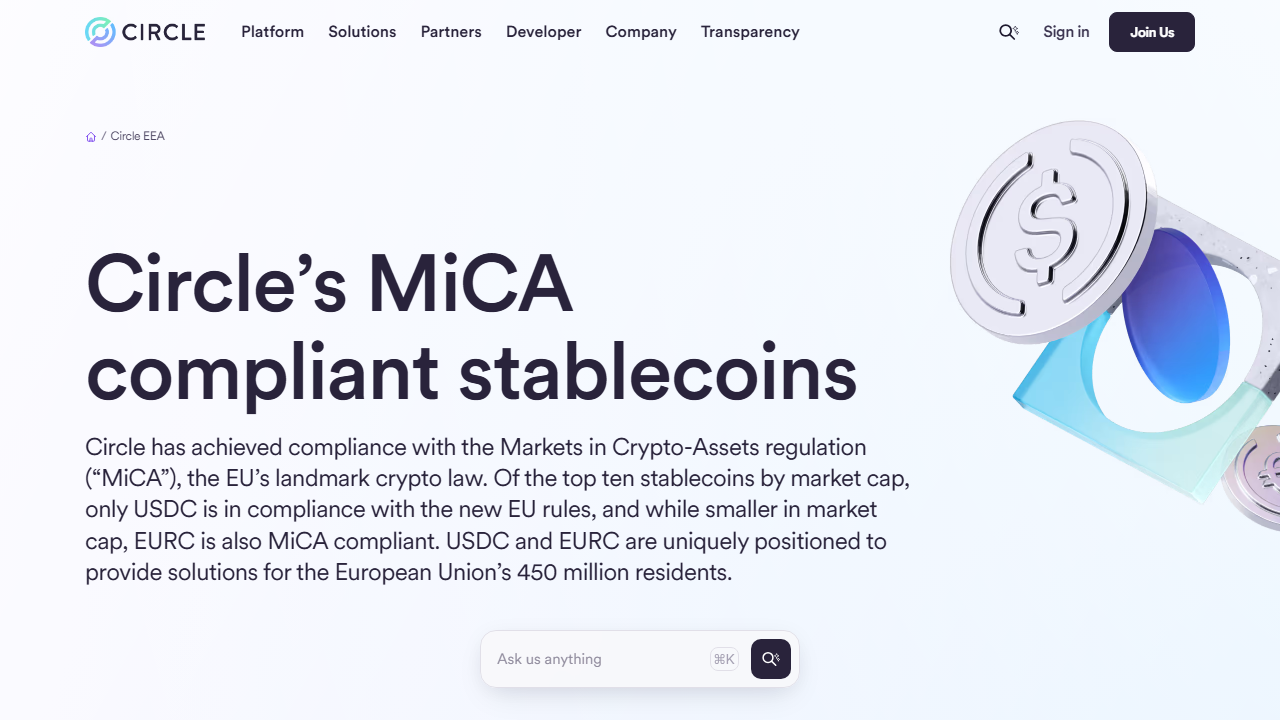
- Regional issuer and compliance constraints. CoinLineup’s EU stablecoin and MiCA coverage provides the relevant regional context; this article focuses on business-payment use.
In an EU fintech discussion about EUR stablecoin payments, a participant described EURC as the most viable MiCA-aligned option while noting thin liquidity and limited counterparty acceptance. The same discussion said many teams still transfer USDC and convert to euros at the destination because the FX cost is easier to price than immature EUR-native infrastructure. For EURC, the practical test is therefore not only whether the token is euro-backed, but whether the named vendor, bank, and compliance provider can actually receive it.
Total payment cost is more than network gas
The cost review should cover seven layers:
- On-chain fee: gas, rent, or provider network fee; a cheap chain is useless if the recipient cannot receive it.
- Provider fee: checkout, custody, payout, or API charge; this can exceed the blockchain transfer cost.
- FX and off-ramp: conversion spread plus exchange, OTC, bank, or payout fee; this determines what the recipient actually receives.
- Compliance operations: screening, KYB, Travel Rule, review, and monitoring.
- Reconciliation: invoice matching, wallet labels, accounting export, and support time.
- Refund exposure: return transfer, provider refund, or fiat reversal; blockchain settlement is not a card chargeback.
This is why “under one cent” is not enough evidence for a payment recommendation. Circle’s settlement-flow documentation separates payins, USDC burns, fiat withdrawals, and bank credit. Those steps should be priced together before a business compares chains.
Payment providers change the answer
Provider fit depends on the workflow:
- Stripe: USDC checkout for eligible businesses, with Payment Links, Checkout, Elements, Payment Intents, and USD balance settlement.
- Coinbase Payment Acceptance: enterprise checkout with authorization, capture, refund, void, webhooks, and USD or USDC settlement.
- Circle Payments Network: managed institutional payins and payouts with wallets, custody, minting, redemption, screening, and local settlement.
- Tether t-0: USDT-based institutional settlement with participant matching, net settlement, and chosen-currency payout.
- Direct wallet transfer: controlled supplier or crypto-native payment, but the business owns contract checks, screening, reconciliation, and refunds.
Coinbase’s payment documentation explicitly includes authorization, capture, refund, and void flows. That is a useful benchmark: a provider that only exposes a deposit address has not solved the whole checkout problem.
Regional and chain fit changes the decision
Market fit changes with the provider, bank, exchange, and regulatory perimeter. Use the following regional screen before launch:
- United States: investigate a USDC processor or PYUSD for PayPal users; confirm eligibility, wallet support, and refunds.
- European Union: investigate EURC for euro obligations and USDC where supported; confirm MiCA, issuer access, and the EUR bank exit.
- Latin America or Southeast Asia: choose USDT or USDC by local exit; confirm liquidity, P2P dependence, and chain support.
- Institutional cross-border: investigate managed USDC or USDT; confirm Travel Rule coverage, custody, and approved counterparties.
Save the native contract, network, provider asset-list entry, deposit route, and off-ramp with the invoice. A bridged token, exchange deposit, and issuer redemption route are not interchangeable.
The five checks before sending a business payment
- Recipient check: Confirm the beneficiary’s wallet, entity name, exact token, exact chain, and permitted jurisdiction.
- Settlement check: Run a small test payment, record confirmation time, and confirm that the recipient can withdraw or convert it.
- Cost check: Calculate network, provider, FX, off-ramp, and compliance costs on the actual corridor, not on a generic chain estimate.
- Accounting check: Attach the invoice ID, sender, recipient, token amount, fiat value, transaction hash, and conversion receipt to the accounting record. CoinLineup’s crypto tax software comparison shows why transaction exports and cost-basis records matter for later reporting.
- Failure check: Define what happens when the payment reaches the wrong chain, the recipient fails screening, the off-ramp pauses, or the customer requests a refund.
For EU operations, add a jurisdiction check before selecting USDT, USDC, or EURC. CoinLineup’s GENIUS Act and stablecoin-rules coverage shows why issuer status and market access can change by region.
Conclusion
USDC fits controlled business checkout and treasury settlement. USDT fits corridors where recipient liquidity and cash-out dominate. PYUSD fits PayPal or Solana-linked commerce, while EURC fits euro-denominated obligations. The final decision should follow the full route from invoice to recipient bank account, not the token’s headline fee or market cap.
Frequently asked questions
When should a business use USDC instead of USDT?
USDC fits regulated checkout, processor integration, and documented treasury workflows. USDT fits when the recipient’s local exchange, OTC desk, or remittance corridor has deeper USDT liquidity.
Can a business accept stablecoins without holding crypto?
Yes, a provider can accept the stablecoin and settle the merchant in USD or another fiat currency. The business still needs to verify eligibility, settlement timing, fees, refunds, compliance, and the provider’s supported regions.
Is a low blockchain fee the cheapest payment option?
Not necessarily. Provider charges, FX spreads, off-ramp fees, compliance work, and manual reconciliation can exceed the network fee. Compare the all-in cost for the exact corridor and recipient.
Should a euro business use EURC instead of USDC?
EURC is cleaner when the invoice and recipient obligation are in euros because it avoids an unnecessary dollar conversion. USDC may still fit when the payment provider, wallet, or recipient has materially stronger USDC support.