Who This Guide Is For
This guide is for readers who have heard that Yearn is one of the oldest names in DeFi and want to know what it does today, in plain words. It is also for people who hold stablecoins or ETH and wonder whether a “vault” is a safer or smarter way to earn yield than lending directly on a money market. You do not need to know how DeFi works. We explain each term the first time it appears.
Yearn has changed a lot since 2020. The old Yearn was a single page where you put in a coin and it hunted for the best rate. The Yearn of late 2026 is a set of products: curated vaults that spread money across lending strategies, a new cross-chain dollar vault called yvUSD, locked tokens for Curve governance, and a staking system for the YFI token called stYFI. This review walks through the app as it looks now, checks the numbers against outside sources and lists the risks, including three exploits in the last few years.
We opened the live app on a desktop browser and connected a throwaway MetaMask wallet with a zero balance. The wallet connected on the first try. We opened the vault list, its filters, a full vault page, a deposit quote, the Portfolio page and the stYFI staking site. We typed an amount into the deposit box to see the quote, and we stopped before any approval or deposit. We signed nothing and sent no transaction.
How We Tested Yearn
| Area | What we did | Result |
|---|---|---|
| Desktop browser, 1440 x 900 | Opened the marketing site, the vault list, a vault page, Portfolio, the menus, the stYFI site and the yvUSD page | Loaded and captured |
| Wallet | Throwaway MetaMask with zero balance, connect only | Connected, header showed 0x5363…A0cD. Nothing signed |
| Deposit quote | Typed 100 USDC into the USDC-1 vault | Quote shown: 88.7 vault shares and 5.81 USDC a year. Red “Insufficient balance” warning. Button read Approve & Deposit. We did not press it |
| Vault list | Opened Filters and read the table | Seen |
| Vault detail | Read info, strategies, risk and contract sections | Seen |
| Portfolio | Opened the account overview, Activity and Claim Rewards tabs | Empty states for a new wallet |
| Menus | Opened Ecosystem and Resources | Seen |
| stYFI site | Loaded the staking page without connecting | Seen, not connected |
| Market numbers | CoinGecko, DefiLlama, GitHub and the Yearn docs, pulled on November 25, 2026 | Cross-checked |
We used the desktop view only. We did not capture tablet or phone views for this review.
One practical note. In our automated browser the wallet link was not kept when we opened a new session, so each time we had to press Connect wallet and approve again. In a normal browser profile that may behave differently. We did not test that.
Quick Verdict
Yearn is one of the most transparent yield products we have looked at. Every vault shows its fees, its strategy split and a risk score before you deposit, and a deposit quote works the moment you type an amount. The yields on the large stablecoin vaults are modest, and the biggest numbers on the list sit on small or specialized vaults. The protocol is much smaller than at its peak, and DefiLlama records exploits in late 2025, so this is a product to size carefully.
| Item | Detail |
|---|---|
| Project | Yearn Finance, site at yearn.fi, docs at docs.yearn.fi, staking at styfi.yearn.fi |
| Products | yVaults (single and multi strategy), yvUSD, yBOLD, yCRV and yYB lockers, stYFI, Curation, analytics tools |
| Chains | Ethereum mainly, plus Katana, Base, Optimism, Arbitrum, Polygon and Fantom |
| Token | YFI, with a fixed supply of 36,666 |
| Our editorial score | 4.0 out of 5 |
| Wallet needed to browse | No |
| Money at risk in our test | None |
What Is Yearn Finance (Plain English)
Imagine a savings account run by software. You deposit one coin, such as USDC. The software lends it on several DeFi lending markets, moves it when rates change and hands the interest back to you. You never pick the markets, pay the gas to move between them or watch the rates yourself. That is the idea behind a Yearn vault.
Think of a restaurant kitchen. A single home cook buys ingredients from one shop. A kitchen with a head chef buys from many suppliers and shifts to whichever one has the best deal that day. In Yearn, the chef is a “strategy”, a small program that knows how to earn on one specific market. A vault can hold one strategy or several, and a manager called an allocator decides how much goes to each.
When you deposit, you receive vault shares, such as yvUSDC-1. The number of shares you hold does not change, but each share is worth more of the original coin as the vault earns. On the USDC-1 vault the page showed a price per share of 1.1269, so one share could be redeemed for about 1.13 USDC. That is how your earnings show up.
The docs say Yearn’s team cannot take your money out of a vault. The multisig, which is a shared wallet controlled by several people, can pause a vault or pull funds back from a strategy to protect depositors, but it cannot send the funds away. The same docs say there is no guarantee of safety and no compensation if something fails. Both statements are true at once, and the exploit list later in this review shows why the second one matters.
Key Facts
| Fact | Detail | Source |
|---|---|---|
| Total deposited in vaults | $184,413,254 | yearn.fi home page |
| TVL on DefiLlama | About $150.2 million, from about $153.5 million 30 days ago | DefiLlama |
| TVL peak, DefiLlama | About $6.9 billion, December 2021 | DefiLlama |
| TVL by chain | About $133.5M Ethereum, $12.6M Katana, $2.2M Base, $1.4M Optimism | DefiLlama |
| Largest vault by TVL | USDS-1 at $27.5 million, estimated APY 7.47% | App |
| USDC-1 vault | Est. APY 5.81%, 30 day APY 4.82%, TVL $18.3 million | App |
| yvUSD vault | Est. APY 9.93%, 30 day APY 9.51%, TVL $14.01 million | App |
| Standard vault fees | 0% management, 10% performance | App |
| Katana vault fees | 0.75% management, 10% performance on the vbUSDC example | App |
| YFI price | About $1,587 | CoinGecko |
| YFI market cap | About $56.9 million | CoinGecko |
| YFI supply | 35,870 circulating of 36,666 | CoinGecko |
| stYFI staked | 2,919 YFI, about 8.0% of supply | styfi.yearn.fi |
| Audit reports on GitHub | More than 40 folders from 2020 to June 2026 | GitHub |
The two TVL figures differ. The marketing page says $184.4 million is deposited, while DefiLlama shows about $150 million. DefiLlama may count some vaults differently, or the home counter may include other products. We did not find out which is closer and we use the DefiLlama figure when we compare trends.
The App, Page by Page
Marketing site
The home page has the headline “Earn on your Crypto” and the line “Yearn is DeFi’s Yield Aggregator”, with a counter that read $184,413,254 deposited. Below it are sections on Compounding Vaults, with shortcuts for ETH, USDS, USDC and crvUSD, an App Ecosystem block, a Security First block with links to audits and bug bounties, and a Partners block. The partners listed were Curve, Alchemix, Origin, Katana, Trueo, Term and Cap. A small FAQ asks what a vault is, what the risks are, what YFI is and whether developer docs exist.
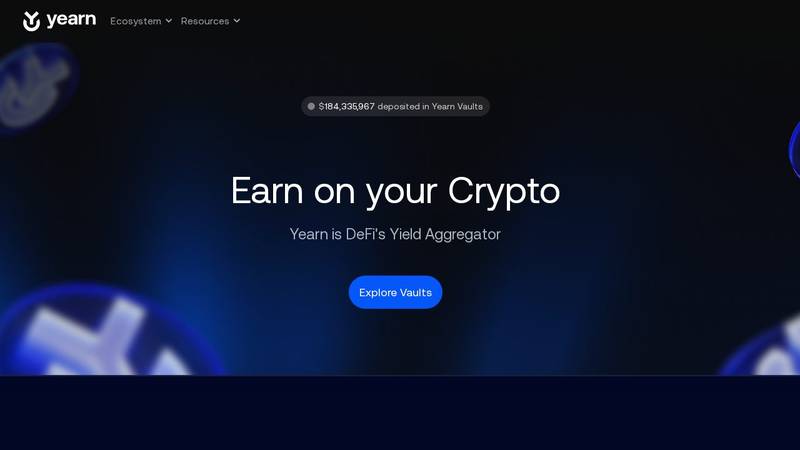
The page is clean and does not push a single big yield number at the top. We liked that, because the number you actually get depends on the vault.
Connecting a wallet
The Connect wallet button sits at the top right of the Vaults page. It opens a wallet picker, and we chose MetaMask. The MetaMask window asked to connect to yearn.fi and showed the permissions: see addresses and balances, and request transactions. It also stated that the site cannot move funds without approval. After we approved, the header showed the short address 0x5363…A0cD. The first press worked.
The vault list
The Vaults page is a table with three columns of numbers: estimated APY, TVL and, once you connect, your holdings. A row shows the vault name, the chain, tags such as Stablecoin, Volatile, Single Asset or LP Token, and the fees. Above the table are switches for All Vaults, Single Asset and LP Token, chain icons, a Filters button, a Compare button and a search box. A pop-up greets first time visitors with a tour, which we dismissed.
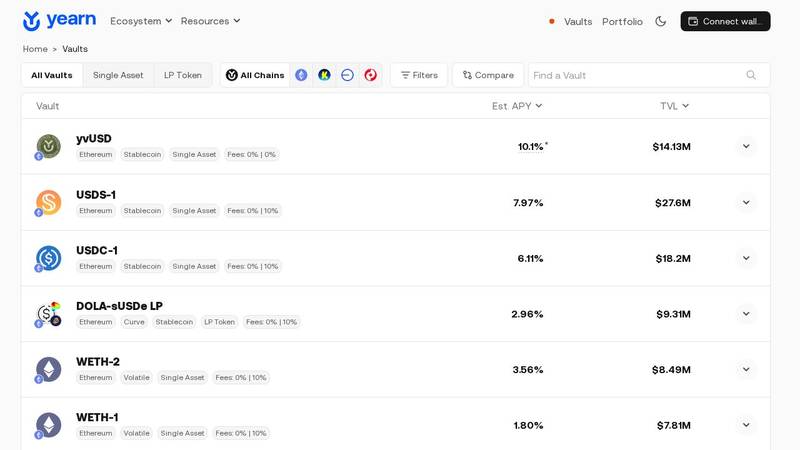
We read the list at 1440 pixels wide. The larger rows were:
| Vault | Chain | Type | Est. APY | TVL |
|---|---|---|---|---|
| yvUSD | Ethereum | Stablecoin | 9.93% | $14.01M |
| USDS-1 | Ethereum | Stablecoin | 7.47% | $27.5M |
| USDC-1 | Ethereum | Stablecoin | 5.82% | $18.3M |
| DOLA-sUSDe LP | Ethereum | Curve LP | 3.83% | $9.30M |
| WETH-2 | Ethereum | Volatile | 3.63% | $8.06M |
| WETH-1 | Ethereum | Volatile | 1.81% | $7.39M |
| Yearn BOLD | Ethereum | Stablecoin | 33.3% | $7.08M |
| yCRV | Ethereum | Curve | 22.9% | $4.13M |
| WBTC-1 | Ethereum | Volatile | 0.03% | $2.79M |
Two things stand out. The best known stablecoin vaults pay between 4% and 8%, which is in line with what lending markets paid when we looked. The Yearn BOLD vault shows 33.3% and the yCRV vault 22.9%. Those are special cases. BOLD is a vault tied to the Liquity v2 stablecoin, and yCRV is a token that holds locked Curve governance power. Neither is a plain savings rate, and the high numbers can move fast. We did not test either one. The WBTC vault shows 0.03%, which tells you a vault will not always pay a lot.
The Filters panel adds a minimum TVL box, an underlying asset picker and an asset category control. We did not find a risk filter on the list itself. The risk score sits on each vault page.
A vault page: USDC-1
The USDC-1 vault is a good example, because it is large and simple. The header showed an estimated APY of 5.81%, a 30 day APY of 4.82% and TVL of $18.3 million. Below it is a chart of the 30 day APY over a year, which ranged between about 2% and 5%, with a dip in March 2026 and a rise in November. A tab bar jumps to Vault Info, Strategies, Risk and More Info, and these all sit on one long page, so you can scroll through them.
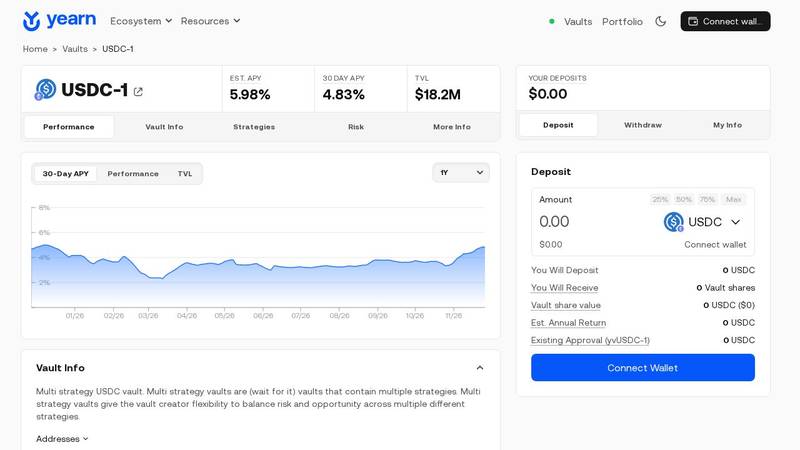
Vault Info describes it as a multi strategy USDC vault with 0% management fee and 10% performance fee. The Strategies block was the most useful part. It showed three active strategies and a donut chart.
| Strategy | Share | Amount | APY |
|---|---|---|---|
| USDC to yvUSDS-1 Depositor | 65.5% | $12.0M | 7.44% |
| stcUSD/USDC Pawn Broker Market | 33.1% | $6.07M | 4.60% |
| Flex siUSD/USDC Lender | 1.36% | $250K | 6.37% |
| Unallocated | 0.03% | $3,061 | none |
This is worth reading slowly. About two thirds of the vault does not sit directly in a lending market. It is deposited into another Yearn vault, yvUSDS-1, which is the USDS vault in the list above. That means the USDC vault’s return depends on the USDS vault’s risk as well. A third sits in a market that lends against a token called stcUSD. We could not judge the quality of those external markets from the page, and a reader should look them up before depositing.
The Risk block gave an overall risk score of 1 out of 5, where 1 is the highest security. The text says the score decides which strategies may be added to the vault, and the strategy scores consider complexity, exposure to loss and reliance on other protocols. The More Info block lists the vault, token and staking contract addresses, a deployment date of March 12, 2024, links to user and developer docs, an analytics page and the raw vault data. That is a generous amount of detail.
The deposit box and quote
The deposit box has an Amount field, shortcut buttons for 25%, 50%, 75% and Max, and a token picker. Below it are five lines: You Will Deposit, You Will Receive, Vault share value, Est. Annual Return and Existing Approval. Each has a small help note. The notes explain that shares can rise or fall in value, that redemption depends on fees and liquidity, and that a token approval lets the contract move your USDC up to a set limit. A gear icon opens approval settings with Revoke and Set Unlimited.
We typed 100. The box showed 100 USDC to deposit, 88.7 vault shares to receive, a share value of 100 USDC and an estimated annual return of 5.81 USDC. The amount turned red with the words Insufficient balance, since the wallet held nothing, and the button changed to Approve & Deposit and stayed disabled. That is the quote we were after. It is an estimate based on the current APR, and the page says that past results do not guarantee future results.
yvUSD
The top row in the list, yvUSD, is Yearn’s newest product. The docs call it a cross-chain, cross-asset, delta-neutral vault. In plain words, you deposit on Ethereum, and the vault uses bridges such as Circle‘s CCTP to place money into strategies on other chains. The docs list extra risks: stablecoin depegs, bridging and remote accounting, long dated fixed rate holdings and leveraged loops. They also say withdrawals can be non-atomic, which means a delay is possible.
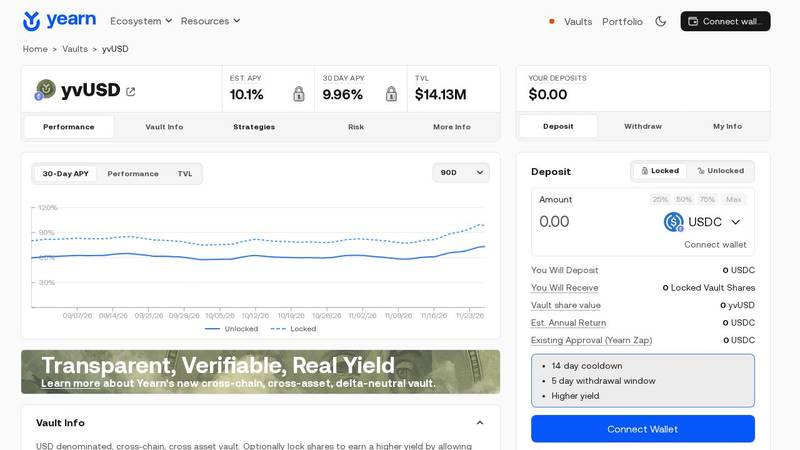
The page shows an Unlocked and a Locked mode. The Locked option adds a 14 day cooldown and a 5 day withdrawal window in exchange for a higher yield. The headline was 9.93% estimated APY and 9.51% over 30 days. Fees were 0% and 0%. We did not deposit into it, and we did not read the strategy-level detail.
Portfolio
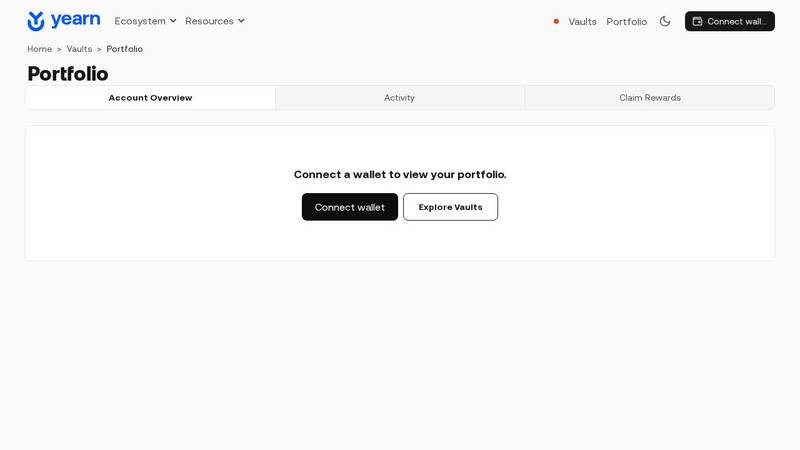
After connecting, the Portfolio page has three tabs: Account Overview, Activity and Claim Rewards. The overview shows a balance and growth chart with 30D, 90D, 1Y and ALL ranges, plus totals for vault balance, estimated annual return, current APY, 30 day APY and all time return. Our empty wallet showed zeros and a note that it would fill in after a deposit, YFI stake or yCRV stake. It then suggested some vaults. Activity said “No transactions to show”, and Claim Rewards listed chains with a claimable total of $0.00.
Menus
The Ecosystem menu has two columns. Products lists yVaults, Curation, yCRV, yYB and stYFI. Tools lists PowerGlove for vault analytics, Kong for vault data, Kalani for vault management, yFactory for LP token vault creation and APR Oracle for projected vault yields. The Resources menu links to the docs, X, GitHub, the blog, brand assets, partners, Discord, Telegram and the governance forum.
The YFI Token and stYFI
YFI is the governance token of Yearn. It was famously launched in July 2020 with no pre-mine, which means the team did not give itself a stash, and it has a fixed supply of 36,666 tokens. CoinGecko listed 35,870 as circulating, so more than 97% is out. That small supply is why one YFI costs four figures.
On November 25, 2026, CoinGecko showed a price of about $1,587, a market cap of about $56.9 million and a fully diluted value of about $58.2 million. The all time high was $90,787 on May 11, 2021, so the token is down about 98% from the top. The all time low was $31.65 in July 2020. The token ranked around 350, and 24 hour volume was about $2.48 million, which is thin for a coin priced this high.
| YFI measure | Value | Source |
|---|---|---|
| Price | About $1,587 | CoinGecko |
| Market cap | About $56.9 million | CoinGecko |
| Fully diluted value | About $58.2 million | CoinGecko |
| Circulating supply | 35,870 of 36,666 | CoinGecko |
| All time high | $90,787 on 2021-05-11 | CoinGecko |
| All time low | $31.65 on 2020-07-18 | CoinGecko |
| Change over 24 hours | -4.6% | CoinGecko |
| Change over 7 days | -9.9% | CoinGecko |
| Change over 30 days | -25.0% | CoinGecko |
| Change over 1 year | -61.4% | CoinGecko |
| Volume over 24 hours | About $2.48 million | CoinGecko |
YFI is not needed to use a vault. You can deposit USDC and never touch YFI. The token matters in two ways. Holders vote on proposals, and holders who stake get a share of protocol income. The staking system is called stYFI, and it has its own site.
The stYFI page showed a total supply of 36,666 YFI and 2,919 YFI staked, about 8.0% of the supply. There are two modes. stYFI keeps direct voting rights, and stYFIx is a passive option that delegates voting to a group called YBC. The page showed an estimated stYFIx APR of 36.33%. Per the docs, rewards are paid in yvUSDC, which is a Yearn vault token, and stYFIx does not auto-compound. Unstaking starts a 14 day linear cooldown, so funds unlock gradually over two weeks, and adding more to an active cooldown resets the timer for the whole position.
Read that 36% with care. Only about 8% of the supply is staked, so the rewards are shared among few stakers, and the rate falls if more people join. It also pays in a vault token whose value depends on Yearn itself. We did not connect to the stYFI site and did not test staking. The same page also links a “yETH recovery” tool for claims related to the 2025 exploit described below.
Our view on YFI: it is a governance and income token for people who want a say in a small, old protocol. It is not a way to earn on stablecoins, and the price has fallen by more than half in a year.
Risks, Audits and Incident History
We list the risks from the bottom up.
Smart contract risk. Yearn vaults and strategies are code that holds user money. The GitHub audits folder in the yearn-security repository has more than 40 report folders from 2020 to June 2026. Firms named in the folder names include MixBytes, Trail of Bits, ChainSecurity, Statemind, Peckshield, Quantstamp, yAudit, Optimum and Dedaub. The most recent entries are a Statemind review of V3.0.2 from March 2024 and a yAudit review of V3.1.0 from June 2026. The repository was last pushed on November 18, 2026 and has 230 stars. We did not open the PDFs, so we cannot tell you what they found or whether every point was fixed. Several audits also cover strategies built by outside teams, and a vault is only as safe as the weakest strategy inside it.
Incident history. This is where Yearn needs a careful reader. DefiLlama’s hacks list shows four entries for Yearn products.
| Date | Amount | What DefiLlama says | Source |
|---|---|---|---|
| February 2021 | About $11 million | A flash loan attack on the yDAI vault through manipulated exchange rates | DefiLlama |
| April 2023 | About $11.5 million | A yUSDT vault with a wrong oracle reference, which let an attacker mint a huge number of shares | DefiLlama |
| November 30, 2025 | About $9 million | The yETH stableswap pool was drained through an accounting flaw where cached variables did not reset at zero liquidity | DefiLlama |
| December 16, 2025 | About $300,000 | A donation attack on a legacy V1 TUSD vault | DefiLlama |
Two of these are recent, and both are share accounting problems. The December 2025 case touched an old V1 vault, while the November 2025 case hit the yETH pool, a separate product. Neither entry, as listed, describes a loss in the current V3 USDC vault we tested. We did not find a post mortem or a repayment summary and we cannot say how much users recovered. The “yETH recovery” link on the stYFI site suggests a claims process exists, but we did not open it.
Strategy and counterparty risk. The USDC-1 vault sends about 65% of funds to the yvUSDS-1 vault and 33% to a market against stcUSD. If any of those fails, the vault loses value. The vault risk score of 1 out of 5 is helpful, but it is Yearn’s own rating.
yvUSD specific risk. The docs list cross-chain bridging, stablecoin depeg, duration and leverage risks. The Locked mode has a 14 day cooldown and a 5 day withdrawal window, so you cannot leave at once.
Governance and key risk. The multisig can pause vaults and withdraw from strategies. The docs say it cannot remove funds, and we did not audit that claim.
Size and trend. DefiLlama’s TVL was about $150 million, down from about $6.9 billion in December 2021. Over the last 30 days it dipped only slightly, from about $153.5 million. A small protocol has less income for security work and a thinner market for its token.
Docs disclaimer. The risk page says the contracts are offered as is and that neither contributors nor YFI holders will compensate users for losses.
| Risk area | What we found | Source |
|---|---|---|
| Audits | More than 40 folders from 2020 to June 2026 | GitHub |
| Hack record | Four entries, two of them in late 2025 | DefiLlama |
| Vault risk score | 1 out of 5 on USDC-1, set by Yearn | App |
| Strategy exposure | 65.5% into another Yearn vault | App |
| Compensation | None promised | Docs |
| TVL trend | About $150M now, $6.9B peak | DefiLlama |
| Audit PDFs read | No | Not tested |
How Yearn Compares
This is a design comparison from public pages, not a test. We did not deposit in any rival.
Beefy is another vault style yield optimizer that works across many chains. DefiLlama showed its TVL at about $79 million, roughly half of Yearn. It leans on auto-compounding of rewards on a very wide range of chains and pools, while Yearn focuses on fewer, curated vaults with listed strategies and risk scores.
Sky, formerly Maker, runs a savings product that pays a rate set by governance. DefiLlama showed its lending TVL at about $2.9 billion, about 19 times Yearn. A reader who wants one stablecoin rate set in one place may prefer it, while Yearn is the choice for a reader who wants a vault that routes among markets.
Depositing straight into a lending market, such as Aave or Morpho, is the simplest alternative. You pick the market and you see one set of risks. A Yearn vault adds a layer, because a strategy sits between you and the market, and it adds a 10% performance fee on most vaults.
| Item | Yearn | Beefy | Sky savings |
|---|---|---|---|
| Rough TVL on DefiLlama | About $150M | About $79M | About $2.9B |
| Choice of strategy | Curated vaults with listed strategies | Many auto-compounding pools | One rate set by governance |
| Fees | 0% management, 10% performance on standard vaults | Varies by vault | Built into the rate |
| Tested by us | Yes, connect and quote only | No | No |
What We Verified and What We Did Not
We verified that the marketing site and the app load on desktop, that MetaMask connects, that the vault list shows APY, TVL and fees, that the Filters panel opens, that a vault page shows strategies, a risk score and contract details, and that a deposit quote appears when you type an amount. We opened Portfolio with its three tabs, the Ecosystem and Resources menus, the yvUSD page and the stYFI staking site. Market numbers were checked against CoinGecko and DefiLlama, and the audit list was read on GitHub.
We did not approve a token, deposit, withdraw or sign anything. We did not test Compare, the Withdraw tab, the My Info tab, the stYFI staking flow with a wallet, the yCRV or yBOLD products, Curation or any of the Katana vaults. We did not read the audit PDFs, the post mortems of the 2025 exploits or the yETH recovery process. We did not confirm the APY numbers over time. The APY is an estimate that changes, and we saw it move by a few hundredths between page loads.
FAQ
Is Yearn safe?
It has a long audit record and clear vault pages. DefiLlama also lists four exploits, two in late 2025. No DeFi product is risk free, and the docs promise no compensation for losses.
Do I need YFI to use Yearn?
No. You deposit the asset itself, such as USDC or ETH, and receive vault shares.
What does Yearn charge?
The standard vaults we saw charged 0% management and 10% performance fee. A Katana vault example charged 0.75% management and 10% performance.
What yield can I expect?
The large stablecoin vaults showed about 4% to 8%. The USDC-1 vault showed 5.81% estimated and 4.82% over 30 days. Higher numbers sat on special products, and the rate changes.
Can I withdraw at any time?
Standard vaults are meant to allow it, subject to liquidity. yvUSD can be non-atomic, and Locked yvUSD has a 14 day cooldown and 5 day window. stYFI unstaking uses a 14 day linear cooldown.
What is the stYFI APR?
The page showed about 36%. It rests on a small staked share and is paid in a vault token, so treat it as variable.
Is YFI a good buy?
We give no price advice. YFI has a market cap of about $56.9 million and a one year drop of about 61%.
Can I use another wallet?
The picker offers more than MetaMask. We tested MetaMask only.
Quick Links
| Link | URL |
|---|---|
| Website and app | https://yearn.fi |
| Vaults | https://yearn.fi/vaults |
| stYFI | https://styfi.yearn.fi |
| Docs | https://docs.yearn.fi |
| Risks page | https://docs.yearn.fi/developers/security/risks |
| GitHub | https://github.com/yearn |
| Audits | https://github.com/yearn/yearn-security/tree/master/audits |
| DefiLlama | https://defillama.com/protocol/yearn-finance |
| CoinGecko | https://www.coingecko.com/en/coins/yearn-finance |
This article is an independent editorial review for information only. It is not financial advice. Vaults and staking can lose money. Figures were collected on November 25, 2026 and change often. Check the live app and your own risk before using any protocol.