If you are new to crypto, three questions come up straight away: what should I buy first, how much, and what could go wrong? This guide answers them with data from 18 November 2026. It also changes advice from our earlier draft, because the market looks different now: Bitcoin is about 22% lower than a month ago, and the “Q4 is usually strong” idea needs a closer look. We cannot tell you what to buy, only what makes a first purchase less risky.
Terms used in this guide
| Term | Plain meaning |
|---|---|
| Market cap | Price times the number of coins. A rough measure of size. |
| Liquidity | How easily you can buy or sell without moving the price. |
| Stablecoin | A coin designed to track $1, such as USDT or USDC. |
| ETF | A fund traded on a stock exchange that holds an asset. Bitcoin ETFs hold Bitcoin. |
| Drawdown | A fall from a previous high. |
| Dollar-cost averaging | Buying a fixed amount at regular intervals instead of all at once. |
| Seed phrase | The 12 or 24 words that control a self-custody wallet. Never share them. |
| Self-custody | Holding your own keys instead of leaving coins on an exchange. |
What the market looks like today
CoinGecko data pulled 2026-11-18:
| Coin | Rank | Price | 7 days | 30 days | 1 year | Market cap |
|---|---|---|---|---|---|---|
| Bitcoin (BTC) | 1 | $64,402 | -12.6% | -22.0% | -29.8% | $1,295B |
| Ethereum (ETH) | 2 | $1,806 | -12.2% | -25.6% | -40.2% | $221B |
| BNB | 4 | $592 | -13.1% | -18.5% | -35.1% | $78B |
| XRP | 6 | $0.98 | -7.5% | -25.7% | -54.5% | $62B |
| Solana (SOL) | 7 | $74.75 | -10.4% | -29.0% | -43.5% | $44B |
| Dogecoin (DOGE) | 13 | $0.059 | -13.3% | -25.8% | -61.1% | $9B |
| Tether (USDT) | 3 | $0.9992 | 0.0% | 0.0% | 0.0% | $175B |
| USD Coin (USDC) | 5 | $0.9996 | 0.0% | 0.0% | 0.0% | $69B |
Source: CoinGecko public API, 2026-11-18. This is a selected comparison table, not a complete market universe or a screened ranking. Our own screenshots of CoinGecko pages were blocked by a bot check, so there are none for this table.
Our reading: every non-stablecoin in the table is down by double digits over a year, and the bigger the “story”, the bigger the fall. Dogecoin is down 61.1%, Bitcoin 29.8%. That is the practical meaning of “beginner-friendly”: not that a coin avoids losses, but that it has fallen less and is easier to sell. It is a reason to start small.
What makes a coin beginner-friendly
A first purchase should meet most of these:
- Big and liquid. Easy to buy and sell without moving the price.
- Track record. Several years of history through at least one bad market.
- Easy to buy. Offered on large regulated exchanges in your currency.
- Clear purpose. Not purely dependent on hype.
- Can be moved to your own wallet if you want to.
Memecoins and newly launched tokens fail most of these tests. They can rise fast and can go to zero.
Three unranked beginner examples
These are editorial examples rather than a scored ranking or a complete list of eligible assets.
Bitcoin
Bitcoin is the largest asset at $1,295B market cap and has the simplest story: a fixed supply of 21 million coins. Spot Bitcoin ETFs in the US also give people a way to hold exposure through a normal brokerage account. According to the Farside Investors flow table, US spot Bitcoin ETFs have seen cumulative net inflows of about $54.7B since launch. In November so far (2 to 17 Nov) the table adds up to a net outflow of about $2.37B, with outflows on 10 of those 12 trading days. We did the sum ourselves from the daily rows.
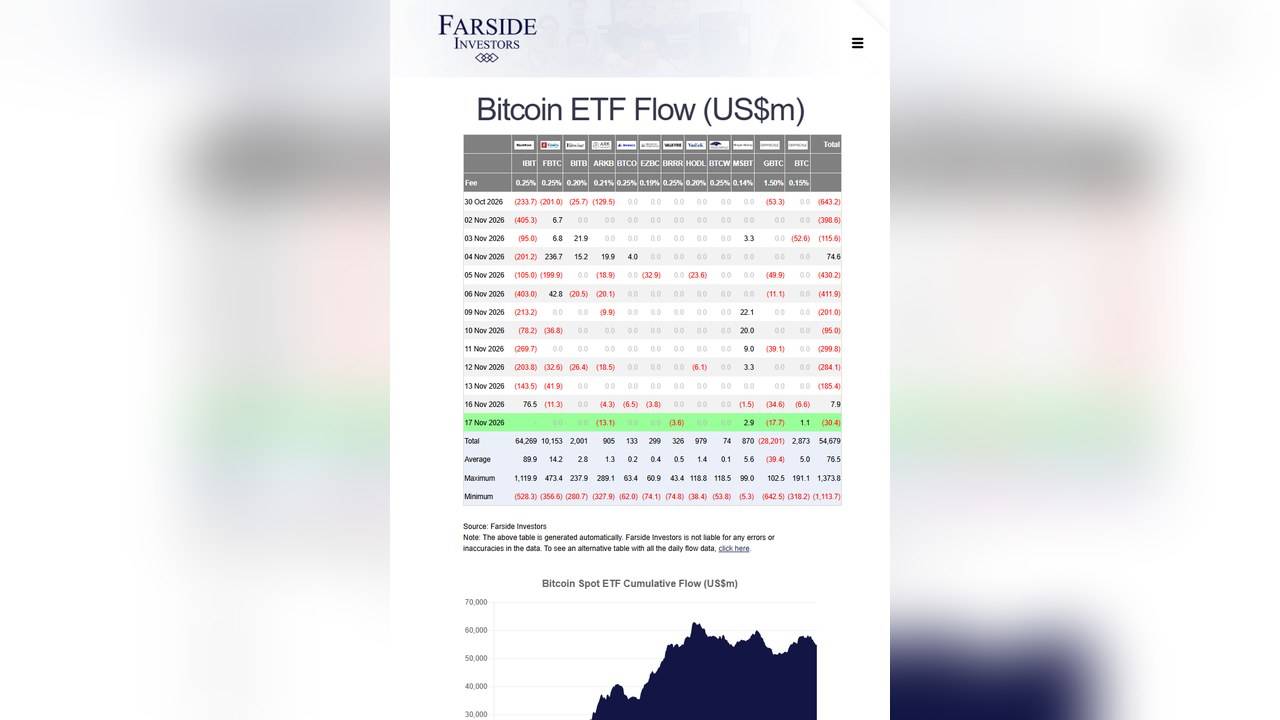
Our reading: institutions are net sellers this month, which fits the price fall. It also shows that “ETF demand supports the price” is not guaranteed. Our earlier draft cited US spot ETF assets above $120B, and we could not verify the figure, so it is removed.
Ethereum
Ethereum is the main network for apps, stablecoins and tokenised assets. ETH is the second-largest coin at $221B, but it has been more volatile: down 40.2% over a year versus 29.8% for Bitcoin. If you hold ETH you can also stake it. As of 2026-11-18, Staking Rewards listed an Ethereum average reward rate of 2.55%, well below the 3.5% to 4% our earlier draft claimed. Coinbase’s own page was listed at 1.70% in search results. Staking adds steps and risks, so a beginner can reasonably skip it at first.
Devcon 8 took place in Mumbai on 3 to 6 November 2026 (devcon.org), and our earlier draft called it a source of positive momentum. ETH is 25.6% lower over 30 days, so event-driven momentum has not shown up in the price.
Stablecoins
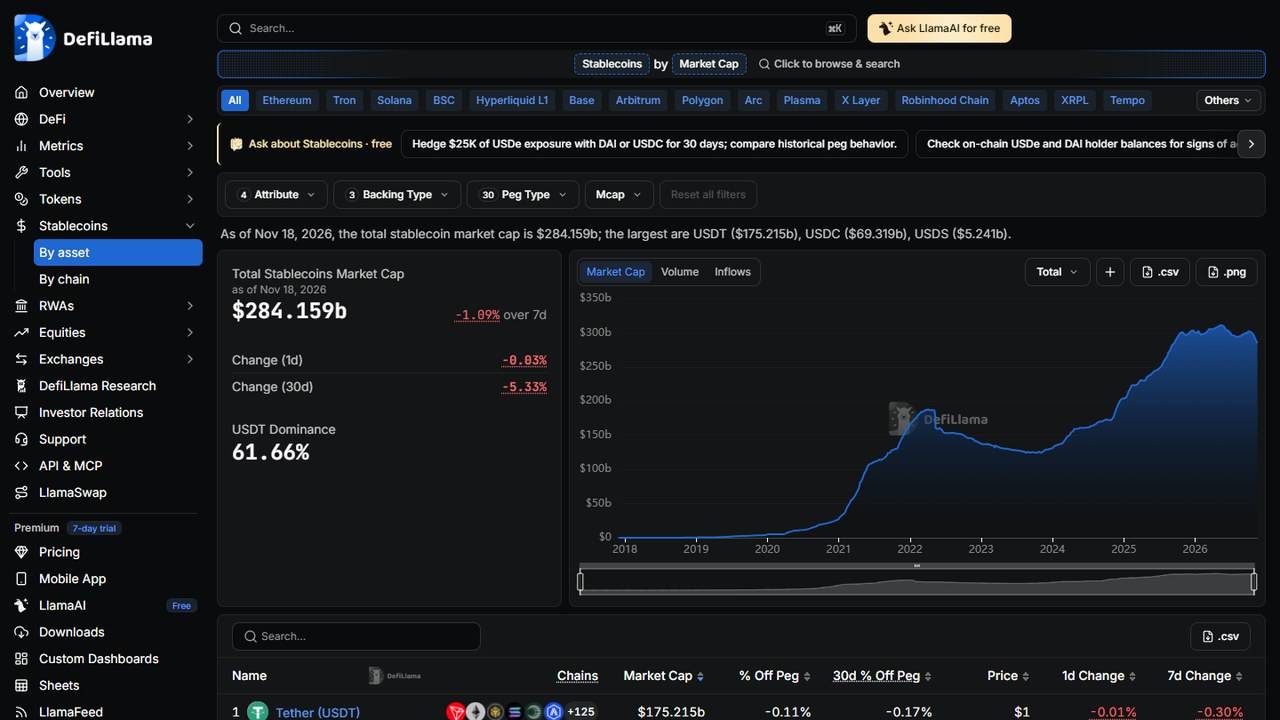
USDT and USDC are not investments. They are digital dollars. DefiLlama shows a total stablecoin market of $284.16B on 18 November, down 5.33% over 30 days, with USDT at $175.2B (61.66% of the market) and USDC at $69.3B.
For a beginner, a stablecoin is a place to park cash between trades or a way to practise sending money on a blockchain without price swings. Our earlier draft said you can earn 4% to 8% on stablecoins in lending. We did not verify that. The only yield-bearing dollar product we checked this week was Ethena’s sUSDe at 5.34%, and its yield comes from a trading strategy, not from a bank-style deposit. Stablecoins also have risks: the issuer, the reserves and the possibility of losing the $1 peg.
Is Q4 really a good time to buy?
Our earlier draft said Bitcoin was positive in Q4 in 9 of 13 years since 2013. We checked using Yahoo Finance monthly closing prices for BTC-USD, comparing the September close with the December close for each year from 2014 (Yahoo’s series starts in September 2014, so 2013 is not covered):
| Year | Sep close | Dec close | Q4 change |
|---|---|---|---|
| 2014 | $387 | $320 | -17.3% |
| 2015 | $236 | $431 | +82.4% |
| 2016 | $610 | $964 | +58.1% |
| 2017 | $4,339 | $14,156 | +226.3% |
| 2018 | $6,626 | $3,743 | -43.5% |
| 2019 | $8,294 | $7,194 | -13.3% |
| 2020 | $10,784 | $29,002 | +168.9% |
| 2021 | $43,791 | $46,306 | +5.7% |
| 2022 | $19,432 | $16,547 | -14.8% |
| 2023 | $26,968 | $42,265 | +56.7% |
| 2024 | $63,330 | $93,429 | +47.5% |
| 2025 | $114,056 | $87,509 | -23.3% |
Source: Yahoo Finance monthly BTC-USD data, fetched 2026-11-18. Rounded.
Result: 7 positive and 5 negative Q4s in 12 years. The negative years match the list in our earlier draft, but “9 of 13” does not hold for the period we could check. 2026 so far: the September 2026 close was about $83,554 and the price on 18 November is $64,402, roughly 23% lower.
Our reading: “Q4 is usually good” is a weak guide. The positive years are large, but the gains are concentrated in a few years (2017, 2020) and the losses were also big (2018, 2025). For a beginner the useful point is that being wrong about timing is common, which is why spreading purchases over time is often suggested.
How much to start with
A common rule is to invest only an amount you could lose without changing your life. In dollar terms, small steps are possible because coins are divisible. One search result we saw says amounts like $10, $50 or $100 are reasonable starting points, though that is a general view and not a rule. Our earlier draft suggested $100 to $500. The amount matters less than the habit: buy a small amount, send it to another wallet, and practise recovering it.
A simple way to avoid timing risk is dollar-cost averaging. For example, splitting $300 into six $50 purchases over six weeks. This does not remove the risk of a falling price, but it reduces the chance of putting everything in right before a drop like the one in November.
What to avoid as a beginner
| Avoid | Why |
|---|---|
| Memecoins | Dogecoin is down 61.1% over a year in our table, and newer ones have less history. |
| New token launches | Little track record, and early holders may be waiting to sell. |
| Leveraged tokens and futures | Designed for short-term traders. Losses can be larger than your deposit in some products. |
| Very high advertised yields | Large numbers usually mean extra risk. We did not review enough products to make a market-wide claim about higher yields. |
| Giving your seed phrase to anyone | No real exchange or wallet support asks for it. |
Where to buy and how to store
Use a large regulated exchange available in your country, check its fees, and turn on two-factor authentication. For small amounts an exchange account is simple. For larger amounts you plan to hold for years, a hardware wallet removes exchange risk, but hardware wallets carry risks too. If you buy one, purchase it only from the manufacturer or an authorised reseller. Never set one up that arrived opened or with a pre-written seed card.
What we did not check
- We did not buy anything or test any exchange for this update. We have not compared exchange fees or local availability.
- Prices come from CoinGecko’s API on 2026-11-18 and move constantly. Screenshots of CoinGecko were blocked, so those numbers have no screenshot.
- The Q4 history uses Yahoo monthly closes and does not cover 2013. We did not check another data source.
- The ETF figures come from one provider, Farside, and the November total is our own sum of the daily rows. We could not verify total ETF assets under management.
- Stablecoin yield figures were not verified beyond the single Ethena figure, which comes from a DeFi data source.
- We did not read the full competitor guides in search results, only titles and snippets. Search results for this topic mostly recommended Bitcoin and Ethereum first, which matches this guide, but we did not compare their details.
- This is not investment advice and nothing here predicts future prices.
FAQ
What is the safest crypto to buy as a beginner?
No crypto is safe in the way a bank deposit is. Bitcoin is the largest and most liquid, so it is the usual first purchase. It is still down 29.8% over a year in our data.
Should I buy Bitcoin or Ethereum first?
Both are reasonable. Bitcoin has the simpler idea and fell less over the past year, while Ethereum has more uses and more complexity. Many beginners split a small amount between the two, or start with one.
Is Q4 a good time to buy crypto for the first time?
Over 2014 to 2025 Bitcoin gained in 7 of 12 Q4s and fell in 5, so it is not reliably positive. In Q4 2026 so far it has fallen about 23% from the September close.
How much should I invest as a beginner?
Only an amount you can afford to lose. Many guides suggest starting with $10 to $500, and dollar-cost averaging can spread the entry.
Are stablecoins a good first purchase?
They are useful for holding cash value and learning to move money on-chain, but they are not a growth investment and have issuer and peg risk.
Should I stake my ETH as a beginner?
It is optional. The network average reward was 2.55% on 18 November, and it adds steps and risks. You can skip it until you are comfortable.
This article is for education only and is not investment advice. Crypto is a high-risk asset class and prices can fall quickly. Do not invest more than you can afford to lose.
Editorial credits
Checked by CoinLineup QC Team before publishing on November 19, 2026 for headline accuracy, original value, factual consistency, metadata, authorship claims and risk disclosure: our AI review system checks every article before it goes live, and our duty editor monitors it after publication. Report an error.
CoinLineup uses AI for research, drafting and review. Our editorial team is responsible for every article and corrects or withdraws articles when needed. How we review.